
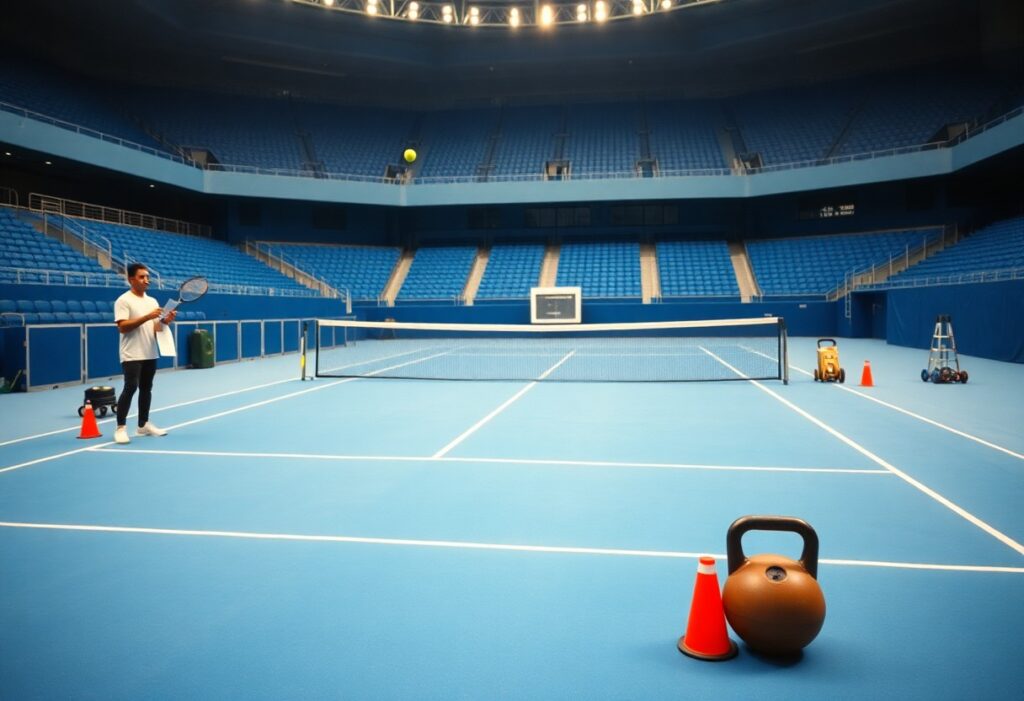

Training like an elite requires systematic blending of technical drills, court-specific conditioning, and gym work; this guide emphasizes periodized strength and plyometrics to build explosive power and court speed, sport-specific endurance, and strict structured recovery and load management to minimize the danger of overuse injuries, while providing clear, progressive steps to safely elevate intensity and competitive performance.
Types of Elite Tennis Training
- Physical Conditioning
- Skill Development
- Tactical Training
- Recovery & Nutrition
- Mental Toughness
| Physical Conditioning | Strength, power, endurance; 3-5 sessions/week, sprint intervals (10×30m), 2-3 resistance sessions. |
| Skill Development | Ball-feel drills, serve placement, 200-400 reps/session, targeted pattern work 20-40 min. |
| Tactical Training | Match-situation drills, opponent-specific patterns, 2-3 simulated matches/week with score-based objectives. |
| Recovery & Nutrition | Daily mobility, sleep 8-9 hrs, periodized nutrition with 1.2-1.8 g/kg protein, cryo/contrast sessions post-load. |
| Mental Toughness | Pressure simulations, visualization 5-15 min/day, breathing routines, sports psychology check-ins weekly. |
Physical Conditioning
Elite conditioning mixes gym and court: 2-3 strength sessions focusing on eccentric-loaded squats and Olympic lifts for maximal power gains, plus 1-2 HIIT sprint sessions (8-12×20-40m) and on-court agility drills for change-of-direction. Periodize in 6-12 week blocks, monitor load with session-RPE, and flag any signs of tendon overload-tendinopathy risk rises when weekly jump in intensity exceeds 10-15%.
Skill Development
Practice emphasizes repetition and variability: typical sessions include 200-400 ball reps, 150-300 serves with targeted zones, and 20-30 minutes of pattern drills (approach-serve, crosscourt-opening shot). Use a ball machine and live feeding to replicate tempo; track serve placement with radar/target boxes and aim for consistent depth under simulated pressure.
Drill selection should progress from isolated technique to pattern integration: start with 10-15 minute technical segments (shadow strokes, slow-motion serve mechanics), then move to 20-30 minute pattern sets (e.g., 3 crosscourt exchanges followed by an approach and volley), finish with 20-minute point play where the server must hit 65-75% first-serve-to-target to gain a point. Incorporate video analysis and metrics-serve speed, spin rate, and first-balls-in-depth-to quantify improvement and adjust reps per session.
Mental Toughness
Training mental skills requires repeated exposure to stressors: schedule 2-3 weekly pressure drills (tiebreak simulations, score deficits), add daily 5-15 minute visualization sessions, and use a 6-8 step pre-serve routine to stabilize behavior. Include sports psychology sessions every 1-2 weeks and guard against burnout by balancing high-intensity mental work with restorative practices.
Pressure drills should include concrete metrics and penalties: practice 10-point tiebreaks twice weekly with time constraints and consequence-based drills (missed target = extra sprint), use box-breathing (4-4-4) before service games, and run cognitive-load exercises (dual-task drills) to maintain technique under mental fatigue. Measure transfer by tracking break-point conversion and unforced-error rates during simulated matches; iterative adjustments typically show measurable gains within 4-8 weeks.
Any plan must sequence these elements across microcycles to maximize gains while minimizing overuse risk.
Step-by-Step Training Guide
| Phase | Primary focus & metrics |
|---|---|
| Pre-Training Preparation | 10-15 min dynamic warm-up, 5-10 min activation, 300-500 ml fluid, 20-60 g carbs, racket/check strings 50-60 lbs. |
| Daily Routine Breakdown | AM strength 45-75 min, on-court 90-120 min (drills + point play), conditioning 20-30 min HIIT, 10-15 min cooldown. |
| Weekly Training Schedule | Microcycle: 4-6 on-court sessions, 2-3 strength sessions, 1 match-simulation, 1 active recovery day; 3:1 load:deload pattern. |
Pre-Training Preparation
Begin with a 10-15 minute dynamic routine (leg swings, spidermans, lateral shuffles) and 5-10 minutes of activation (glute bridges, band walks). Consume 20-60 g carbs 30-60 minutes before practice and sip 300-500 ml water or electrolyte drink. Verify racket tension and shoe condition; skipping mobility increases risk of soft-tissue strains and reduces stroke efficiency.
Daily Routine Breakdown
Structure days around a morning strength session (45-75 min) and a primary on-court block (90-120 min) split: 30-45 min technical drills, 30-45 min pattern work, 20-30 min point play. Add 20-30 minutes of conditioning (interval sprints: 6-8 x 20-30s, 1:3 work-rest) and a 10-15 minute cooldown with foam rolling to lower injury risk.
For drill specifics, allocate 30-60 first-serve reps per session and 80-120 groundstroke reps focusing on directional patterns (inside-out, short crosscourt). Integrate footwork ladders (3 sets), medicine-ball rotational throws (3×8), and 3×12 single-leg Romanian deadlifts to target unilateral strength. Monitor session load with RPE and heart-rate to keep weekly on-court hours between 8-15 for peak adaptation.
Weekly Training Schedule
Adopt a 6-day microcycle: Day 1 heavy strength + technical, Day 2 low-intensity recovery + mobility, Day 3 match-simulation, Day 4 plyometrics + serve focus, Day 5 speed/agility + tactical drills, Day 6 simulated match or tournament play, Day 7 active recovery. Use a 3:1 load-to-deload pattern and limit consecutive high-load days to reduce overuse injury risk.
Example week: Mon AM strength (60 min), Mon PM on-court (90 min); Tue mobility (30 min) + light technical (60 min); Wed match-simulation (120 min); Thu strength (45 min) + plyos (20 min); Fri speed/agility (60 min) + serve practice (45 min); Sat match simulation/tournament; Sun swim or massage (active recovery). Track metrics (RPE, jump height, 5-0-5 time) to adjust load.
Essential Training Tips
Prioritize balanced load, mixing on-court work and gym sessions: many pros do 3-4 hours/day split into technical, tactical, and strength blocks to limit overuse injuries. Include progressive periodization with high-intensity weeks followed by de-loads, and use objective metrics (session time, RPE, heart rate) to track stress and recovery. Assume that you will log sessions, adjust volume by 10-20% when fatigue rises, and schedule at least one full rest day weekly.
- Footwork
- Serve
- Conditioning
- Recovery
- Match-simulation
Focus on Technique
Spend targeted blocks on fundamentals: allocate 40-60% of court time to repetition drills-3 sets of 20 forehands with progressive drill difficulty, 10 minutes of shadow swings for timing, and 15-minute serve placement routines. Emphasize the contact point, consistent split-step timing, and video review to spot tiny inefficiencies; small adjustments (5-10° racket face change) often yield immediate improvements in accuracy and spin.
Incorporate Variety
Alternate training stimuli to build adaptability: mix high-intensity interval rallies, slow-control rallying, and situational points (e.g., 0-30, 30-40) within sessions; pros often use a 60/30/10 split of technical/tactical/conditioning drills across a week. Change ball speed and spin frequently to force decision-making under varied conditions and reduce plateauing.
For practical implementation, design a weekly microcycle: two days focused on power (plyometrics, medicine-ball serves), two days on endurance and footwork (6×3-minute point-play intervals with 2-minute rest), and one day for tactical match-simulation with targeted goals (first-serve % and break-point conversion). Monitor fatigue via simple tests-vertical jump and 10-meter sprint-before sessions; if performance drops >5%, reduce intensity and prioritize mobility and soft-tissue work to prevent injury.
Set Realistic Goals
Break season aims into measurable short-term targets: set a 6-week objective like increasing first-serve percentage by 5% or shaving 0.2s off split-step reaction in five weeks. Use objective KPIs (serve %, unforced errors, sprint time) and keep goals specific, time-bound, and tied to session plans so daily work maps directly to match outcomes.
Translate long-term ambitions into progressive milestones: example-if aiming to improve return pressure, first track current return-win % over 10 matches, then plan 4-week blocks with progressively harder return drills (block, counter, aggressive) and weekly match-simulation to test transfer. Record metrics each week, review monthly, and adjust volume by ±10% based on trend lines; this data-driven approach reduces guesswork and speeds meaningful progress while protecting against overload.
Factors Influencing Training Effectiveness
- Periodization
- Load Management
- Strength & Power
- Aerobic Capacity
- Recovery & Nutrition
- Training Surface
- Coaching Quality
- Individualization
Training gains hinge on how those elements interact: typical elite schedules combine 3-5 court sessions, 2 strength sessions, and 1-2 high‑intensity intervals weekly, while monitoring RPE and GPS load. Evidence links an acute:chronic workload ratio >1.5 to higher injury rates, and targeting protein 1.6-2.2 g/kg plus 7-9 hours sleep accelerates adaptation. Assume that consistent monitoring of load and recovery prevents setbacks and speeds progress.
Individual Fitness Levels
Baseline metrics like VO2max (elite men ~50-60 ml·kg−1·min−1), strength asymmetries, age and prior injury history determine session intensity and frequency; for example, a player with low eccentric thigh strength needs extra Nordic/hamstring work and reduced high‑tempo court sprints to lower hamstring re‑injury risk while still preserving match fitness.
Training Environment
Surface type, climate and altitude alter load: hard courts increase impact forces versus clay, temperatures above 32°C (90°F) raise heat‑illness risk, and altitudes >1,500 m reduce oxygen availability, all requiring adjustments to volume, footwear and recovery protocols.
Practically, reduce high‑intensity volume on hot days, schedule heavier strength sessions after cooler morning practices, and use ball and string choices to match court speed; monitor body‑mass loss (>2%) to trigger aggressive hydration, and on clay prioritize sliding drills and longer point construction to mirror match demands.
Coaching Quality
Frequency and specificity of feedback determine technical transfer: video analysis at 60-120 fps for serve and groundstroke kinematics, plus session‑by‑session load planning and objective metrics, produces faster technical and physical gains than ad‑hoc instruction; high‑quality coaching reduces injury-prone technique errors.
Elite programs pair on‑court coaches with strength, physiotherapy and data staff using GPS, inertial sensors and force plates to quantify load and asymmetry; integrating weekly microcycles (e.g., 2 high‑intensity, 2 technical emphasis, 1 recovery day) and immediate video feedback shortens correction time and improves match consistency.
Pros and Cons of Elite Training Methods
| Pros | Cons |
|---|---|
| Increased power and explosiveness: targeted strength and plyometrics boost serve and groundstroke velocity. | Higher injury risk – overuse issues like rotator cuff strain and lumbar overload from repetitive loading. |
| Technical refinement via high-rep, video-assisted drills improves stroke consistency and timing. | Technique degradation when fatigue accumulates during long high-intensity sessions. |
| Speed and agility gains: court coverage improves with sprint and change-of-direction work (often 5-15% gains). | Systemic fatigue and immune suppression from insufficient recovery between hard blocks. |
| Mental toughness develops through simulated pressure scenarios and match-intensity drills. | Psychological burnout from relentless volume and travel demands. |
| Objective monitoring (radar, GPS, force plates) produces measurable progress and targeted adjustments. | High financial and logistical costs for technology, coaches, and support staff. |
| Periodized plans allow peak performance for major tournaments with structured load cycles. | Poorly designed periodization can cause mistimed peaks or prolonged performance dips. |
| Specialized drills accelerate skill transfer for serve, return, and net play. | Early specialization raises long-term burnout and limits athletic versatility. |
| Integrated recovery protocols (contrast therapy, sleep strategies) enhance adaptation. | Neglecting recovery amplifies injury risk and reduces long-term performance. |
Benefits of Specialized Training
Elite programs often dedicate 60-80% of on-court time to sport-specific drills, producing measurable gains: plyometrics and rotational strength work can add an estimated 3-5 mph to serve velocity and shave tenths off reaction times. Video feedback and force-plate data refine technique, while periodized conditioning aligns peak power and endurance for Grand Slam windows.
Challenges and Risks
Intense specialization elevates risk of overuse injuries-common examples include rotator cuff tendinopathy, tennis elbow, and lumbar stress-and brings higher rates of psychological burnout, especially in juniors exposed to year-round pressure and heavy travel schedules.
To manage these risks, teams use load monitoring (GPS, session-RPE), impose the ~10% weekly load increase guideline, schedule regular musculoskeletal screens, and incorporate cross-training to preserve movement variety; without these safeguards, short-term gains often trade off for long-term availability and career length.
Common Mistakes to Avoid
Overtraining
Pushing daily high-intensity sessions without planned deloads causes performance drops and injury; athletes doing more than 10-15 hours/week of intense practice and match play with no rest show higher rates of tendinopathy, stress fractures, and illness. Limit on-court high-intensity to 2-3 hours/day, pair with 1-2 strength sessions, and insert a deload week every 3-6 weeks to preserve serve power and reaction speed.
Neglecting Recovery
Skipping sleep and recovery blunts adaptation: sleep under 7 hours impairs reaction time and decision-making, while missing active recovery increases DOMS and stiffness. Prioritize 8-9 hours nightly, add 20-30 minute low-intensity recovery sessions after matches, and monitor readiness with resting HR/HRV so you can swap a hard practice for skills or mobility when needed.
Build a practical protocol: fixed sleep schedule, targeted mobility (thoracic rotation, hip flexor length) and 10-15 minutes of foam rolling post-session. Use hydrotherapy for double-session days-about 10 minutes cold immersion at 10-15°C-and employ compression or contrast baths for rapid soreness relief. Track objective markers (resting HR, HRV, weekly jump height); if trends worsen over three sessions, cut load by ~20-30% or add an extra rest day.
Ignoring Nutrition
Under-fueling reduces on-court intensity and slows repair; during extended sessions aim for 30-60 g/hour carbohydrates and consume 20-30 g of protein within 30-60 minutes post-session. Inadequate hydration and electrolytes raises cramp risk and cognitive decline late in matches.
Target daily intakes by phase: on heavy training or tournament days aim for ~5-7 g/kg carbohydrate and 1.2-1.7 g/kg protein depending on body mass. Perform a sweat-rate test (typical 0.4-1.5 L/hour) to set fluid plans and use isotonic drinks for sessions over 60-90 minutes. Schedule 1-4 g/kg carbs 2-3 hours pre-match and top up with gels, bananas, or sports drinks during changeovers to sustain repeated high-intensity efforts.
Conclusion
From above, this guide synthesizes targeted drills, progressive strength and conditioning, sport-specific agility work, recovery protocols, and mental training into a structured plan that builds power and match durability. Follow the step-by-step progression, monitor load and technique, and prioritize recovery and injury prevention to sustain gains. Apply objective metrics and deliberate practice to elevate performance toward elite tennis standards.
FAQ
Q: How should I structure a weekly training plan to train like elite tennis players?
A: Build a periodized weekly plan with clear goals for technical, tactical, physical and recovery work. Example microcycle: 1) Two high-intensity on‑court sessions focused on points, serve/return practice and match-simulation; 2) Two medium-intensity on‑court sessions for technique, pattern drills and footwork; 3) Two strength/conditioning sessions (one strength/hypertrophy, one power/speed) and one dedicated mobility/recovery day. Distribute load so high-intensity sessions are separated by at least 48 hours when possible. Monitor volume with session RPE or objective metrics (GPS, heart rate, jump height) and reduce volume 20-40% during recovery weeks or after tournaments. Include a warm-up progression (dynamic mobility, activation, progressive hitting) and a cool-down (light aerobic, mobility, soft-tissue work) every session.
Q: What strength and conditioning exercises and progressions do elite players use?
A: Focus on transfer-driven lifts and unilateral work: hip-dominant patterns (Romanian deadlifts, kettlebell swings), loaded and split squats, single-leg Romanian deadlifts, step-ups, and carries for stability. Add core anti-rotation and rotational medicine ball throws for racket-speed transfer, and Olympic-pull derivatives or trap-bar pulls for explosive intent. Progress through phases: anatomical adaptation/hypertrophy (8-12 reps) → maximal strength (3-6 reps) → power conversion (1-6 reps, ballistic/plyometric emphasis). Integrate plyometrics (lateral bounds, single-leg hops, depth jumps) and COD drills for reactive speed, plus short maximal sprints (10-30 m) for acceleration. Typical frequency: 2-3 strength sessions per week with 1-2 dedicated speed/power sessions, and mobility/activation work daily. Prioritize technique, tempo, and quality sleep to maximize adaptation.
Q: How do elite players manage recovery, nutrition, and injury prevention during heavy training blocks?
A: Manage recovery with consistent sleep (7-9 hours), scheduled low-intensity days and active recovery (light aerobic, mobility, foam rolling). Nutrition targets: daily protein ~1.6-2.2 g/kg bodyweight, carbohydrate intake adjusted to training load (3-6 g/kg on moderate days, 6-8+ g/kg during high-volume matchweeks), and adequate fluids and electrolytes around sessions. Post-session refuel with ~20-40 g protein and 0.5-1.0 g/kg carbohydrates to support glycogen and repair. Use proactive injury-prevention measures: load management, progressive strengthening of rotator cuff and scapular stabilizers, eccentric loading for achilles/quad tendons, hip and glute strengthening for knee health, and mobility to maintain joint ranges needed for strokes. Employ objective monitoring (wellness questionnaires, jump tests, HRV) to spot trends; apply immediate load reductions when persistent fatigue or pain appears. Use modalities like contrast baths, massage, or compression as adjuncts-prioritize progressive return-to-play protocols over rapid fixes.