
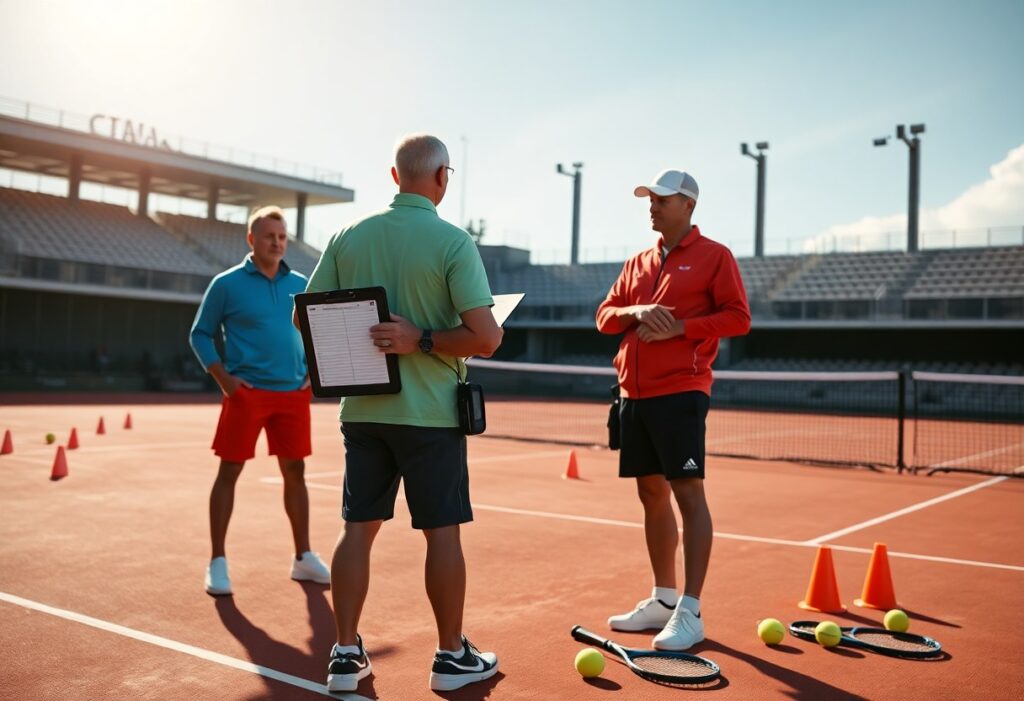

You will learn how elite coaches blend technical drills, tactical planning, and mental training to build champions; this guide isolates high-impact coaching methods, warns about overtraining and injury risks, and showcases positive, repeatable routines that improve consistency, decision-making, and resilience.
Types of Renowned Tennis Coaches
| Former Professional Players | Provide match-tested instincts, tactical nuance and mentorship drawn from 8-20 year tours; examples include Ivan Lendl and Amélie Mauresmo moving into high-level coaching. |
| Technical Specialists | Focus on biomechanics, video analysis and equipment tuning (string tension, racquet setup); use high-speed cameras and motion capture to refine strokes and reduce injury risk. |
| Mental Coaches | Deliver sports-psychology tools, visualization, breathing and HRV biofeedback; typical programs are 30-60 minute weekly sessions targeting pressure regulation and routines. |
| Tactical Analysts | Turn match data into patterns-serve placement, return tendencies and court-zone efficacy-using video tagging and data sets of 20-40 metrics per match. |
| Fitness Trainers | Manage periodization, strength conditioning and load monitoring with GPS/IMU data to prevent overuse injuries and optimize peak performance for 5-7 tournament blocks per season. |
- Former Professional Players
- Technical Specialists
- Mental Coaches
- Tactical Analysts
- Fitness Trainers
Former Professional Players
Former Professional Players translate tour experience into coaching: they teach match rhythm, point construction and on-court adaptability using examples from their careers. Coaches like Ivan Lendl and Brad Gilbert have converted deep competitive insight into tactical frameworks that shorten decision-making time and improve situational choices during tight matches.
Technical Specialists
Technical Specialists concentrate on stroke mechanics, serve kinematics and equipment tuning; they use high-speed video and motion-capture to tweak technique and often target serve speeds above 230 km/h or optimize spin-to-power trade-offs while watching for injury risks from overloading.
They typically run focused blocks: 15-30 minute video breakdowns followed by 20-40 minutes of drill work, incorporating force-plate data, IMUs and racquet telemetry. Small adjustments-string tension shifts of 2-4 lbs, grip changes, or a 5-10° alteration in toss-can measurably improve control and shoulder load. Academies use tools like Dartfish/V1Pro plus on-court load metrics to monitor progress and avoid the danger of technique changes that increase injury risk if not phased in over weeks.
Mental Coaches
Mental Coaches deliver structured routines, visualization and arousal control to convert physical practice into clutch performance; typical work is weekly 30-60 minute sessions using breathing drills and HRV biofeedback to stabilize performance under pressure.
They design pressure-simulation drills (e.g., staged tiebreaks, serve-under-count scenarios) and measurable practice plans over 6-12 weeks to ingrain coping strategies. Metrics tracked include HRV variability, self-reported anxiety scales and on-court execution in final-set simulations; combining these with match replay creates targeted interventions that reduce unforced errors and improve decision-making when margins are small.
After comparing these roles, teams often blend specialties to match a player’s stage and goals.
Key Factors to Success
Top coaches blend disciplined training, precise communication, tactical adaptability, and data-driven analysis; Bollettieri’s academy logged players practicing 5-6 hours daily, Toni Nadal emphasized repetitive pattern play from age seven, and Ivan Lendl introduced marathon-style conditioning to raise physical ceilings. Case studies show targeted interventions-serve placement work or simulated pressure points-reduce unforced errors by double digits. After prioritizing the single highest-impact change, they sequence microcycles, recovery, and match simulation to sustain gains.
- Training Regimen
- Communication Styles
- Adaptability
- Match Strategy
- Mental Conditioning
- Physical Conditioning
- Data & Analytics
Training Regimen
Elite programs typically allocate 4-6 hours daily with a practical split-about 60% technical drills, 25% tactical/point play, and 15% conditioning; periodization uses 3-6 week blocks, tapering into grand-slam peaks. Examples include specific serve-return sessions (200 serves per hour) and simulated five-set matches to build endurance, while monitoring workload to avoid overuse injuries.
Communication Styles
Successful coaches adapt tone and timing: Patrick Mouratoglou favors immediate, directive cues during drills, Darren Cahill mixes blunt technical correction with short motivational reframes, and video reviews translate subjective feedback into measurable targets-like improving first-serve percentage by 6-8% after focused sessions.
Effective messaging also depends on context-during changeovers coaches use concise, single-goal directives, while post-match debriefs explore stats (break-point conversion, rally length) to set 48-72 hour action plans; voice modulation, empathy, and concrete numbers turn guidance into behavioral change.
Adaptability
Top coaches pivot strategies mid-match and across seasons: Toni Nadal shifted Rafa’s attack patterns to target opponents’ backhand, and Ivan Lendl restructured Andy Murray’s conditioning to win Grand Slams. Adaptability includes swapping session goals, adjusting court position by 0.5-1.0m based on opponent tendencies, and reallocating training hours when injuries arise.
Operationally this means building flexible drills, maintaining a prioritized checklist of fixes, and using analytics to test small tactical shifts-if return position gains 3-5% in practice, coaches trial it in low-stakes matches before full adoption, minimizing risk while accelerating improvement.
Essential Tips from Iconic Coaches
- Technique & Drills
- Match Strategy
- Mental Routines
- Fitness & Recovery
- Sportsmanship
Nick Bollettieri’s academy produced over 100 professional players, Toni Nadal emphasized relentless physical patterns and heavy topspin, and Brad Gilbert popularized tactical simplicity that wins matches. Coaches blend technical repetition, match simulations, and opponent scouting into weekly plans; specific drills-like 15-minute pressure serving blocks-translate to match wins. Knowing how to sequence those elements-technique, strategy, mental work-yields faster, sustainable progress.
Developing Player Identity
Top coaches groom a distinct on-court persona by isolating a player’s best weapons-serve, slice, heavy forehand-and building rehearsal drills around them. For example, a serve-and-volleyer practices 50% of return drills at net transition, while a baseline heavy-topspin player repeats crosscourt patterns with varied depth. Video analysis and targeted practice sessions turn tendencies into consistent strengths and define how a player approaches every match.
Emphasizing Sportsmanship
Coaches model and enforce etiquette: respectful handshakes, controlled reactions to calls, and gracious press behavior become nonnegotiable habits. Tournaments and sponsors favor players with professional conduct, so teams use post-match debriefs to correct lapses and reward positive behavior, creating a reputation that supports a long career.
Practical methods include scripted post-match rituals, mandatory opponent-feedback segments, and in-practice penalties for unsportsmanlike actions; coaches also use match clips to teach empathy and perspective. Emphasizing role modeling-where coaches visibly demonstrate calm under pressure-reduces flare-ups and keeps focus on performance rather than controversy.
Fostering Mental Resilience
Effective programs combine visualization, breathing routines, and simulated pressure drills-like tiebreak practice sets-to build clutch performance. Coaches integrate short daily mental sessions and pre-match routines that stabilize arousal levels, while sports psychologists help translate those exercises into match-ready habits that reduce unforced errors when points matter most.
Implementation often means 1-2 focused mental-skill sessions per week, heart-rate or breathing biofeedback for measurable control, and regular pressure simulations to track improvement. Coaches monitor metrics-pressure-point error rates and tiebreak outcomes-and adjust mental drills accordingly, ensuring resilience training produces observable gains.

Step-by-Step Coaching Approach
Step-by-Step Breakdown
| Step | Detail |
|---|---|
| Assessment | Baseline video, movement screen, match stats (serve %, unforced errors, break points won) and physical tests to set starting KPIs. |
| Planning | Periodized 6-week microcycles with 3 technical days, 2 physical days, one recovery day; clear weekly targets and drill prescriptions. |
| Training | Constraint-based drills, situational point play, serve patterns (30-40 minutes/session) and match-simulations to build transfer. |
| Feedback | On-court cues, video analysis at 60-240 fps and wearable metrics; limit corrections to avoid overload. |
| Measurement | Weekly KPI dashboard, monthly fitness re-tests (Yo-Yo, 20m sprint), and match-analytics to inform the next cycle. |
Crafting a Training Plan
Build a data-driven plan around a 6-week microcycle: each week targets a measurable outcome (example: raise first-serve % to 65-70% or reduce unforced errors by 15%). Allocate sessions-technical repetition, situational point play, physical conditioning and recovery-and prescribe drill volumes (serves 30-40 minutes, pattern-based rally sets) so that practice load and match demands align.
Implementing Feedback Loops
Combine immediate coaching with short video reviews and wearable data: capture key moments at 60-120 fps, show 30-60 second clips after reps, and log racket speed and HR for context. Deliver concise, actionable cues so players can trial changes within the same session and see objective impact on KPIs.
Organize feedback across three tiers: in-the-moment corrections during drills, brief in-session video checkpoints, and a weekly analytic debrief. Prioritize 2-3 corrections per session, link each correction to a numeric KPI (serve speed, first-serve %), and use frame-by-frame clips to illustrate mechanical shifts; this preserves focus while accelerating motor learning.
Measuring Progress
Rely on a mix of match and fitness metrics: first-serve %, unforced errors, break-point conversion and fitness tests like the Yo-Yo test and 20m sprint. Produce a weekly dashboard versus baseline and target incremental gains-typical goals are a 5-10% improvement in prioritized metrics over a quarter.
Use technology for precision: Hawk-Eye or match analytics for shot placement, video for technical change, and standardized fitness screens to track capacity and injury risk. Set intervention thresholds-if first-serve % remains below 65% after eight weeks, increase specific serve volume by ~20% or restructure the microcycle; pair this with monthly mobility and shoulder screens to manage load.
Pros and Cons of Different Coaching Styles
| Pros | Cons |
|---|---|
| Rapid technical gains and match-readiness from high-intensity, results-driven programs (Bollettieri Academy produced multiple young pros). | Can sacrifice long-term fundamentals and increase relapse into poor habits when pace prioritizes short-term wins. |
| Structured periodization yields measurable fitness and skill improvements; many pros follow 4-6 on-court sessions plus gym work weekly. | Too rigid plans reduce in-match adaptability and may not account for travel fatigue or tournament variability. |
| Encouraging styles build confidence and consistency; emotional support often translates to improved clutch performance. | Overly permissive coaching can weaken competitive edge and fail to force needed technical corrections. |
| Data-driven, modern methods (video, Hawk-Eye, wearables) boost precision in serve/return patterns and load management. | Overreliance on analytics risks ignoring player feel and situational instincts during momentum shifts. |
| Flexibility allows real-time tactical pivots and individualized recovery, reducing acute performance drops across a season. | Flexible systems may slow technical progression and produce inconsistent practice habits without clear benchmarks. |
| High-volume, intensive regimes can accelerate skill acquisition and match toughness when supervised. | Intense workloads carry a higher injury risk and increase burnout if recovery is insufficient. |
Aggressive vs. Encouraging
Aggressive coaches impose strict repetition and accountability to forge resilience; Toni Nadal’s firmness is often credited with Rafael Nadal’s mental edge. Encouraging coaches like Patrick Mouratoglou emphasize praise, autonomy and tactical confidence, which can restore form after slumps. Aggressive methods often speed technical fixes, while supportive ones sustain motivation-both need calibration, because excessive harshness raises stress and excessive leniency can blunt competitive urgency.
Structured vs. Flexible
Structured plans use periodization, measurable targets and consistent weekly loads-many pros follow 4-6 on-court sessions and 2-4 gym blocks-to build peak form; Ivan Lendl’s regimented work with Andy Murray is a landmark example of structure improving major outcomes. Flexible approaches adapt daily to fatigue, opponent style and travel, prioritizing freshness and tactical variability over uniform repetition.
In practice, structured systems rely on benchmarks (video metrics, serve percentages, court time) and scheduled recovery blocks to push progressive overload safely; coaches track load via heart-rate and session RPE to avoid overtraining. Flexible coaches pivot drills, rest days and match plans based on immediate data and player feedback, which reduces chronic wear but can delay motor-pattern engrainment if not anchored to periodic testing.
Traditional vs. Modern Techniques
Traditional coaching centers on high-repetition drills, feeder patterns and live point play to develop instincts; modern techniques layer biomechanics, video analysis and analytics-Hawk-Eye and wearable data now inform serve placement and recovery decisions. Combining both yields hands-on feel with evidence-based optimization rather than choosing one exclusively.
Deeper integration shows up in practices that use slow-motion racket-angle correction alongside analytics-driven target maps for serve placement; teams now quantify workloads and use biomechanical cues to reduce shoulder/elbow stress. Coaches who blend tactile, repetitive learning with measured, data-guided adjustments achieve gains while limiting overuse issues-data improves precision, but feel preserves creativity and in-match adaptability.
Common Pitfalls in Tennis Coaching
Overtraining
Excessive training without planned recovery drives overuse issues like lateral epicondylitis, patellar tendinopathy and stress fractures; injury rates climb when weekly on-court hours exceed 15-20 hours without deloads. Successful programs use periodization, scheduled rest weeks and objective load tracking (session RPE, wearable sensors). For example, elite teams that enforce structured recovery minimize chronic breakdown and extend player careers.
Overtraining – Related Warning
Fatigue-related technical decay often precedes injury: serve toss errors and slow footwork rise with cumulative load, measurable through stroke-count analytics and movement velocity. Practical fixes include reducing high-intensity intervals by 20-30% during congested weeks and using GPS/accelerometer data to keep acute spikes in check.
Neglecting Mental Health
Naomi Osaka’s 2021 withdrawal and Ashleigh Barty’s 2022 retirement show how unmanaged mental strain can halt elite careers; research indicates roughly 30-35% of high-performance athletes report anxiety or depressive symptoms. Coaches who omit regular psychological screening risk burnout, motivation loss and performance collapse; integrating mental skills work is both protective and performance-enhancing.
Signs include persistent sleep disruption, declining practice quality and social withdrawal; validated tools like the Athlete Psychological Strain Questionnaire (APSQ) help quantify risk. Interventions that work include on-staff sports psychologists, brief CBT, mindfulness training and scheduled media-management plans. Teams that formalize mental-health protocols see improved retention and sharper clutch performance under pressure.
Failing to Customize Training
Generic, one-size-fits-all plans cause plateaus and injury-adolescents with open growth plates need different loads than international adults, while elites require individualized strength, power and recovery cycles. Movement asymmetries, stroke-pattern deficits and competition schedules demand tailored prescriptions informed by testing and ongoing regression analysis.
Implement customization through baseline screens (FMS, hop tests), force-velocity profiling and monitoring tools like HRV and session RPE; aim to keep the acute:chronic workload ratio near 0.8-1.3 to reduce injury risk. Use PlaySight or inertial sensors for stroke counts, then adjust drills, volume and intensity weekly in collaboration with the athlete and multidisciplinary staff.
Final Words
Conclusively, the world’s top tennis coaches teach disciplined preparation, tactical clarity, tailored feedback, and mental resilience; they emphasize process over outcome, structured practice, biomechanical efficiency, and continual adaptation to each player’s needs. Emulating their focus on observation, communication, and principled progression can elevate players at every level and foster long-term improvement.
FAQ
Q: What coaching philosophies do the world’s top tennis coaches commonly use?
A: Renowned coaches emphasize a blend of technical mastery, tactical intelligence and mental preparation. They break strokes into biomechanical principles, then tailor drills to each player’s body and style. Tactical work focuses on point patterns, shot selection and court positioning rather than isolated shot replication. Mental preparation includes routines for pressure situations, goal-setting and reframing mistakes as learning opportunities. Sessions are organized with clear objectives, progressive difficulty, immediate feedback and regular video review to link feel with measurable outcomes.
Q: How can club players and recreational competitors apply those pro coaching methods?
A: Start by prioritizing a few high-impact habits: consistent warm-ups that emphasize movement and stroke mechanics, focused drill blocks (20-30 minutes) that target one objective per session, and simple match-situation practice. Use short-term measurable goals (e.g., first-serve percentage, backhand crosscourt depth) and log progress. Incorporate basic tactical drills-serve+1 scenarios, transition patterns-and practice decision-making under mild pressure. Add a basic pre-match routine and a post-session reflection to consolidate learning. Small, structured changes deliver big improvements more reliably than unfocused repetition.
Q: What coach behaviors most influence long-term player development?
A: The habits that produce consistent improvement are clear communication, individualized progression, and measured patience. Top coaches set realistic milestones, adjust load through periodization, and balance technique work with tactical and physical conditioning. They foster autonomy by teaching players how to self-assess and solve problems on court, provide specific, actionable feedback, and use data and video to track trends across months and seasons. Consistent, thoughtful planning and a growth-focused culture create the conditions for reaching higher levels over time.