
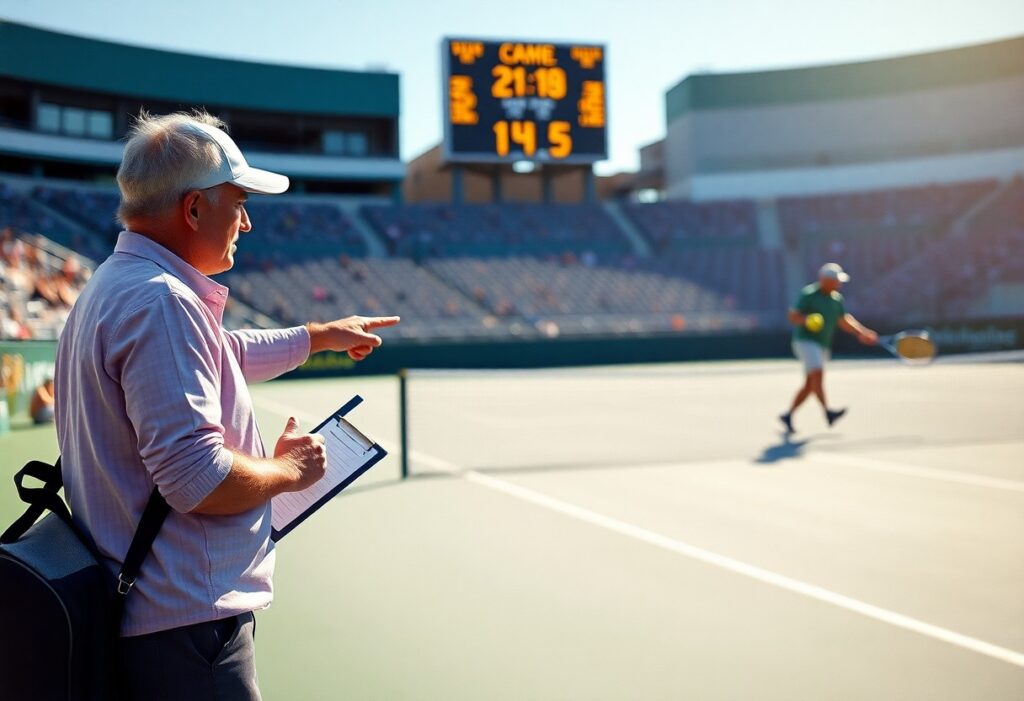

Success in tennis often springs from the coach’s blend of tactical acumen and psychological support; this guide examines how elite mentors create champions by delivering strategic insight, fostering transformative mentorship, and managing the risk of burnout that can derail talent, while implementing training that produces career-defining breakthroughs. You’ll learn proven frameworks, training habits, and match-day adjustments that separate top players from contenders.
Types of Tennis Coaches
- Developmental Coach
- Technical Coach
- Tactical Coach
- Performance Coach
- Fitness/Mental Coach
| Developmental Coach | Focuses on ages 8-16 with staged skill windows and a 3-6 year progression; academy pathways move juniors to national level. |
| Technical Coach | Refines stroke mechanics using video and biomechanics; common format is 8-12 session technical blocks. |
| Tactical Coach | Designs match plans, opponent scouting and in-match adjustments driven by stats like serve % and breakpoint conversion. |
| Performance Coach | Integrates periodization, sports science and recovery in 4-12 week cycles; coordinates with physios and nutritionists. |
| Fitness/Mental Coach | Delivers strength, conditioning and sports psychology; load management and mental training reduce injury and burnout risk. |
Developmental Coaches
Developmental coaches sculpt juniors’ trajectories by sequencing motor skill, technical and tactical training across a 3-6 year arc; they emphasize coordination from ages 8-12, then competitive decision-making at 13-16. Programs often use weekly microcycles (five training days, two intensity peaks) and milestone testing so promising players transition to national circuits within 3-5 years, as seen in several academy-produced top juniors.
Performance Coaches
Performance coaches drive elite gains through periodized blocks (typically 4-12 weeks), targeted match-simulation and metrics-driven tweaks-serve %, return depth, rally length. They coordinate recovery, nutrition and travel plans, and use interventions that in practice yield measurable improvements (for example, a focused 6-8 week program raising first-serve percentage by several points).
At tour level they manage day-to-day variables: taper before Slams, adjust practice intensity using GPS and heart-rate variability, and run opposition scouting sessions with video breakdowns. Collaboration with a physiotherapist and sports psychologist during a 10-day tournament window reduces load spikes and sharpens on-court reactions, producing steadier performance across rounds.
Recognizing how each coach’s timeline-from a multi-year developmental plan to short, data-led performance cycles-fits a player’s stage is what accelerates progress toward the top.
Key Factors in Shaping Winning Players
Top tennis coaches merge technical development, match strategy and mental resilience into measurable plans: for example, using 12-week periodized blocks, Hawk-Eye analytics for break-point conversion and a 60:40 practice-to-match simulation ratio. Sports science often targets a 3-5 km/h serve-speed gain while guarding against overwork-overtraining raises injury risk by ~25%. Assume that these elements are tracked with KPIs and adjusted weekly.
- Technical development – stroke mechanics, footwork drills, biomechanics testing
- Match strategy – opponent scouting, point-construction templates, set-play plans
- Mental resilience – pressure-replication, routines, 1:1 sports psychology
- Physical conditioning – periodized strength, agility, recovery protocols
- Data-driven preparation – Hawk-Eye stats, video breakdowns, KPI dashboards
Coaching Philosophy
Effective coaching philosophy often prioritizes long-term trajectories over single-match fixes: many elite programs adopt 2-4 year development arcs with quarterly testing, combine deliberate practice with high-intensity match simulations, and set objective KPIs (first-serve %, unforced error rate). Coaches balance discipline and autonomy, using video-led feedback and quantified goals to convert practice gains into consistent tournament outcomes.
Player-Centric Approach
A player-centric approach personalizes loads, tactics and communication: individualized gym programs, tailored match plans based on opponent weaknesses, and daily subjective wellness checks (RPE, sleep scores). This method reduced injury downtime in several academies by measurable margins when recovery protocols were enforced.
More detail shows teams often implement a weekly microcycle: two high-intensity on-court sessions, three technical/conditioning days, plus one active recovery day; GPS and heart-rate data guide adjustments, while video tags highlight 3 tactical patterns per opponent to exploit during matches, ensuring the player-centric approach translates into repeatable competitive advantages.
Step-by-Step Guide to Coaching 101
Coaching Roadmap
| Step | Focus / Example |
|---|---|
| Assessment | Video analysis, first-serve %, movement screens; baseline: 60-70% first-serve target for advanced juniors |
| Plan | Periodized 12-week mesocycles with 4-week microcycles and measurable goals (e.g., +5-10% serve accuracy) |
| Drills | Progressive drill ladder – shadow → feeder → live-ball → match-simulation; use 200-rep sets selectively |
| Conditioning | 30-45 min strength, 20-30 min agility per session, 2-3 sessions weekly; monitor load with session-RPE |
| Match Prep | Pressure scenarios: tiebreak simulations, return-of-serve patterns, opponent-specific game plans |
Building a Foundation
Start with targeted blocks: 20-30 minute technical sessions isolating one stroke, plus 20 minutes of footwork drills focusing on split-step, directional recovery and balance. Emphasize grip consistency and economy of motion; juniors 12-16 should allocate roughly 60-70% of practice time to motor patterns and footwork early on. Avoid high-volume serving for beginners to limit rotator cuff strain.
Techniques for Progression
Introduce a drill hierarchy: begin with shadow swings, progress to feeder-fed ball machines, then to constrained live-ball drills and finally full point play. Set numeric targets – for example, 150-250 targeted forehands per session, and aim to improve first-serve percentage by 5-10% over an 8-12 week cycle. Track progress with video and simple stats each week.
More specifically, use a 3:2:1 practice ratio (repetition:controlled rally:match play) in mid-season blocks; an example week might be Monday technical + strength, Wednesday high-intensity interval agility, Friday match-simulation with pressure tiebreaks. Monitor weekly load increases and keep them under about 10% to reduce overuse injuries like lateral epicondylitis and tendinopathy, and employ regular video comparisons to ensure technical gains translate to match outcomes.
Tips for Becoming a Successful Tennis Coach
Aim for at least 500+ hours of deliberate court time in the first two years, combine national certifications (PTR/ITF/USTA) with weekly video analysis and structured fitness plans, and study how top coaches adapt tactics mid-match. Limit technical corrections to 2-3 points per 30-minute session, use a 3:1 praise-to-correction ratio, and integrate GPS/HR data to monitor load. Recognizing that consistent, evidence-based practice builds reputation and player trust.
- Tennis coach
- Player development
- Match strategy
- Communication
- Conditioning
Communication Skills
Use concise cues and tactical questioning: for instance, after a rally ask, “Which court zone will you attack next?” Pair that with video at 50% speed and overlayed markers to show patterns. Keep feedback to 2-3 actionable points per 30-minute block and maintain a 3:1 praise-to-correction ratio; coaches using this approach see higher retention and faster technical uptake in junior and adult squads.
Continuous Education
Commit to one certification or advanced clinic per year (PTR/ITF/USTA), complete online modules (about 10-12 hours annually) and review 10-12 peer-reviewed articles yearly. Implement 12-week periodized training blocks and pilot new drills with a small group before scaling to the whole program.
Create a practical 12-month learning plan: Q1-finish a certification module and attend one webinar; Q2-introduce two new drills and collect baseline metrics (serve speed, first-serve %, Yo-Yo test); Q3-conduct a peer case review and read 3 sport-science papers; Q4-run a pilot adjusting periodization and update the season plan. Use resources like the ITF Academy, PTR courses, university journals and coach forums, and apply small-sample A/B testing (change one variable monthly) to confirm impact before full implementation.
Pros and Cons of Different Coaching Styles
Different approaches yield distinct outcomes: academies like Bollettieri’s used a more directive method to produce technical consistency, while Toni Nadal’s strict regimen accelerated mental toughness in juniors; conversely, modern coaches such as Patrick Mouratoglou emphasize shared decision-making and adaptability. Comparing styles shows trade-offs between rapid technical gains, player autonomy, injury/burnout risk, and long-term tactical growth-factors that often determine whether a talented junior becomes an elite pro.
Pros vs Cons by Coaching Style
| Pros | Cons |
|---|---|
| Rapid discipline and consistent drill progression | Higher burnout risk and reduced creative problem-solving |
| Greater tactical adaptability and player ownership | Slower early technical polish; potential indecision under pressure |
| Data-driven gains with objective metrics for improvement | Can overemphasize numbers at the expense of feel and instinct |
| High motivation and resilience through transformational mentorship | Coach-dependent performance swings if relationship falters |
| Develops autonomy and creative shot-making | Lack of structure can delay fundamental skill acquisition |
| Strong stroke mechanics and repeatable technical patterns | May neglect match tactics and situational play |
| Superior conditioning reduces late-match errors | Physical focus can compromise technique when fatigued |
| Sharp match strategies that win key points | Over-focus on tactics can ignore long-term technical development |
Authoritative Coaching
Often led by a single, directive voice, this style enforces structured practice plans, repetitive drill cycles, and immediate corrective feedback; examples include Toni Nadal’s early work with Rafael Nadal and Bollettieri’s academy system. Players typically gain rapid technical consistency and mental toughness, but the approach can increase stress and reduce on-court creativity, producing early results that sometimes come at the cost of long-term adaptability or higher attrition among juniors.
Collaborative Coaching
Built around dialogue and shared planning, collaborative coaches like Patrick Mouratoglou involve the player in match strategy, video review, and periodization decisions; this fosters tactical nuance and greater player ownership. Though technical improvements may emerge more slowly, the model often yields heightened decision-making under pressure and longer careers because athletes internalize strategy and recovery planning.
Teams using collaborative methods typically combine video analysis, on-court problem-solving drills, and input from sport scientists and psychologists: weekly video debriefs, targeted KPI tracking (first-serve percentage, break-conversion), and simulated match scenarios are common. That integrated setup creates measurable progress while building the player’s ability to adapt mid-match, reducing reliance on a single coach’s in-match calls.
The Role of Technology in Coaching
Advanced tools now sit alongside intuition in elite coaching, with systems like Hawk-Eye, TrackMan and PlaySight delivering objective metrics on ball trajectory, spin and placement while wearables track racket speed and joint load. Coaches combine these outputs with match stats-first-serve win rates, unforced error maps-to design drills and load plans. At the tour level, serve velocities regularly exceed 200 km/h, so data-driven tweaks to toss, shoulder angle or recovery timing can be the difference between marginal gains and match wins.
Performance Analysis Tools
Video platforms (Dartfish, Hudl) and ball-tracking (Hawk-Eye, TrackMan) create shot heatmaps, serve zones and biomechanical snapshots that coaches use to target corrections; for example, mapping return positions explains why a player concedes break points. Motion-capture can quantify shoulder extension or hip rotation to reduce injury risk, while statistics like first-serve percentage and breakpoint conversion guide tactical reps. Misreading small-sample data or neglecting context, however, can lead to faulty training priorities.
Virtual Coaching Sessions
Live video calls and asynchronous apps (CoachNow, PlaySight) let coaches deliver annotated clips, slow‑motion at up to 240 fps and voiceover drills across continents, enabling week‑by‑week technique refinement without physical presence. Players send multi-angle clips; coaches respond with structured progressions. The benefits include access to elite minds and faster feedback loops, though poor video quality or latency can produce misleading cues if not managed.
In practice, remote coaching splits into synchronous sessions for tactical walkthroughs and asynchronous review for technical repetition: record at 120-240 fps from two angles, upload to a shared folder, then coach tags frames, adds draw‑overs and prescribes 3-5 focused reps. Pairing video with wearable outputs-racket head speed, ball impact location-and automated SmartCourt clips creates a unified picture; coaches use that to write micro‑periodized plans and opponent scouting notes. Strong data governance and clear communication of contextual limits prevent overreliance on numbers and protect player privacy.
Conclusion
So the journey from sidelines to stardom shows how elite coaches translate technical insight, tactical planning, mental conditioning, and individualized mentorship into measurable competitive success, shaping athletes’ habits, decision-making, and resilience while fostering environments where talent matures into championship performance.
FAQ
Q: How do famous tennis coaches develop a player’s technical and tactical skills?
A: Elite coaches begin with detailed video and biomechanical analysis to isolate weaknesses and reinforce reliable patterns. They design progressive drills that replicate match rhythms-serve and return sequences, transition patterns, rally construction-and use targeted repetition to ingrain efficient movement and shot selection. Tactical work includes opponent scouting, building game plans for different styles, practising point-construction scenarios and situational drills (e.g., break-point play, end-of-set tactics). Coaches also integrate data analytics to track trends over time, then adjust training loads and on-court focus to ensure technical gains translate into consistent match performance.
Q: What techniques do top coaches use to strengthen a player’s mental game and match-day performance?
A: Top coaches embed mental conditioning into daily routines: goal-setting, visualization, controlled breathing, and pressure simulations in practice that mimic high-stakes moments. They collaborate with sports psychologists when needed, teach coping strategies for momentum swings and crowd noise, and structure small, achievable targets to build confidence through measurable progress. Match-day protocols-pre-match routines, cue words, simplified tactical reminders and post-match debriefs-help players maintain focus and make clear decisions under fatigue. Over time these methods reduce performance variability and improve the player’s ability to execute under pressure.
Q: In what ways does the coach-player relationship influence a player’s long-term career and success?
A: A strong relationship is built on trust, clear communication and a shared vision for development; that enables coaches to tailor training, manage scheduling, and make long-term strategic choices like surface focus or physical periodization. Coaches assemble and coordinate a support team (fitness trainers, physios, nutritionists, mental coaches), advise on tournament selection and workload to prevent burnout, and help with media and contractual matters. They also mentor players toward autonomy, gradually transferring decision-making so athletes can adapt on-court and sustain performance across seasons and coaching transitions, which often determines longevity and peak achievement.