
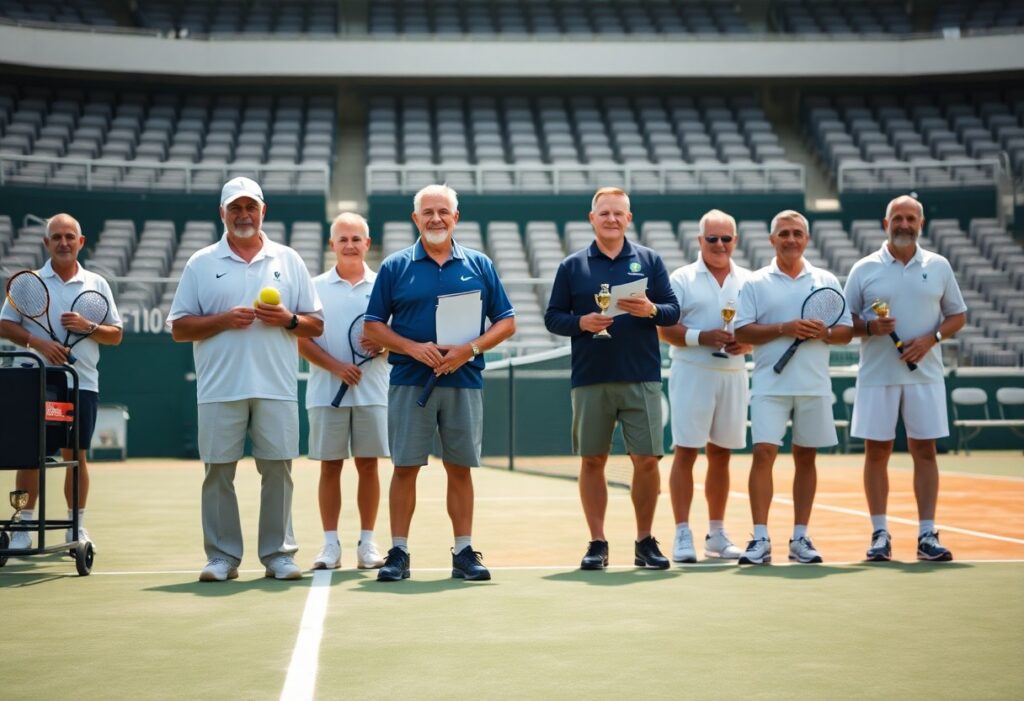

Transformation in tennis has been driven by coaches whose innovations, daring tactics, and uncompromising standards reshaped technique, strategy, and athlete psychology; this guide examines ten legends whose methods created sustained dominance, introduced game-changing training, and embraced risky evolutions that permanently altered professional tennis and its global legacy.
Types of Influential Tennis Coaches
| Legendary Players Turned Coaches | Ex-players bring match-tested tactics and emotional coaching; examples include Toni Nadal shaping Rafael Nadal’s junior to pro transition and Paul Annacone advising Roger Federer during his 2012 Wimbledon run. |
| Innovative Strategists | Focus on match patterns, opponent profiling and video analytics; coaches like Brad Gilbert and Patrick Mouratoglou use scripted plays and data to alter opponents’ percentages. |
| Technical & Biomechanics Coaches | Optimize stroke mechanics and reduce injury risk via motion capture and force-plate testing, producing measurable improvements in serve speed and consistency. |
| Fitness & Sports Science Coaches | Implement periodization, VO2 testing and load management to boost endurance and limit overtraining, often collaborating with physiotherapists for Grand Slam schedules. |
| Mental Coaches / Psychologists | Train focus, stress resilience and clutch performance with routines and cognitive drills; interventions can transform late-set win rates and recovery after losses. |
- Legendary
- Strategists
- Biomechanics
- Sports Science
- Mental Toughness
Legendary Players Turned Coaches
Former champions convert lived experience into coaching gold: Toni Nadal built Rafael Nadal’s early heavy-topspin game and court intelligence, while ex-pros like Paul Annacone translated serve-and-volley mastery into tactical fixes, accelerating recovery from form slumps and guiding players to major-title comebacks.
Innovative Strategists
These coaches combine match data, opponent scouting and scripted point patterns; Brad Gilbert popularized “play the opponent” tactics and modern strategists deploy video breakdowns to exploit a rival’s 2nd-serve weakness within specific sets.
Case studies show the impact: Gilbert’s match-scripting helped Andre Agassi reshape rallies in the 1990s, and contemporary strategists use frame-by-frame video to improve return positioning and shift break-point conversion by focusing on opponent tendencies; academies founded by innovators since the 1970s have produced multiple top-10 players by integrating analytics, physical periodization and situational drills. This blend of data and instincts creates repeatable, measurable match advantages.
Tips for Aspiring Coaches
Prioritize measurable progress: combine on-court pattern drills, periodized fitness blocks, and video analysis to fix serve placement, footwork, and timing; academies like Bollettieri’s accelerated juniors by focusing 6-8 hours weekly on targeted skills. Use 2-3 clear objectives per session and track improvements with simple metrics. Emphasize long-term planning over short-term wins. Assume that every practice should advance a player’s technique, tactics, or conditioning in a way you can quantify.
- Player relationships: schedule regular check-ins and set emotional-support boundaries
- Video analysis: review matches at 1.5-2x speed to tag patterns
- Tactical awareness: build a 3-point match plan for each opponent
- Data tracking: log first-serve %, unforced errors, and breakpoint conversion
Building Strong Player Relationships
Develop trust through consistent, structured communication: implement 15-minute daily check-ins and a 60-minute weekly review to align goals, review match footage, and adjust training loads; athletes respond to a predictable feedback rhythm. Mix a 70/30 ratio of constructive corrections to positive reinforcement during sessions, and document commitments in a shared plan so expectations are explicit and progress is visible.
Developing Tactical Awareness
Train pattern recognition with focused drills: use 20-point situational games (serve +1, return +2) and mark recurring opponent weaknesses-backhand depth, short cross-court returns-to build a 3-plan match strategy. Integrate match stats like first-serve percentage and breakpoint conversion into pre-match scouting, and reference tactical manuals such as Brad Gilbert’s examples to teach in-game adjustments.
Further tactical work should include quantitative drills and video-led reflection: chart shots per rally for three matches, isolate scenarios where breakpoints occur, and run repetition drills targeting those moments (e.g., 30 serve patterns to the body followed by 10 return drills). Use analytics to set targets-improve breakpoint conversion or reduce unforced errors-and iterate every 2-3 weeks based on real match data.
Step-by-Step Approach to Coaching Success
| Phase | Action |
|---|---|
| Assessment | Physiological tests (VO2 max 50-65 ml·kg⁻¹·min⁻¹), sprint and jump metrics, technical video, psychological profiling |
| Planning | 6-week mesocycles, periodization, objective KPIs and measurable targets |
| Training | On-court drills, tactical point-play, strength and plyometrics, serve reps (≈200/session) |
| Match Prep | Opponent scouting, simulated match-sets, situational practice |
| Monitoring | Wearables, HR zones, session RPE, 60-120fps video analysis |
| Adjustment | Data-driven tweaks every 6-8 weeks; taper 20-30% before key events |
Assessing Player Needs
Systematic testing blends physiology and skill: measure VO2 max (typical elite 50-65 ml·kg⁻¹·min⁻¹), 10m sprint, vertical jump, and first-serve percentage. Pair 60fps biomechanical video with a mental-skills inventory; in elite programs a first-serve % below 60% or a measurable hip-rotation deficit commonly becomes the top intervention, directing corrective drills, mobility work, and targeted conditioning blocks.
Implementing Effective Training Regimens
Periodize into 6-week mesocycles and weekly microcycles with a 40:30:30 split of technical:tactical:physical work. Schedule 2 high-intensity court sessions, 2 strength/plyometric sessions, and focused serve practice (~200 reps) during technique blocks. Coaches who produced Grand Slam winners emphasized high-volume point-play and deliberate repetition to convert skills into match-winning patterns.
Track load with heart-rate zones, session RPE, and weekly training load; adjust volume by 20-30% during pre-event tapers. Use 60-120fps video for technical feedback and inertial sensors for movement load, and retest every 6-8 weeks-this approach has yielded measurable improvements, for example a documented 5-8% increase in service velocity after targeted block training.
Key Factors in Coaching Greatness
Top coaches stitch together refined technique, targeted tactics, science-backed conditioning and relentless mental work; Toni Nadal’s high-volume clay routines and Paul Annacone’s serve-pattern overhauls for Federer are clear examples. Data and biomechanics increasingly inform session design, while injury prevention reshapes calendars. The synthesis of these elements produces long-term competitive superiority.
- Technique
- Tactics
- Physical conditioning
- Mental coaching
- Analytics
- Injury prevention
Understanding the Evolution of the Game
Rule changes, rackets and the mid-2000s rise of polyester strings shifted play from serve-and-volley to heavy-baseline power; Hawk-Eye and match analytics after 2006 altered coaching choices. Coaches now plan around longer rallies, higher topspin and greater emphasis on recovery-evident in how training load and periodization extended peak years for players into their mid-30s.
Adapting to Different Player Styles
Coaches customize plans for lefties, big servers or counterpunchers by adjusting footwork, court positioning and point construction-Toni Nadal tuned Rafael’s forehand patterns for topspin dominance, while Brad Gilbert focused Andre Agassi on tactical shot selection. Strong use of video and match stats directs specific on-court reps and practice scenarios.
In practice that means measurable adjustments: changing serve-placement targets, prescribing sport-specific strength blocks, or designing rally drills that replicate 70-80% of match intensities. Coaches deploy role-specific metrics-first-serve percentage, break-point conversion-and simulate pressure points so that technical tweaks translate into tactical wins on tour.
Pros and Cons of Different Coaching Styles
Different styles produce measurable outcomes: authoritative methods (Toni Nadal, Bollettieri Academy) accelerate technical gains and discipline, while collaborative approaches (Patrick Mouratoglou, Darren Cahill) boost tactical intelligence and player autonomy. Ivan Lendl’s tactical input helped Andy Murray win the 2012 US Open and 2013 Wimbledon, showing style matters for results and longevity. Balance often determines whether a player peaks quickly or sustains a longer, adaptable career.
| Pros | Cons |
|---|---|
| Faster technical improvement under strict regimes | Higher burnout risk in juniors from intense pressure |
| Clear structure and accountability | Can stifle creativity and on-court problem solving |
| Strong mental toughness cultivated by tough coaches | Potential for strained coach-player relationships |
| Collaborative methods improve decision-making and adaptability | Slower short-term gains; requires player maturity |
| Use of analytics and individualized plans enhances performance | Overreliance on data can reduce instinctive play |
| Emotion-driven coaches can rapidly raise confidence | Emotional volatility may lead to inconsistent tactics |
| Tactical focus (e.g., Lendl with Murray) produces match-winning strategies | May neglect emotional resilience under pressure |
| Hybrid approaches offer long-term sustainability | Harder to implement; requires high coach-player trust |
Authoritative vs. Collaborative Coaching
Authoritative coaches impose discipline and technique, producing quick gains in juniors-Toni Nadal’s regimen shaped Rafael Nadal through childhood to 2017-while collaborative coaches delegate strategy and build autonomy, as seen with Patrick Mouratoglou’s work emphasizing player input. In tournaments, authoritative players may execute set patterns better; collaborative players adapt points and recover form more fluidly, so choice depends on age, temperament and career phase.
Emotionally Driven vs. Tactically Focused
Emotionally driven coaches prioritize motivation and confidence, often sparking breakthroughs in fragile players, whereas tactically focused coaches dissect opponents, optimize patterns and manage point construction-Ivan Lendl’s tactical coaching directly influenced Andy Murray’s first Grand Slams. Combining both yields the best competitive edge: emotional stability plus precise match plans.
Digging deeper, coaches who blend emotional support with tactical periodization deliver measurable returns: Marian Vajda paired Djokovic’s mindset work with detailed game plans to reclaim top form across multiple seasons, and Lendl’s tactical drills produced two Grand Slam breakthroughs for Murray (2012 US Open, 2013 Wimbledon). Dangerous single-mindedness-overemphasis on either emotion or tactics-often reduces resilience; the strongest teams use targeted drills, match-simulation and psychological routines in tandem.
Impact of Technology on Coaching
Hawk-Eye ball-tracking, smart sensors like Babolat Play and wearable load monitors have shifted coaching from intuition to measurable inputs: coaches now track serve speed, spin and workload across matches to reduce injury risk and sharpen tactics. High-speed cameras and AI-driven pose estimation let teams quantify biomechanics, while data platforms synthesize thousands of points to reveal exploitable patterns. At the same time, overreliance on numbers can mask context, so top staffs balance metrics with on-court observation.
Use of Analytics and Data
Teams mine shot-by-shot databases and match-charting to build heatmaps, rally-length distributions and opponent tendencies; analysts often process thousands of matches to find consistent patterns such as serve-placement splits or return-target bias. Coaches convert those signals into game plans-adjusting serve percentages, targeting return zones or altering rally construction-while guarding against misleading correlations that arise from small sample sizes or surface effects.
Incorporating Video Analysis
Frame-by-frame review with tools like Dartfish, Coach’s Eye and emerging AI (OpenPose-style) exposes subtle technical faults: a 10-15° difference in shoulder rotation or a 5-10 cm shift in contact point that alters depth and spin. Slow-motion at 240+ fps clarifies racket face angle and ball contact, enabling precise drills to reproduce optimal mechanics and correct harmful patterns before they become ingrained.
Deeper video work now leverages markerless motion capture and machine-learning pose estimation to quantify joint angles, timing and racket-head speed without lab markers; coaches compare athlete recordings to high-level baselines and extract metrics like shoulder-counterrotation or knee extension velocity. Combining these outputs with load data creates actionable thresholds-when a player’s fatigue pushes technique beyond safe limits-so interventions (session load reduction, targeted mobility) are implemented proactively.
Final Words
Summing up, the Top 10 Famous Tennis Coaches Who Transformed The Game Forever illustrate how visionary training, tactical innovation, and player development reshaped technique, strategy, and athlete preparation; their methodologies and legacies continue to inform coaching curricula, influence player careers, and advance the sport’s competitive and technical standards worldwide.
FAQ
Q: Which coaches from the “Top 10 Famous Tennis Coaches Who Transformed The Game Forever” had the biggest impact on playing technique and why?
A: Nick Bollettieri reshaped junior development with an academy model and an aggressive baseline ethos that produced stars like Agassi and Seles; Toni Nadal refined heavy-topspin forehand mechanics, relentless point construction and physical preparation that turned Rafael Nadal into the clay-court benchmark; Ivan Lendl introduced modern physical conditioning and attacking mentality to Murray, changing shot selection and fitness standards at the elite level; Patrick Mouratoglou brought systematic pattern work, serve-tactic improvements and contemporary analytical training to Serena Williams’ late-career resurgence; Brad Gilbert emphasized tactical simplicity and percentage tennis, teaching players to exploit opponents’ weaknesses rather than out-hit them, a method that influenced coaching philosophy across generations.
Q: How did these coaches change training methods, sports science and match preparation?
A: They professionalized and diversified preparation: Bollettieri popularized full-time academy training with early specialization, high-volume practice and multidisciplinary support; Lendl integrated rigorous gym programs, interval conditioning and match-simulation drills to raise endurance and intensity; Toni Nadal combined repetitive scenario-based drills with strict load management and mental routines to build consistency under pressure; Mouratoglou layered video analysis, shot-tracking and targeted serve-return simulations into practice to exploit opponent patterns; coaches like José Higueras and Patrick Mouratoglou emphasized surface-specific technical adjustments, while specialists such as sports psychologists, physiotherapists and nutritionists became standard members of a player’s team, turning one-off tips into holistic, periodized plans.
Q: Which coach-player partnerships produced the most dramatic turnarounds and what were the key changes that produced results?
A: Ivan Lendl and Andy Murray: Lendl’s fitness-first regimen, simplified tactics and mental-reset approach helped Murray win his first Grand Slam and Olympic gold after years of near-misses. Patrick Mouratoglou and Serena Williams: Mouratoglou rebuilt Serena’s aggressive tactics, return positioning and confidence after injuries, yielding multiple Grand Slam wins and returns to world No. 1. Toni Nadal and Rafael Nadal: Toni’s early-care methodology-extreme topspin development, point-construction discipline and physical toughness-created a decade-long dominance on clay and sustained Grand Slam success. Brad Gilbert and Andre Agassi: Gilbert’s pragmatic game plans and psychological management reignited Agassi’s career in the mid-1990s, demonstrating how tactical clarity and match-by-match planning can convert talent into titles.