

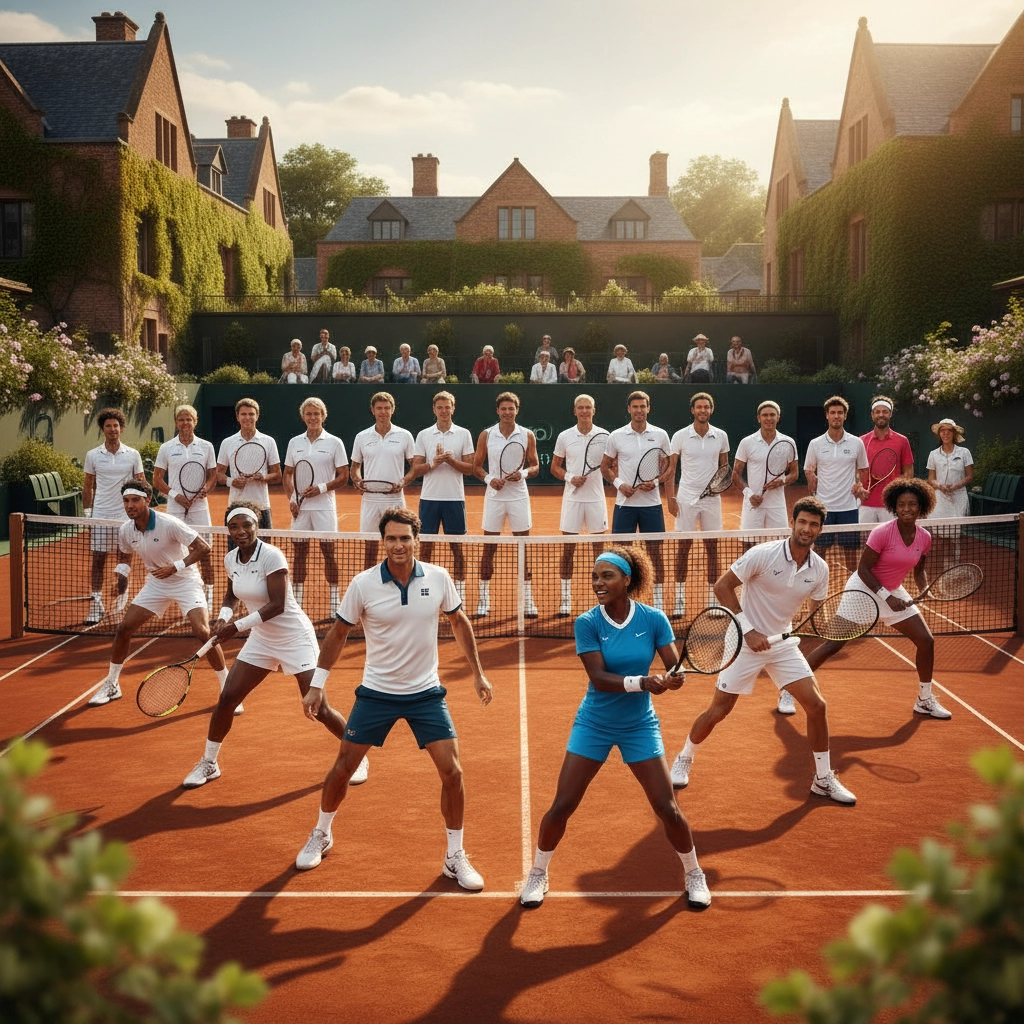
Why these 25 tennis players matter to your understanding of the sport
When you want to understand tennis—its tactics, rivalries, and cultural impact—it helps to study the people who defined it. This list of 25 famous tennis players spans pioneers, record-breakers, and modern icons. You’ll see how rule changes, surface specialization, and advances in training and equipment are reflected in individual careers. As you read, pay attention not only to titles but to influence: who changed how the game is played, who pushed social progress, and who created rivalries that drew new audiences.
The players selected represent different eras and styles: serve-and-volley masters, baseline powerhouses, counterpunchers, and all-court strategists. You’ll learn to spot patterns—how a single player’s approach can shift coaching methods worldwide, or how a rivalry can elevate a sport’s popularity. Use this first section to get context; later sections will present the remaining players and deeper career highlights.
Foundations and early icons you should recognize
Start here with the players who set the foundation for modern tennis. These athletes were innovators, record-setters, or cultural figures who helped establish tennis as the international sport it is today. Below are eight players whose names you should know and the reasons they remain essential to any tennis conversation.
-
Suzanne Lenglen (France)
Lenglen dominated women’s tennis in the 1910s and 1920s with a graceful, attacking style that contrasted with the era’s more conservative play. You should know her for transforming women’s tennis into a spectator sport—she attracted huge crowds and was one of the first female athletes to achieve celebrity status. Lenglen’s athleticism and volleying prowess influenced how midcourt aggression would be valued in later generations.
-
Bill Tilden (United States)
Tilden was the defining male player of the 1920s, winning multiple Grand Slam titles and popularizing strategic baseline play. If you study his matches, you’ll see early examples of tactical use of spin and placement rather than sheer power. Beyond results, Tilden contributed to tennis literature and coaching, helping codify approaches that coaches used for decades.
-
Rod Laver (Australia)
Laver’s name is synonymous with the “Calendar Grand Slam” because he won all four major singles titles in a single year—twice. You should know Laver for his exceptional versatility across surfaces and for bridging the amateur and Open Eras. His left-handed attacking game and remarkable shot-making remain benchmarks for measuring all-court excellence.
-
Margaret Court (Australia)
Court holds one of the highest Grand Slam tallies in history and dominated in the 1960s and early 1970s with a powerful serve-and-volley game. When you study Court, focus on her adaptability across surfaces and her ability to win in singles, doubles, and mixed doubles—demonstrating complete on-court dominance. Her record books are essential context for discussions about the greatest careers.
-
Billie Jean King (United States)
King is as important for her social impact as for her titles. A fierce competitor on court—with numerous Grand Slam wins—she’s best known off court for leading the fight for equal prize money and founding the women’s professional circuit. You should know King for how she leveraged athletic success into lasting institutional change for women in sport.
-
Martina Navratilova (Czechoslovakia/United States)
Navratilova redefined fitness, serve-and-volley strategy, and longevity in women’s tennis. Her aggressive net play, lefty serve, and athleticism brought new intensity to the women’s game in the 1970s and 1980s. You’ll study her training methods and rivalry with Chris Evert to understand how contrasting styles can produce some of the most compelling matches in history.
-
Björn Borg (Sweden)
Borg’s cool baseline consistency and ice-cold mental game dominated late-1970s tennis, especially on clay and grass. He brought baseline endurance and topspin-heavy rallies into the spotlight, and his rivalries—most notably with John McEnroe—helped globalize tennis fandom. Knowing Borg helps you see the shift toward sustained rallying and athletic baseline play.
-
Serena Williams (United States)
Williams is a modern icon whose power, serve, and competitive mentality redefined women’s tennis in the 2000s and 2010s. You should know Serena for her blend of athleticism and mental toughness, her record of Grand Slam wins, and her cultural impact outside the court. Her matches illustrate how modern equipment and training enabled a new era of power tennis.
These eight players give you a cross-section of tennis evolution: from early celebrity athletes to modern powerhouses, and from social pioneers to technical innovators. As you prepare to learn about the next cohort, keep an eye on how playing surfaces, racket technology, and off-court influence shaped each career; the next section will introduce the rivalries and record-holders who dominated the Open Era and modern game.
The Big Three: a generation that rewrote the record books
-
Roger Federer (Switzerland)
You should know Federer for the combination of aesthetic stroke-making and sustained excellence that made him the global face of tennis for a decade. Federer’s one-handed backhand, effortless movement, and attacking all-court game reintroduced a classical elegance to an increasingly power-driven sport. His run of Wimbledon and hard-court dominance, record weeks at world No. 1, and a large collection of Grand Slam titles set benchmarks for consistency and versatility. Off court, Federer’s professionalism and marketability helped broaden tennis’s commercial reach and inspired many young players to model a graceful, varied style.
-
Rafael Nadal (Spain)
Nadal is essential to understanding how surface specialization and ferocious physicality can define a legacy. Nicknamed the “King of Clay,” he transformed clay-court tennis with relentless topspin, extreme court coverage, and a mental approach that emphasized relentlessness. Nadal’s record at Roland Garros is unmatched, but his career also demonstrates adaptability—he evolved his game to win repeatedly on grass and hard courts. His rivalry with Federer and Djokovic shaped match narratives for nearly two decades, and his fitness-first approach influenced training methods across the sport.
-
Novak Djokovic (Serbia)
Djokovic stands out for his defensive mastery, return of serve, and unmatched record in Masters and major tournaments. He brought a new standard of flexibility, balance, and baseline precision that allowed him to neutralize power and turn defense into offense. Djokovic’s ability to win across surfaces, his numerous weeks at world No. 1, and multiple career Grand Slams position him at the center of modern statistical debates about greatness. Studying his match play shows how conditioning, movement, and mental resilience can dominate even in an era of powerful serves and baseline hitting.
Style-shifters and headline rivalries of the late 20th century
-
Pete Sampras (United States)
You should know Sampras for epitomizing the serve-and-volley champion in the 1990s. His big, precise serve and aggressive net game made him especially formidable on grass and fast hard courts, and his Wimbledon success helped define a decade of male tennis. Sampras’s tactical simplicity—serve, attack the net, finish—remains a lesson in court geometry and pressure play. His rivalry with Andre Agassi also symbolized the clash of styles and personalities that drew mainstream interest to tennis in the United States.
-
Andre Agassi (United States)
Agassi changed public perceptions of tennis with his charisma, fashion, and baseline aggression. His two-handed backhand and return-of-serve made him the archetypal counterpuncher who could take the ball early and dictate rallies. Agassi completed a career Grand Slam and enjoyed a dramatic late-career resurgence that illustrated longevity through fitness and mental renewal. He’s also notable for bringing tennis culture into pop culture, helping expand the sport’s audience beyond traditional fans.
-
Steffi Graf (Germany)
Graf combined ferocious forehands, speed, and tactical intelligence to dominate women’s tennis in the late 1980s and 1990s. Her Golden Slam in 1988—winning all four majors and Olympic gold in the same year—makes her career singular. Graf’s slice backhand, penetrating forehand, and footwork allowed her to excel on all surfaces, and she set a standard for consistency and dominance that shaped how champions are measured in the modern era.
-
Monica Seles (Yugoslavia/United States)
Seles burst onto the scene with ferocious two-handed strokes on both sides and an aggressive, flat-hitting style that overwhelmed opponents in the early 1990s. Her intense rivalries with Graf and her sudden, tragic interruption after the on-court attack are part of tennis history—both for what she achieved in a short period and for how the sport responded to player safety and mental recovery. Studying Seles is a reminder of how talent and circumstance can combine to alter careers and the sport’s narrative.
-
John McEnroe (United States)
McEnroe’s artistry at the net, touch volleys, and uncanny feel for angles made him a standout serve-and-volleyer in the late 1970s and 1980s. Beyond technique, his fiery on-court personality and high-profile rivalries (especially with Björn Borg) helped make tennis a television spectacle. McEnroe taught audiences and players the value of improvisation, poaching at the net, and the psychological edge—how temperament can be as decisive as shots in defining match outcomes.
More players who shaped eras and inspired change
-
Serena Williams (United States)
Serena’s power, athleticism, and competitive spirit redefined the modern women’s game. Her ability to dominate with serve and groundstrokes, plus a record of major titles across decades, makes her one of the most influential athletes in tennis and sport overall.
-
Venus Williams (United States)
Venus brought height, reach, and a booming serve to the women’s tour, helping elevate the athletic standard. Her success on grass and her advocacy for equal prize money have left a lasting impact on the sport’s professional landscape.
-
Martina Navratilova (Czechoslovakia/United States)
Navratilova’s relentless fitness, serve-and-volley excellence, and longevity across singles and doubles set new professional benchmarks. Her tactical versatility and athletic conditioning influenced generations of players to focus on all-court play.
-
Margaret Court (Australia)
As one of the most prolific major winners in history, Court’s powerful, direct game and success across singles, doubles, and mixed doubles mark her as a foundational figure in women’s tennis.
-
Billie Jean King (United States)
Beyond her multiple Grand Slam titles, King’s leadership in gender equality and the founding of the WTA changed the sport’s social and professional fabric. She remains a model of activism and competitive excellence.
-
Chris Evert (United States)
Evert’s consistency from the baseline, mental toughness, and clay-court mastery produced an extraordinary winning percentage and a standard for defensive, precise play on tour.
-
Maria Sharapova (Russia)
Sharapova combined mental strength and a big groundstroke game with rare marketability for a tennis player. Her success at a young age and crossover appeal brought additional attention to the women’s tour.
-
Andy Murray (United Kingdom)
Murray’s tactical intelligence, defensive skills, and breakthroughs at Wimbledon and in Davis Cup play made him a modern British sporting icon and a key figure in the Big Three era’s competitive balance.
-
Boris Becker (Germany)
Becker exploded onto the scene as a teenage Wimbledon champion with a fearsome serve and aggressive net play. His early success and charisma helped globalize tennis in the 1980s and 1990s.
-
Björn Borg (Sweden)
Borg’s cool demeanor, exceptional baseline consistency, and dominance at Roland Garros and Wimbledon made him one of the sport’s first true global superstars, influencing training and stamina standards.
-
Rod Laver (Australia)
Laver’s two calendar-year Grand Slams and all-court brilliance place him among the game’s all-time greats. His achievements highlight the historical continuity of excellence across tennis generations.
-
Jimmy Connors (United States)
Connors combined grit, flat groundstrokes, and fierce competitiveness to compile a career of remarkable longevity and headline-grabbing rivalries, especially through the 1970s and 1980s.
-
Ilie Năstase (Romania)
Năstase’s flair, shot-making creativity, and on-court personality helped popularize tennis worldwide while showcasing how individual expression can coexist with top-level results.
-
Stan Wawrinka (Switzerland)
Wawrinka’s powerful one-handed backhand and ability to peak at Grand Slams produced surprising major wins and demonstrated how determination and timing can yield elite success even outside the top-ranked favorites.
-
Gustavo Kuerten (Brazil)
“Guga” brought flair and clay-court mastery to the fore, winning Roland Garros multiple times and inspiring tennis’s growth in South America through an affable personality and gripping style.
-
Lindsay Davenport (United States)
Davenport’s powerful, flat groundstrokes and clinical serve made her a dominant hard-court player and a multiple major champion, exemplifying the effectiveness of precision and depth from the baseline.
-
Ken Rosewall (Australia)
Rosewall’s longevity, guile, and elegant backhand helped him win major titles across decades. His career is a study in adaptation and technical excellence during tennis’s amateur and professional transition.
Final reflections on tennis as a living tradition
Tennis is a conversation across generations: tactics, technique, personalities, and off-court advocacy all shape how the game evolves. The players above highlight different routes to influence—dominance, stylistic innovation, cultural impact, or pioneering activism—and together they illustrate why watching matches and reading histories remain rewarding. For current rankings, player biographies, and official tournament information, visit the ATP Tour.
Frequently Asked Questions
Who are the “Big Three” and why are they important?
The “Big Three” refers to Roger Federer, Rafael Nadal, and Novak Djokovic. They are important because their sustained success, rivalries, and records across Grand Slams and tour events shaped the modern era of men’s tennis and raised standards for consistency and versatility.
How have playing surfaces influenced famous players’ careers?
Surface characteristics—clay, grass, and hard courts—affect ball speed, bounce, and movement, favoring different styles. Players like Rafael Nadal (clay) and Pete Sampras (grass) built dominant identities around surfaces, while all-court players learned to adapt tactics and footwork to succeed everywhere.
Which players combined on-court success with influence off the court?
Several players used their platforms beyond match results. Billie Jean King advocated for gender equality and helped found the WTA; Roger Federer and Serena Williams expanded the sport’s global appeal and marketability; others, like Margaret Court and Martina Navratilova, influenced coaching, fitness, and social conversations within tennis.