

Why the Australian Open Stands Apart From Every Other Grand Slam
The Australian Open is the first Grand Slam of the tennis calendar year, held each January in Melbourne, and it sets the tone for the season in ways that go beyond simply crowning early champions. For fans new to professional tennis, it offers one of the most accessible entry points into understanding how major tournaments work. For longtime followers, it remains one of the most technically and physically demanding events on tour — a tournament where heat, surface speed, and scheduling create a competitive environment unlike anything found at Wimbledon, Roland Garros, or the US Open.
What makes it distinctive is the combination of factors players must manage simultaneously: the hard court surface, the January heat of the Southern Hemisphere summer, the tournament’s retractable-roof infrastructure, and a format that demands consistent excellence across nearly two weeks. Understanding each element explains why certain playing styles thrive here and why upsets can carry greater significance than they might elsewhere.
Melbourne Park: The Venue That Shaped the Modern Australian Open
The tournament has been held at Melbourne Park since 1988, when it relocated from Kooyong, a grass-court club venue. The move to a purpose-built facility changed everything. Melbourne Park was designed to accommodate large crowds, broadcast demands, and the logistical scale of a modern Grand Slam, and it has been expanded repeatedly since.
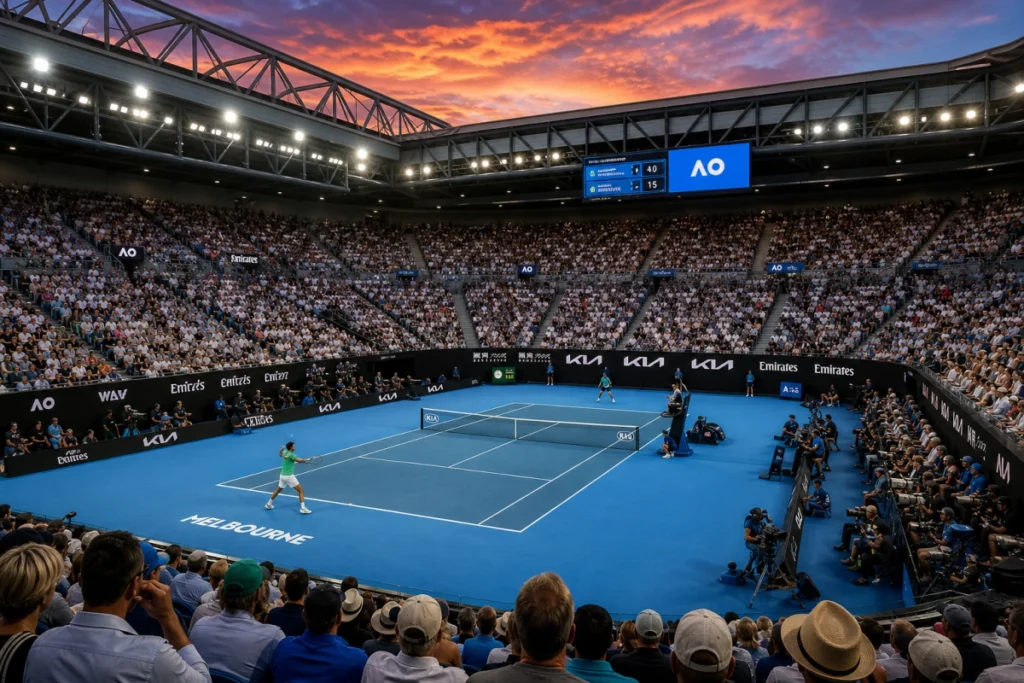
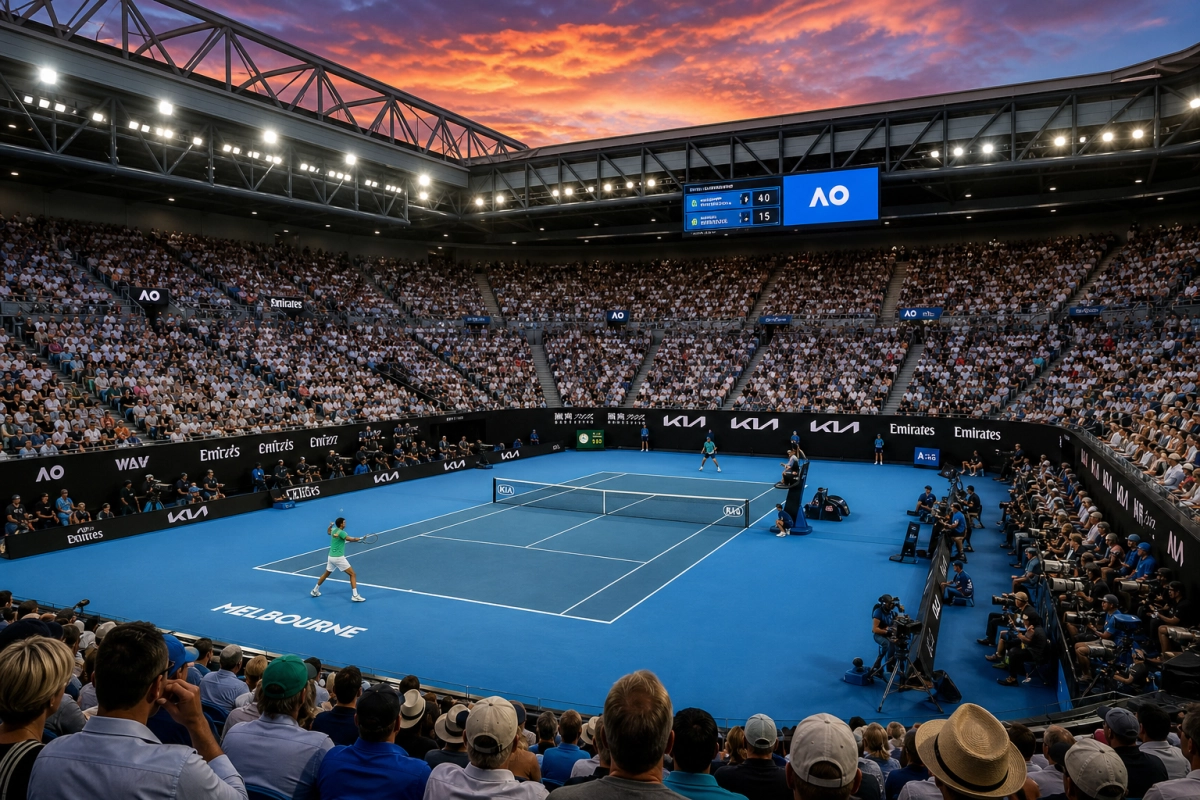
The three primary show courts — Rod Laver Arena, John Cain Arena, and Margaret Court Arena — are each equipped with retractable roofs. When temperatures spike or rain arrives, play on the show courts can continue without interruption. That operational flexibility is something the Australian Open has leveraged more effectively than most other Grand Slams during extreme weather events that would otherwise cause significant scheduling chaos.
Rod Laver Arena seats approximately 15,000 spectators and functions as the heart of the tournament. The surrounding grounds contain additional courts where earlier rounds are played, giving the site a campus-like feel that allows fans to move between matches freely during the opening week.
Court Surface and Playing Conditions
The Australian Open uses a hard court surface called Plexicushion, an acrylic-based material applied over an asphalt base. Compared to the DecoTurf surface used at the US Open, Plexicushion produces a medium-paced game with a relatively true and consistent bounce. The ball sits up enough for aggressive baseliners to attack, but the surface also rewards solid defensive retrieving — which is part of why the tournament has historically suited all-court and power baseline players in roughly equal measure.
Hard courts place significant physical demands on players’ joints because the surface absorbs less impact than clay. Over two weeks, that accumulation matters. Players who enter Melbourne underprepared or carrying fitness concerns from the off-season often find the surface unforgiving deep into the second week. The weather adds an entirely separate layer of complexity — one that has produced some of the most dramatic moments in the tournament’s modern history.
The Heat Policy: How the Australian Open Manages Extreme Weather
No other Grand Slam has had to formalize its approach to extreme heat the way the Australian Open has. Melbourne’s January climate sits squarely in the Southern Hemisphere summer, and temperatures on the exposed outer courts can reach levels that genuinely threaten player health. That reality pushed tournament officials to develop the Extreme Heat Policy — a structured framework for deciding when and how to modify play conditions during dangerous weather events.
The policy uses a combination of temperature and humidity readings to calculate a heat stress index, monitored in real time throughout each day. When conditions cross defined thresholds, play on outer courts can be suspended entirely, and the retractable roofs on the show courts are closed. Humidity significantly amplifies physical stress on athletes performing at maximum intensity, which is why the index calculation matters more than the thermometer reading alone.
The US Open faces summer heat in New York, and Roland Garros can encounter warm May conditions in Paris, but neither tournament has needed to develop an equivalent formal response. From a competitive standpoint, the heat policy introduces a scheduling variable that players and coaches must factor into preparation. A player acclimatised to high-heat conditions through careful pre-tournament training carries a real advantage over one who arrived in Melbourne days before the draw began.
Tournament Format and the Demands of a Two-Week Draw
The Australian Open follows the standard Grand Slam format: 128-player main draws in both singles competitions, with matches played as best-of-five sets for men and best-of-three sets for women. To win the title, a player must win seven consecutive matches. Each could potentially extend to a maximum of five sets — a cumulative physical toll that has no equivalent in any regular tour event.
Seedings play an important structural role, positioning top-ranked players to avoid one another until the later rounds. In practice, however, the draw also creates the possibility of high-profile early-round collisions when unseeded players perform beyond expectations — a dynamic that has repeatedly produced some of Melbourne’s most memorable results.
Tiebreaks, Super Tiebreaks, and Final-Set Rules
One area where the Australian Open has made a distinctive structural decision is its final-set format. Unlike Wimbledon, which introduced a tiebreak only at 12-12 in the fifth set, the Australian Open uses a match tiebreak — played to ten points — to decide the fifth set if it reaches six games all. This rule, adopted in 2019, was a direct response to the logistical and physical problems created by indefinite final sets, which had produced exhausting marathons in previous years.
Traditionalists argued that the sudden-death nature of a ten-point tiebreak felt mismatched with Grand Slam prestige. Supporters countered that it protected player welfare and prevented scheduling chaos. Whatever position fans hold, the rule reflects the Australian Open’s broader willingness to modernise in ways the other Grand Slams have been slower to adopt.
What Sets the Australian Open Apart When Everything Is Considered Together
Each Grand Slam carries its own identity. Roland Garros rewards clay court specialists. Wimbledon elevates serve-and-volley instincts. The US Open brings urban noise and night session electricity. The Australian Open does something distinct from all of them — it opens the year when fitness is still being established, asks players to perform at the highest level in conditions that can shift from manageable to extreme within hours, and delivers its verdict across two weeks of hard court attrition that rewards completeness above almost any other quality.
The Plexicushion surface rewards aggression without entirely punishing patience. The heat policy acknowledges what previous generations endured without formal protection. The final-set tiebreak reflects an administration willing to prioritise practical solutions over inherited convention. Together, these elements mean there is no easing in — the draw is too large, the conditions too variable, and the format too unforgiving for a champion to build form gradually.
For fans approaching the tournament for the first time — or returning with fresh curiosity — understanding these interlocking elements transforms the viewing experience. A baseline rally on Rod Laver Arena in the fourth round carries different meaning when you know what the surface does to the body, what the heat earlier in the day may have already cost both players, and what six more matches of this quality would require to claim the title. The Australian Open rewards that kind of attention, and it has consistently produced tennis that justifies it.