
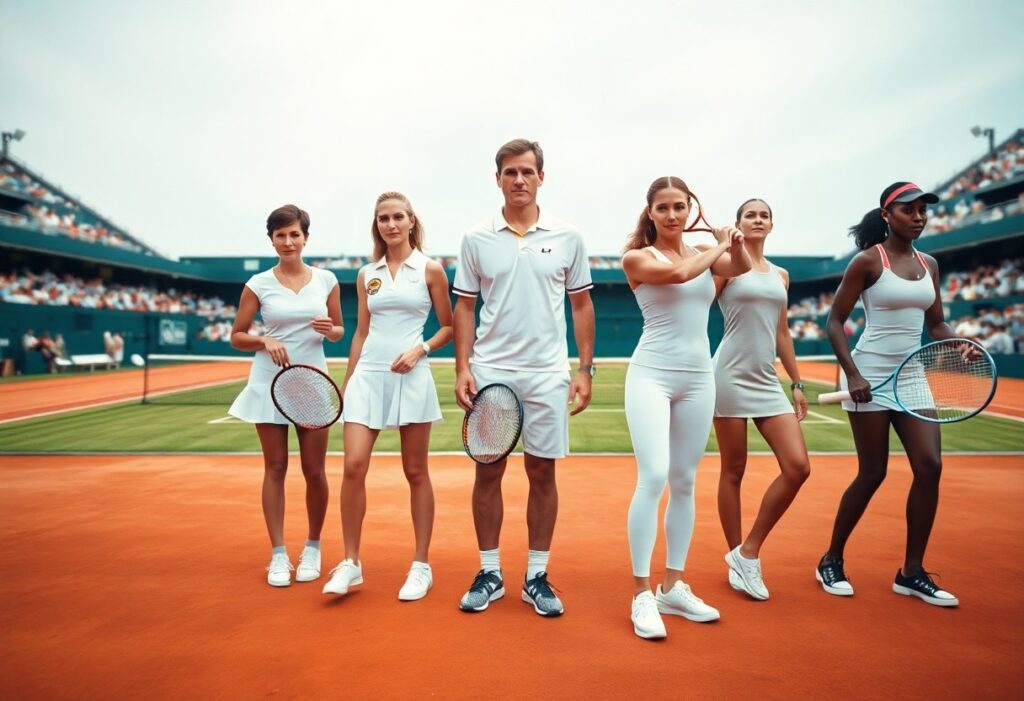

Tennis has transformed through bold champions who introduced new strokes, strategies and equipment, shifting both play and training. This guide traces innovations like power serves, the two-handed backhand, aggressive serve-and-volley tactics, and advances in racket technology, alongside the risk-taking that raised injury concerns and the lasting legacy that shaped coaching, analytics and global fandom.
Types of Famous Tennis Players
Styles split into distinct archetypes that reshaped tactics: aggressive servers who shorten points, baseline grinders who construct rallies, serve-and-volley exponents who dominated grass, all-court tacticians mixing spins and slices, and counterpunchers who turn defense into offense. Examples include players who changed scoring patterns and surface dominance across eras, with equipment and sports science amplifying these roles. Strategic matchups often dictate outcomes.
- Aggressive Servers
- Baseline Masters
- Serve-and-Volleyers
- All-Court Players
- Counterpunchers
| Aggressive Servers | Examples: Sampras, Isner – impact: shorter points, decisive tiebreak records and high ace counts per match. |
| Baseline Masters | Examples: Djokovic, Nadal – impact: dominant from the backcourt, extended rallies, superior return statistics. |
| Serve-and-Volleyers | Examples: Laver, Becker – impact: grass-court success, high net-point win percentages. |
| All-Court Players | Examples: Federer, Agassi – impact: versatile shot repertoire, success across surfaces and tactical adaptability. |
| Counterpunchers | Examples: Hewitt, Soderling – impact: defensive resilience, turning opponent aggression into errors. |
Legends of the Game
Players like Rod Laver (two calendar Grand Slams in 1962 and 1969), Björn Borg (11 major titles including six French Opens and five Wimbledons), and Pete Sampras (14 Grand Slams) rewired tactics: serve-and-volley precision, ironclad mental games, and surface specialization that defined decades and set statistical benchmarks for match-winning patterns.
Modern Icons
Contemporary figures such as Novak Djokovic (24 majors), Rafael Nadal (14 Roland Garros titles), and Serena Williams (23 singles majors) pushed athleticism, recovery science, and data-driven preparation, producing longer rallies, improved return percentages, and era-defining head-to-head records on tour.
Training innovations now combine GPS-monitored conditioning, targeted nutrition, and video analytics; Djokovic’s unparalleled flexibility and return stats, Nadal’s clay-court dominance with a record run at Roland Garros, and Alcaraz becoming the youngest world No.1 at 19 after his 2022 US Open win illustrate technical and physiological shifts. Matches like the 2012 Wimbledon final (Nadal vs Djokovic, 5h53m) highlight endurance evolution. Knowing, these modern trends force coaches to prioritize recovery, biomechanics, and match-specific analytics when developing future champions.
Key Factors That Changed Tennis
Several interlocking forces-player athleticism, equipment advances, surfaces and officiating-reshaped tactics and outcomes; graphite rackets and polyester strings increased power and spin, while sports science raised fitness and recovery standards. Examples include the 1980s racket revolution and mid-2000s challenge systems. Recognizing how these elements combined explains why modern players must mix power, endurance and precision.
- Racket technology
- String innovations
- Sports science & fitness
- Surfaces & court speed
- Officiating & analytics
Evolution of Playing Styles
Serve-and-volley prominence through the 1980s (Becker, Edberg) gave way to baseline power in the 1990s-2000s (Agassi, Courier), then to heavy-topspin and all-court mastery (Nadal, Federer, Djokovic). Equipment and string changes amplified spin and pace, increasing rally intensity and forcing players to develop superior movement, endurance and shot tolerances to succeed at Slams and hard-court tours.
Technological Advancements
Graphite and composite frames in the 1980s boosted ball speed, while polyester strings in the 2000s multiplied spin potential and reduced dwell time; these shifts changed stroke mechanics and point construction. The mid-2000s arrival of Hawk-Eye and electronic review systems altered pressure moments, and modern sports science-load monitoring and biomechanics-optimized training but also highlighted increased injury risk from higher forces.
Digging deeper, polyester fibers allow players to routinely generate very high spin on forehands and serves-often exceeding 3,000 RPM on heavy shots-leading to steeper bounce and new tactical patterns. Challenge systems improved fairness and introduced tactical usage of reviews, while analytics platforms track shot depth, spin and conditioning metrics so teams can tailor drills, periodize schedules and manage recovery to extend careers and reduce acute overload.
Tips for Aspiring Tennis Players
Sharpen footwork, consistency on the serve, and tactical patterns by adopting targeted drills: 30-45 minute intensity blocks, weekly match play twice, and video review after every session. Schedule two full rest days to reduce risk of overuse injuries, and add strength work to protect the shoulder and knees. Thou combine disciplined repetition, measurable goals, and deliberate recovery to accelerate improvement.
- Drills: short-court footwork, serve-targeting, and 3-ball feeding for patterns
- Fitness: two strength sessions/week, one sprint session, mobility work
- Match-play: at least 2 competitive matches weekly, analyze 30-60s video clips
- Mental: pre-serve routines and breathing; use pressure simulations in practice
Learning from the Greats
Study champions’ habits directly: observe Federer’s variety and court positioning, Nadal’s heavy topspin and left-handed angles, and Djokovic’s elite return depth. Emulate specific drills-Federer-style slice practice for 10 minutes/day, Nadal-pattern forehand repetitions, and Djokovic return drills focused on depth and timing. Use match case studies like Nadal’s 2008 Wimbledon endurance or Djokovic’s 2019 return mastery to inform tactical adjustments and measurable goals.
Developing a Unique Style
Blend learned elements into a personal game by testing one major change per month: pair a big serve with selective net approaches or build a counterpunch baseline plan. Prioritize strengths-speed, power, touch-and hide gaps through positioning and shot selection; refine a signature weapon such as a kick serve or angled backhand to define your style on court.
Build signature elements with targeted reps: 100-200 focused serves twice weekly, 150 approach-shot repetitions per week, and 20 live-point scenarios emphasizing your chosen pattern. Analyze case studies-Pete Sampras’s serve-and-volley, Steffi Graf’s inside-out forehand, Ash Barty’s slice and variety-to see how distinct traits won matches. Track metrics like first-serve win % and forced-error rates to decide which traits to keep, adapt, or drop.
Step-by-Step Guide to Improving Your Game
Progress through five focused steps: assess weaknesses with match stats, build footwork and conditioning, isolate strokes in 20-30 minute technical blocks, simulate pressure with match-play sets, and review video to track improvements. Emphasize measurable goals-improve first-serve percentage by 10 points or reduce unforced errors by 25%-and use 4-6 week cycles to solidify gains.
| Step | Action |
|---|---|
| Assessment | Collect match stats (1st serve %, winners/unforced errors) and 2-3 video clips for analysis. |
| Technique | 20-30 min stroke blocks: 200 reps/week per key shot; include targeted drills. |
| Footwork | Daily ladder/agility work: 10-15 minutes, plus 4 court-movement drills twice weekly. |
| Fitness | HIIT sprints (10×30s) 2-3×/week, strength 2×/week, mobility daily. |
| Match Simulation | Play 2 competitive sets twice weekly, practice pressure points (break points, serve-and-hold scenarios). |
Techniques to Master
Focus on a heavy topspin forehand for depth, a compact slice backhand to change pace, and a dependable kick serve for high-bounce returns; aim for structured practice-about 200 reps weekly per priority shot-and study patterns from pros like Nadal’s topspin depth and Federer’s serve placement to translate technique into tactical advantage.
Training Regimens
Combine on-court skill work 4×/week with strength 2×/week and HIIT sprints 3×/week; a typical microcycle: four 90‑minute court sessions, two 45-60 minute gym sessions, one recovery day. Monitor load with session RPE, increase volume by ~10% across three-week blocks, then deload to avoid plateau.
Implement periodization across a 12‑week mesocycle divided into 4‑week blocks-accumulation (volume), intensification (power/speed), and peaking (match simulation). Prioritize daily mobility and soft‑tissue work, target 8-9 hours sleep, and include recovery methods (contrast baths, compression) to reduce risk of overuse injuries while maximizing performance gains.
Pros and Cons of Following Famous Players
| Pros | Cons |
|---|---|
| Clear tactical blueprints-patterns like Djokovic’s return depth and Federer’s serve + forehand control. | One-size-fits-all risk-pro tactics may not suit smaller or less athletic players. |
| Technique models to study (e.g., Federer’s footwork and single-handed timing). | Copying mechanics can create bad habits if physiology differs. |
| Proven practice routines-structured stamina work used by top players for 4-6 days/week. | Overtraining and higher injury chance when intensity is matched without periodization. |
| Mental approaches-examples include Djokovic’s breathing and focus rituals under pressure. | Unrealistic mental expectations can cause burnout and anxiety in juniors. |
| Benchmark metrics-serve speeds, first-serve % and return stats provide measurable goals. | Obsession with stats leads to neglecting feel, court sense and creativity. |
| Surface-specific adaptations-Nadal’s heavy topspin on clay offers a clear model. | Misapplying surface tactics (e.g., flat strokes on slow clay) reduces effectiveness. |
| Career-management lessons-scheduling, recovery and smart tournament selection. | Commercial and media pressure from mimicking pros’ public lives can distract development. |
| Motivation and aspiration-seeing elite standards raises practice intensity and focus. | Constant comparison can damage confidence and alter long-term goals. |
Benefits of Learning from the Best
Studying elite players accelerates progress by providing concrete examples: copy Federer’s footwork drills to improve balance, adopt Nadal-style topspin patterns for higher margin on clay, or analyze Djokovic’s return positioning to increase break-point chances. Using match data-serve speeds, first-serve % and rally lengths-lets players set measurable targets and shave months off trial-and-error development, with clear drills that translate directly into match wins.
Potential Pitfalls
Following stars blindly risks injury, poor technique transfer and skewed priorities: juniors imitating pros’ power without strength adaptation often suffer shoulder or elbow problems, while obsessing over stats can undermine tactical creativity and court sense. Pressure to match visible success also fuels anxiety and early burnout.
Deeper problems arise when imitation replaces adaptation: for example, a young player copying a flat, low-bounce serve model on clay will see spike in unforced errors and fewer service winners. Coaches should quantify changes-track serve velocity and placement, increase load by no more than 5-10% per month, and run regular movement screenings. Combining observation with tailored conditioning, periodized workloads and coach-led biomechanical tweaks mitigates most risks and preserves long-term development.
The Impact of Famous Players on Tennis Culture
Across eras, iconic champions rewired norms: Billie Jean King’s 1973 Battle of the Sexes accelerated gender equity in prize distribution, Serena Williams’s 23 Grand Slams broadened representation and community investment, and Federer/Nadal/Djokovic’s rivalries globalized fandom and broadcast reach. Academies in Spain and the U.S. expanded after player-led demand, while commercialization produced multi-million-dollar endorsement ecosystems and increased pressure that raises injury and burnout risks for young prospects.
Inspiring Future Generations
Emma Raducanu’s 2021 US Open breakthrough at 18 and Naomi Osaka’s four major titles show how single runs spark junior enrollment surges and diversify role models; national federations report growth in girls’ programs and scholarship funds tied to star visibility. At the same time, coaches note intensified early specialization and mental-health strain among teens, making mentorship and load management central to converting inspiration into sustainable careers.
Changes in Popularity and Marketability
Television and social platforms turned top players into global brands: Grand Slams now offer total purses in the tens of millions, while top athletes attract multi-million-dollar sponsorships and stadium crowds in the tens of thousands. Broadcasters leverage rivalries for ratings spikes, and federations monetize star power through exhibition tours, licensing, and youth camps that drive grassroots participation and corporate investment.
Case studies underline the shift: Roger Federer’s 2018 apparel deal with Uniqlo, reported near $300 million, exemplifies direct commercial valuation of player image, and Serena’s long-term endorsement portfolio helped fund community initiatives. Digital sponsorships and content deals now supplement prize earnings, yet this market focus also pushes condensed schedules and high-stakes promotion, increasing the risk of overuse injuries and calendar burnout for elite players.
Summing up
Taking this into account, the evolution from early pioneers to modern champions demonstrates how technical innovation, strategic adaptation, athleticism, and cultural influence reshaped tennis; equipment advances, novel shot-making, training methods, and boundary-breaking personalities collectively expanded the sport’s tactics, reach, and professionalism, establishing precedents that continue to inform coaching, competition, and the game’s global appeal.
FAQ
Q: How did early champions and organizers set the foundation for today’s tennis styles and professional structure?
A: Early champions like Suzanne Lenglen, Bill Tilden and later Rod Laver helped popularize tennis beyond a leisure pastime by demonstrating new levels of athleticism, shotcraft and international competition. Administrators and players pushed for the Open Era in 1968, which unified amateur and professional circuits and created the modern tour structure (rankings, consistent prize money and year-round events). Billie Jean King and other pioneers founded and expanded the women’s tour, fought for better pay and visibility, and altered the sport’s commercial and social landscape. Those combined changes turned tennis into a global, professional sport where coaching, sponsorships and media exposure shaped how players trained and competed.
Q: In what ways have equipment and training innovations, many driven by top players, changed on-court tactics?
A: The switch from wooden rackets to graphite and composite frames in the 1970s-90s increased racket head size and power, enabling heavier topspin and more penetrating serves; polyester strings later amplified spin potential. Players adjusted: serve-and-volley declined as powerful, spin-heavy groundstrokes allowed baseliners to dictate rallies; open-stance hitting and two-handed backhands became widespread because they offer greater stability and drive for modern rackets. Off-court, figures like Ivan Lendl professionalized training-introducing year-round strength and conditioning, periodized practice, nutrition and sports science-which improved endurance and recovery and made longer, high-intensity baseline exchanges the new norm. Analytics and video coaching further refined tactics, helping players exploit opponents’ patterns and return tendencies.
Q: How have contemporary stars-Federer, Nadal, Djokovic, Serena and others-reshaped playing styles, preparation and tennis culture?
A: Roger Federer popularized fluid all-court offense and shot variety, influencing players to combine elegant point construction with aggression. Rafael Nadal’s extreme topspin, lefty angles and unmatched physicality forced opponents to adapt to heavy, high-bouncing forehands and superior defense; he also showed the value of specialized preparation for surface-specific success. Novak Djokovic redefined elite movement, flexibility and return excellence, proving that defending and counterpunching can consistently win major titles. Serena Williams brought unprecedented power, athletic explosiveness and uncompromising serve-dominance to the women’s game, accelerating the sport’s physical evolution. Collectively these champions changed coaching priorities (movement, strength, recovery), elevated global interest, and inspired a generation to blend technique, tactics and elite fitness-while also influencing scheduling, commercial models and how national federations invest in player development.