
You can transform your serve by adopting resilient players’ methods: prioritize a consistent toss and compact motion, build a strong core and leg drive for power and placement, and practice progressive overload while protecting the shoulder to avoid overuse injuries. Emphasize rhythm, targeted drills, and pressure-replication to develop reliable technique under match stress.
Types of Resilient Tennis Techniques
Blend technical elements like the first serve, kick serve, and compact wing-span toss with tactical habits-practice 50 targeted serves and simulate 2-on-1 return pressure to force adaptation. Use timed drills (30-60s intervals) and measurable markers such as serve speed and % of in-targets to track progress. Thou prioritize high-intensity repetition plus recovery to convert practice stress into match resilience.
| Serve Type | Drill / Benefit |
| Flat serve | Power sets: 3×10 max-effort serves to improve velocity |
| Kick serve | Topspin toss drills: 4×12 to increase margin and second-serve safety |
| Slice serve | Wide-angle targets: 5×8 to open the court for the next shot |
| Spin placement | Target boxes: 6 rounds of 10 to train consistency under pressure |
| Footwork & balance | Split-step timing + 3x30s balance holds to stabilize toss-to-racket transfer |
- Mental toughness-pressure simulations, visualization (10 min/day)
- Physical conditioning-2-3 sessions/week focused on rotational power
- Routine consistency-pre-serve cues and 5-step checklists
- Data tracking-log serve % in/out and average speed each week
Mental Toughness Strategies
Practice structured pressure: play simulated tiebreaks and force-play points with a target of 20 high-pressure serves per session, pair with breathing routines (box breathing 4-4-4-4) and 10-minute visualization of successful points. Use short-term goals (reduce double faults by 30% over six weeks) and measurable feedback to reframe setbacks as data, and include a pre-serve micro-routine to anchor focus.
Physical Conditioning Methods
Emphasize rotational power, explosive legs, and shoulder durability via 2-3 weekly sessions combining plyometrics, medicine-ball throws, and resistance band shoulder work; aim for 6-8 week blocks with progressive overload and 30-45 minute sessions to translate strength gains into increased serve consistency and speed.
Implement concrete exercises: medicine-ball rotational throws 3×10, single-leg Romanian deadlifts 3×8 each leg, lateral bounds 3×6, and resisted sprint intervals 10x20m with 20s rest. Monitor load-progress by 5-10% volume every 2 weeks-and include scapular stability work (face pulls 3×15) to reduce injury risk; consult a coach for periodization and technique to ensure safe power gains.
Tips for Enhancing Your Serve
Small, targeted changes deliver measurable serve gains: tighten your toss, synchronize legs and shoulder turn, and reduce wasted motion. Short, focused sessions of 20-30 minutes on a single element-like toss consistency or leg drive-produce faster improvement than unfocused hours. Aim for a repeatable toss height (about 1.8-2.0 m above the court) and avoid tossing too far forward. The single best habit is a reliable toss routine repeated for 100-200 reps per session.
- Serve toss
- Grip
- Stance
- Timing
- Rhythm
- Leg drive
- Shoulder rotation
Grip and Stance Adjustments
Switch to a slightly modified continental grip to improve pronation and topspin-shift one bevel toward continental if you currently use an eastern. Place feet at 10-20° open for kick serves or 5-10° closed for flatter first serves, keeping roughly 60% weight on the back leg before launch. Keep the racket-holding hand relaxed; excess tension reduces racket head speed and elevates elbow stress.
Timing and Rhythm Improvement
Use count-based drills and a metronome to lock timing: practice a 3-count toss (1-2-launch) or set a metronome at 60-72 BPM to sync leg drive with shoulder coil. Target contact about 0.2-0.4 s after toss peak and include a 0.2 s split-step for quicker recovery and improved readiness.
Drill examples: shadow-serve 50-100 reps focusing solely on the launch tempo, then run “10-serve rhythm sets”-10 serves at one cadence with 30 s rest. Film at 120-240 fps to analyze toss-to-contact delay, adjust until consistency reaches 80-90% within an hour of focused practice; many club players report a 5-10% bump in first-serve percentage after six weeks of metronome-based training.
Step-by-Step Guide to Perfecting Your Serve
| Step | Focus & Cues |
|---|---|
| Setup | Stance width ~ shoulder to 1.5× shoulder; grip continental; eyes on toss pocket. |
| Toss | Toss slightly in front, ~30-36″ (76-91 cm) peak; consistent release point. |
| Trophy & Loading | Turn shoulders 70-90°; knee bend 30-45° to load legs and hips. |
| Acceleration & Contact | Explosive leg drive, full shoulder rotation, pronate through contact; aim in front of lead foot. |
| Follow-through | Finish across body for slice/flat; complete extension for kick; control deceleration to protect shoulder. |
| Practice Plan | 60-100 focused serves/session; mix technical reps, power sets, and match-sim pressure drills. |
Basics of Serve Mechanics
Efficient serves marry a consistent toss with coordinated lower-body drive and shoulder rotation: set the toss ~30-36 inches high and slightly ahead so contact occurs just in front of the lead foot, load hips via a 30-45° knee bend, and rotate shoulders ~80° into the trophy position. Strong pronation through impact creates spin and speed; avoid wrist hyperextension and over-rotating the lumbar spine, which can cause shoulder or back injury. Many coaches track racquet-head speed to measure progress.
Progressive Drills to Implement
Begin with shadow swings (50 reps), advance to toss-only reps (30-50), then serve-to-target: 5 sets of 8 serves focusing on T, wide, and body. Add power sets of 3×10 at near-match intensity and finish with pressure games (first-serve points, 2 sets of 10). Maintain 60-100 quality serves per session, and stop if fatigue degrades form to avoid injury risk.
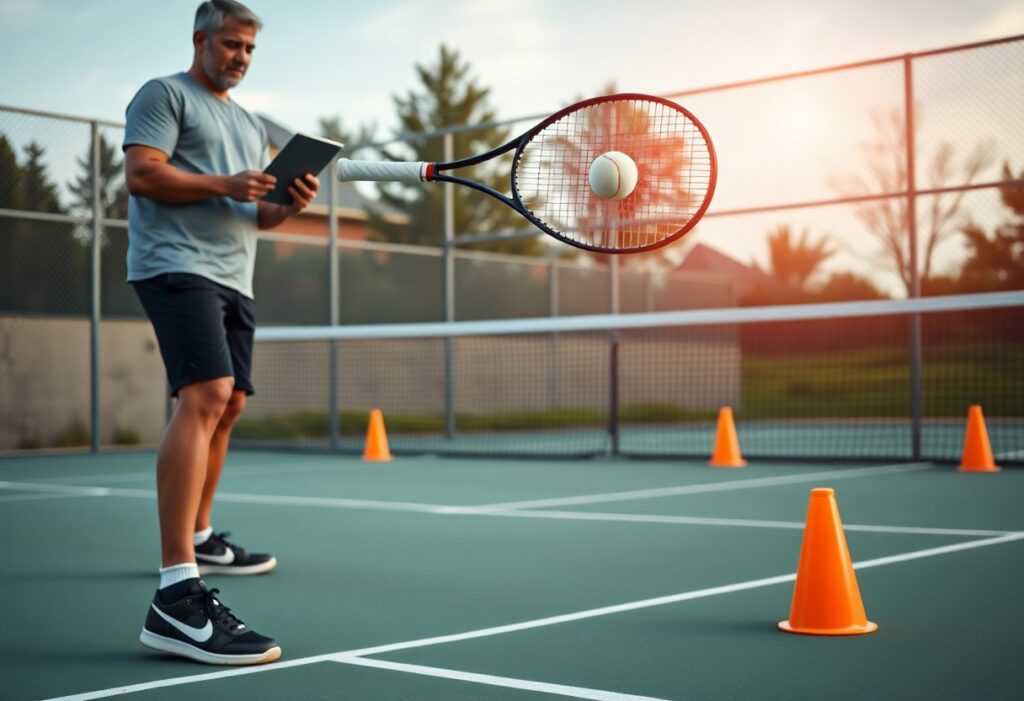
Structure the progression over 4-6 weeks: weeks 1-2 emphasize mechanics and tempo (video every 10th rep), weeks 3-4 add velocity and placement drills with a radar or smartphone app to track speed (+2-5 km/h gains are common), weeks 5-6 simulate match pressure and analyze first-serve percentage. Use cones at 1 m diameter for targets, log outcomes, and adjust toss by 1-2 inches when consistency falls below 70% in a set.
Factors Affecting Serve Performance
Several interconnected elements shape a successful serve: mechanics, timing, environmental shifts and the player’s mental state; for example a 120 mph service demands millimeter-precise toss placement and hip-shoulder separation. Coaches in resilient programs measure serve variance across conditions and drill adaptability with targeted reps. Resilience comes from practicing under stress and changing inputs-toss, grip, and stance-so you can adjust on the fly. The interaction of these variables demands targeted practice and adaptation.
- Wind and cross-court gusts
- Altitude and air density
- Court surface (clay vs grass vs hard)
- Player psychology and match pressure
- Temperature and humidity
Environmental Conditions
Wind of 10-20 km/h can shift trajectory enough to turn an ace into a fault; at higher altitude (e.g., Denver ~1,600 m) players report serves carry about 2-4% faster due to reduced air density. Hot, dry air reduces drag and increases pace, while humidity and cold slow the ball and amplify spin. Clay courts absorb speed and enhance bounce, grass produces low skids-so adjust toss depth, spin rate and aiming targets when conditions change, especially under strong crosswinds.
Player Psychology
Anxiety and pressure routinely reduce first-serve percentage by roughly 5-10% in high-leverage points, shortening the swing and increasing double-fault risk. Resilient players use consistent pre-serve routines, cue words and visualization to anchor mechanics and target choice; these mental habits preserve tempo and reduce rushed tosses, which often cause service breakdowns. Pressure management separates repeatable servers from volatile ones.
Practical methods include a fixed pre-serve routine (3-4 ball bounces, breath pattern), simulated pressure drills (point penalties for missed serves) and micro-goals (target quadrant rather than ace). Combining routine with progressive exposure-start with low stakes, add consequences-builds tolerance; several touring pros credit simple rhythms and short breathing cycles for stabilizing serve accuracy under match stress, a strong technique for building long-term resilience.
Pros and Cons of Various Techniques
Distilling techniques into trade-offs lets you select what fits your game and body: adopting a high-kick serve can boost margin and second-serve security, while shortening the backswing improves repeatability but may cost top-end speed; use data-driven practice-track serve placement and velocity-to judge what to keep or drop.
| Pros | Cons |
|---|---|
| Higher margin over net and increased spin control | Timing-sensitive; can reduce raw pace by ~5-10% |
| Kick/topspin gives safer second serves and higher bounce | Lower ace potential compared with flat serves |
| Slice creates wide angles and forces weak returns | Predictable on some surfaces; less effective on high-bounce courts |
| Continental grip enables variety (slice, kick, flat) | Steep learning curve for players used to eastern grips |
| Shorter backswing improves consistency and repeatability | May cap maximum serve speed for taller, more powerful players |
| Strong leg drive increases serve velocity and stability | Places greater load on knees and hips if technique is poor |
| Structured toss and pre-serve routine boosts accuracy | Can become rigid under pressure without variability training |
| Mixing patterns keeps opponents off-balance; match data shows 70-80% success with planned sequences | Requires consistent practice to hit target percentages in matches |
| Injury-prevention drills lower chronic load and improve recovery | Consume time that might otherwise be spent on pure serve reps |
Benefits of Resilient Techniques
Implementing resilient techniques yields measurable gains: many coaches report a 5-15% uptick in first-serve consistency and fewer unforced errors after six weeks of focused work, while targeted shoulder and core conditioning reduces serve-related pain and speeds return-to-play, improving match availability over a season.
Potential Drawbacks to Consider
Adapting techniques can temporarily lower serve speed or create timing issues; novices often see a dip in ace rate and need 4-8 weeks to rebuild power, and improper progression risks overuse injuries-particularly to the shoulder and elbow-if volume isn’t monitored.
Mitigation strategies include phased load increases, limiting high-intensity serving to 2-3 sessions per week during transition, and using monitoring metrics (RPE, ball speed, shoulder soreness). Consulting a coach or physiotherapist and logging serve reps helps avoid setbacks and keeps improvements sustainable.
Common Mistakes to Avoid
Technical Errors
Common technical errors that kill serve consistency include a low or inconsistent toss that forces a rushed swing, an early racket drop that robs power, and collapsing legs that shift strain into the shoulder, increasing risk of overuse injury. For example, a collegiate player cut faults from 8 to 2 per match after raising the toss about 6 cm and keeping weight on the back leg longer; drill: 50 practice tosses aimed at a 6 cm target above your usual release point.
Mental Pitfalls
Anxiety and overanalysis shrink serve effectiveness: rushing between points or overthinking mechanics on critical points often spikes error rates, especially on the second serve. Pros commonly use a 5-7 second pre-serve routine to reset focus; in practice, simulate 20 pressure serves and log how many second-serve faults occur to identify patterns.
Train mental resilience with specific, repeatable cues: use a two-breath reset, visualize toss and contact for 3-5 seconds, and adopt a single-word trigger like “smooth.” Coaches who run pressure simulations (e.g., 10 serves from 30-40 with crowd noise) report players noticeably lower second-serve faults and raise first-serve percentage; prioritize pressure simulations, visualization, and controlled breathing in warmups.
To wrap up
Now integrate resilient players’ techniques-consistent deliberate practice, progressive overload, varied pressure drills, and focused recovery-into serve training to build technical soundness and mental toughness. Refine toss, leg drive, shoulder rotation and timing through video feedback and situational reps, and use breathing and routine cues to maintain composure under pressure for more reliable, powerful serves.
FAQ
Q: How do resilient players build a consistent toss and rhythm to improve serve accuracy?
A: Start by isolating the toss in slow, repeated reps until it lands in the same pocket every time; use a marked spot or cone to train placement. Combine a stable toss with a compact, repeatable pre-serve sequence-feet set, grip check, breath out-so the body moves from the same starting position each time. Work on kinetic chain sequencing: generate power from a loaded knee bend and hip rotation, transfer through a strong core and shoulder external rotation, then time wrist pronation at contact for spin and control. Drills that help: toss-only practice without swinging, toss-plus-swing at half speed, and target serving with cones or towel zones to enforce accuracy. Video feedback and slow-motion review help detect toss drift or early extension; address those with focused micro-reps until the rhythm is automatic.
Q: What mental-resilience techniques do top players use to serve effectively under pressure?
A: Develop a concise pre-serve routine that cues focus and calms the autonomic response: a fixed number of deep breaths, a visual target, and a single short phrase or trigger to reset attention. Practice under simulated pressure-scoreboard drills, small-stakes bets, serving after losing a point-to condition responses so nervousness produces a familiar routine rather than panic. Use micro-goals (e.g., “get toss in pocket” or “finish toss in two seconds”) and process-focused self-talk to shift attention from outcome to execution. Build tolerance for errors by deliberately practicing missed serves followed immediately by repetition and adjustment; this reduces fear of failure and increases adaptive problem-solving mid-match.
Q: How should I structure training, conditioning, and recovery to increase serve speed and reliability over time?
A: Periodize practice with blocks devoted to technique, explosive power, and match simulation. Technique blocks emphasize high-quality, low-fatigue repetitions (toss, contact point, pronation) and video review. Power blocks add plyometrics, medicine-ball rotational throws, and Olympic-lift variations to increase hip and shoulder drive; integrate progressive overload for legs and core while preserving shoulder health. Include mobility and rotator-cuff strengthening daily, and schedule deliberate recovery-sleep, nutrition, contrast therapy, and active-rest days-to prevent breakdowns. Track metrics (radar speed, placement accuracy, first-serve percentage) and use mixed practice (randomized targets and pressure scenarios) to transfer gains to match play. Balance intensity so quality repetitions outnumber fatigued ones; prioritize technique and recovery when speed increases start degrading form.