
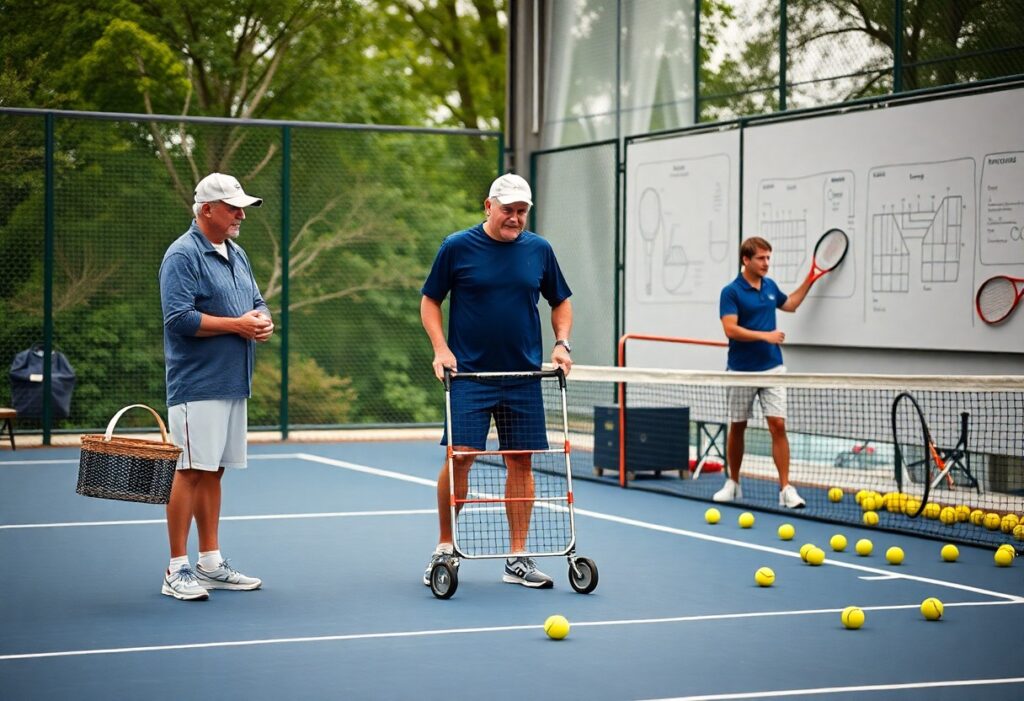

Many top coaches have built distinct methodologies that shape champions, and this guide surveys their approaches to technical fundamentals, fitness, and strategy while explaining how emphasis on repetition and feedback creates reliable results. It contrasts philosophies that prioritize power or finesse, warns about overtraining and injury risk, and celebrates proven practices like mental resilience and tactical clarity that elevate performance across levels.
Types of Famous Tennis Coaches
| Traditional | Technique-first mentors who emphasize repetition, footwork and on-court drills; examples include Nick Bollettieri (academy founded 1978) and long-term personal coaches who shape basics over years. |
| Modern | Data- and science-driven teams using video analysis, GPS, and periodized conditioning; often integrate sports scientists and analysts into daily planning. |
| Technical Specialist | Stroke or serve experts hired for short, intensive camps to fix biomechanical flaws and add weapons to a player’s arsenal. |
| Sports Scientist | Physios, strength coaches and statisticians who monitor load, recovery and match metrics to reduce injury risk and optimize performance. |
| Player‑Mentor | Former pros turned coaches focusing on psychology, match tactics and career management; they often guide players through high‑pressure decisions. |
- Traditional
- Modern
- Technical Specialist
- Sports Scientist
- Player‑Mentor
Traditional Coaches
Often centered on high-volume on-court work, traditional coaches prioritize stroke mechanics, repetition and court positioning; for instance, academies in the 1980s produced multiple top-10 players by enforcing daily 20-30 hour weekly training blocks and live-ball drills, which can yield rapid technical gains but also raise concerns about overuse injuries when load isn’t managed.
Modern Coaches
Today’s modern coaches blend analytics, individualized conditioning and tactical periodization, using match stats (first-serve %, break-point conversion) and video tools to tailor sessions; teams around elite players commonly include 3-5 specialists to cover fitness, strategy and recovery, producing measurable improvements in match consistency.
Further detail: many modern setups run weekly microcycles based on GPS load and heart-rate variability, adjust practice intensity by objective metrics, and employ instant video breakdowns to change technique within days-this approach increases precision and can lower long-term wear if coordinated well, but mismanaged technology dependence may create blind spots in on-court intuition and raise performance risk.
Assume that many top coaches combine elements from multiple types to fit a player’s physical profile, career stage and surface schedule.
Signature Training Philosophies
Coaches differ sharply: some prioritize relentless physical repetition and technical drilling, while others emphasize strategic patterning and situational sparring. Bollettieri’s Bradenton academy (opened 1978) produced top pros such as Andre Agassi and Monica Seles, Toni Nadal built Rafael Nadal’s heavy-topspin forehand through repetitive drills, and Ivan Lendl insisted on elite conditioning and match-scenario practice. Modern programs blend analytics, periodized fitness and on-court patterning to ensure technique survives real-match pressure.
Technical Focus
Many coaches structure sessions around component drills-serve placement, split-step timing and a low-to-high swing path for topspin. Players often complete 200-400 repetitions per stroke in focused blocks; Toni Nadal’s forehand work and Bollettieri’s serve-series drills exemplify this. Trainers layer biomechanical cues, video feedback and progressive overload to convert groove into power, while warning that persistent bad mechanics increases injury risk if unchecked.
Mental Conditioning
Mental work separates winners in tight matches: visualization, pre-point routines, breathing exercises and pressure simulation are standard. Patrick Mouratoglou runs scenario-based drills like simulated third-set tie-breaks, and Novak Djokovic emphasizes mindfulness and controlled breathing before key points. Coaches stress consistent pre-point rituals and visualization to improve clutch execution and reduce unforced errors under stress.
Deeper protocols use measurable drills-timed tie-break simulations (often 5-10 per session), 3-10 minute guided visualizations of specific rally patterns, and biofeedback or heart-rate monitoring to practice down-regulation. Micro-goals (win the next two points, hit a target zone) and video review train decision scripts, making stress responses predictable and turning match pressure into a practiced skill.
Step-by-Step Training Approaches
Progressive schedules move from foundation to competition: a 12-week macrocycle splits into 3×4-week mesocycles-foundation (footwork, endurance), skill (technique, 30-45 minute technical blocks), and tactical (match simulation, point-play). Coaches commonly apply a 5:1 drill-to-match ratio during skill weeks and high-intensity 2-week peaking immediately before events to maximize readiness while minimizing injury risk.
Training Phases
| Phase | Focus |
|---|---|
| Foundation | Footwork, conditioning – 3 sessions/week, interval runs, agility ladders |
| Skill | Technique, repetition – 30-45 min blocks, 5-ball feeds, video analysis |
| Tactical | Point patterns, serve placement – situational drills, match simulation |
| Peak | Match intensity – 2-week taper, simulated matches at ~90% intensity |
Skill Development
Three weekly technical sessions emphasize stroke mechanics and consistency: 30-45 minute focused blocks with 5-ball feeding, shadow swings, and slow-motion video review. Performance is tracked with objective targets-such as 80% rally consistency over 50 balls on the forehand-and coaches adjust swing path, contact point, or footwork sequencing based on those metrics.
Game Strategy
Match planning draws on pattern analysis and statistics: chart opponent tendencies, prioritize first-serve percentage above 65%, and design plays to exploit recurring weaknesses (for example, attacking a weak backhand on 60% of return plays). Teams usually prepare two primary tactical plans plus a fallback, enabling on-the-fly shifts driven by point-by-point data.
More tactical work involves 15-minute scenario drills, 5-point pressure sequences, and simulated tiebreaks; one weekly session should be opponent-specific. Integrate GPS and heart-rate data to manage pacing, rehearse on-court signals for in-match changes, and monitor load because overtraining during tactical prep risks fatigue and tactical collapse.
Key Factors Influencing Training Success
Success depends on integrated attention to technique, conditioning, tactical awareness, mental resilience, and recovery protocols. Elite setups often prescribe 12-20 hours/week on-court plus 4-8 hours of gym and recovery work, and use GPS, heart-rate variability and stroke analytics to align load with readiness. Coaches adjust periodization around slams and heat; equipment tweaks like string tension matter at altitude. Any top program limits overtraining by scheduling at least one full rest day per week and tracking sleep and soreness.
- Technique – biomechanics, video analysis for stroke repeatability
- Conditioning – on-court hours, strength, power and agility metrics
- Tactical awareness – match-situation drills, point-construction percentages
- Mental resilience – routines, sports psychology interventions
- Recovery – sleep (8-9 hours), nutrition, active recovery
- Environment – surface, altitude, temperature, facility quality
Player’s Role
Players must execute the plan daily: follow the periodized program, log soreness and sleep, and apply coach feedback in training. Many pros aim for 8-9 hours sleep and 12-20 hours/week on-court before slams, while tracking nutrition (≈1.6 g/kg protein) and hydration. Self-assessment tools-session RPE, mood scores, sleep logs-help players modulate intensity and preserve soft tissue health while maintaining competitive sharpness.
Environmental Considerations
Surface and climate shape practice content: clay increases sliding and rally length, hardcourts raise impact forces, and grass shortens points. Altitude effects are noticeable-cities above 1,500 m speed the ball (Mexico City ~2,240 m), often prompting a 1-2 lb reduction in string tension. Heat above 32°C elevates metabolic strain and risk of heat illness, so teams use cooling strategies and adjust session timing.
Operationally, teams arrive 7-14 days early for altitude or hot-weather events to acclimate, reduce high-intensity load by roughly 20-30% during initial days, and monitor hydration with urine specific gravity or body-mass changes. Equipment decisions-altering string tension or shoe choice-are data-driven; for a clay swing, coaches often add sliding drills and eccentric hamstring work to lower soft-tissue injury risk, while indoor climate control and targeted recovery protocols mitigate environmental stressors.
Pros and Cons of Different Coaching Styles
| Pros | Cons |
|---|---|
| Clear structure and fast technical corrections, useful in short-term performance cycles. | Can suppress player autonomy and increase risk of psychological burnout. |
| Builds decision-making and buy-in, improves in-match adaptability through player-led practice. | Slower to implement change; inconsistent outcomes if player lacks discipline. |
| Fixes mechanics and reduces unforced errors with focused drills and repetition. | May neglect tactical awareness and match-situation application. |
| Enhances point construction and match wins by emphasizing patterns and scouting. | Risk of overfitting to specific opponents and limiting creativity. |
| Improves endurance, recovery, and injury prevention when periodized correctly. | Overtraining and reduced technical practice time if load isn’t managed. |
| Data-driven insights enable measurable progress and targeted interventions. | Can produce information overload and miss intangibles like confidence. |
| Addresses sleep, nutrition, and mindset-supports long-term career sustainability. | Requires more resources and multidisciplinary staff to implement well. |
| Long-term youth programs build solid technical foundations and motor patterns. | Slow ROI and increased risk of early specialization injuries if unchecked. |
Advantages
Many top programs combine styles to amplify strengths: technical work fixes strokes, tactical sessions improve point construction, and fitness blocks extend match longevity. For example, academies that use 6-12 week periodized cycles often produce faster measurable gains in serve and footwork. Coaches who integrate data with on-court drills and emphasize recovery tend to prolong careers and reduce injury incidence among elite juniors.
Disadvantages
However, leaning too far toward one approach creates trade-offs: autocratic methods can erode strategic thinking, analytics-heavy regimes may cause decision paralysis, and fitness-dominant programs can leave tactical deficiencies. Many players exposed to one-dimensional coaching show stagnation or loss of creative shotmaking in competition. Burnout, overtraining, and reduced match intuition are common consequences.
More specifically, development research links year-round single-sport specialization to higher rates of overuse injury and psychological dropout in adolescents. Case studies reveal players shifting from a fitness-first program to a tactical environment often need 6-12 months to adapt tactically and regain match timing. Additionally, resource-limited coaches who focus narrowly on one domain frequently create mismatched priorities that derail progress unless corrected with individualized load management and a balanced curriculum.
Tips for Selecting a Tennis Coach
Prioritize measurable outcomes and specific experience: seek coaches who’ve guided juniors to national finals or placed players in NCAA programs, and verify typical training volumes-2-3 sessions/week for recreational, 4-6 sessions/week for competitive juniors. Inspect how they manage injury risk with load monitoring and recovery protocols, and ask for documented player improvements. The coach’s approach should match your objectives and commit to transparent progress tracking.
- Qualifications: certifications and specializations
- Experience: tournament results and players developed
- Coaching Philosophy: technical vs tactical emphasis
- Compatibility: communication style and personality fit
- Progress Tracking: metrics, video analysis, and benchmarks
Assessing Compatibility
Schedule a trial lesson and observe coach-player ratio (1:1 vs 1:4), tone of feedback, and adaptability to your learning style; many academies offer a single-session assessment or a short trial week. Check how they set short-term metrics-serve percentage, first-serve speed, movement efficiency-and whether they provide written plans or weekly notes. Favor transparent communication and predictable session structure that fits your commitment level.
Evaluating Coaching Methodologies
Request a sample weekly plan showing microcycles, session goals, and the balance of technical drills, tactical pattern work, and conditioned matchplay-effective schedules often dedicate 30-40% of court time to simulated matches and 15-25% to strength/conditioning. Confirm the coach uses video analysis, baseline testing, and periodized 4-8 week mesocycles to track progress and adjust loads for tournaments.
Look for integration of biomechanics (slow-motion video, movement screening), strength programs (commonly 2×/week for juniors advancing physically), and data-tracked recovery; academies using 8-12 week macrocycles typically plan tapering phases before key events to reduce overuse injury risk. In practice, players who adopted structured periodization plus weekly video reviews reported clearer technical cues and steadier match gains within 3-6 months when adherence and load were monitored.
Summing up
Considering all points, the study of famous tennis coaches and their signature training philosophies shows how tailored technique, mental conditioning, tactical intelligence, and periodized physical preparation produce consistent elite performance; adapting these principles to individual player needs and stages of development offers a practical framework for coaches seeking measurable improvement and long-term player growth.
FAQ
Q: What are the signature training philosophies of Nick Bollettieri, Toni Nadal, and Patrick Mouratoglou?
A: Nick Bollettieri emphasized high-intensity, volume-based training that builds aggression, endurance, and shot tolerance-long live-ball drills, pressure serving and returning, and conditioning circuits to support an attacking baseline game. Toni Nadal focused on simplicity, discipline, and process: repetitive drilling to develop consistency, hitting to targets, tactical clarity, and mental toughness through structured routines and accountability. Patrick Mouratoglou adopts a holistic, player-centered approach that combines technical refinement, tactical patterning, physical preparation, and mental coaching; he uses video analysis and scenario-based drills to tailor sessions to a player’s strengths and to develop adaptable point-construction and match intelligence.
Q: How do these philosophies translate into specific drills and daily practice structure?
A: Under a Bollettieri-style plan you’ll see extensive live-ball rallying with emphasis on aggression and point endings, serve-plus-one patterns, high-repetition groundstroke feeding, and rigorous fitness blocks integrated into practice. A Toni Nadal-style session prioritizes high-repetition target drills for consistency, short-sided games that enforce shot selection, repetition under mild stress to build reliability, and explicit behavioral standards (work-rate, punctuality, focus). A Mouratoglou-inspired session begins with technical tweaks via video, moves to pattern-based drills that simulate match scenarios, includes tactical decision-making exercises, tailored strength and conditioning, and mental-preparation segments such as goal-setting and visualization; recovery and periodization are planned across the week.
Q: How should a player choose or combine these coaching philosophies to best develop their game?
A: Assess your current needs (technical gaps, tactical awareness, fitness level, mental resilience) and your temperament-some players thrive under high-volume, hard-driving styles; others progress faster with patient, detail-focused coaching. For juniors, prioritize technical foundation and consistency with elements of Toni Nadal’s approach; for competitive adults seeking match wins, blend Bollettieri’s pressure drills and conditioning with Mouratoglou’s tactical tailoring and sports psychology. Interview coaches about session structure, feedback style, and use of analytics; trial a few sessions and evaluate measurable progress (consistency, match results, fitness markers) before committing. Plan a phased program that balances repetition, tactical variety, and recovery, adapting coaching emphasis as the player improves.