
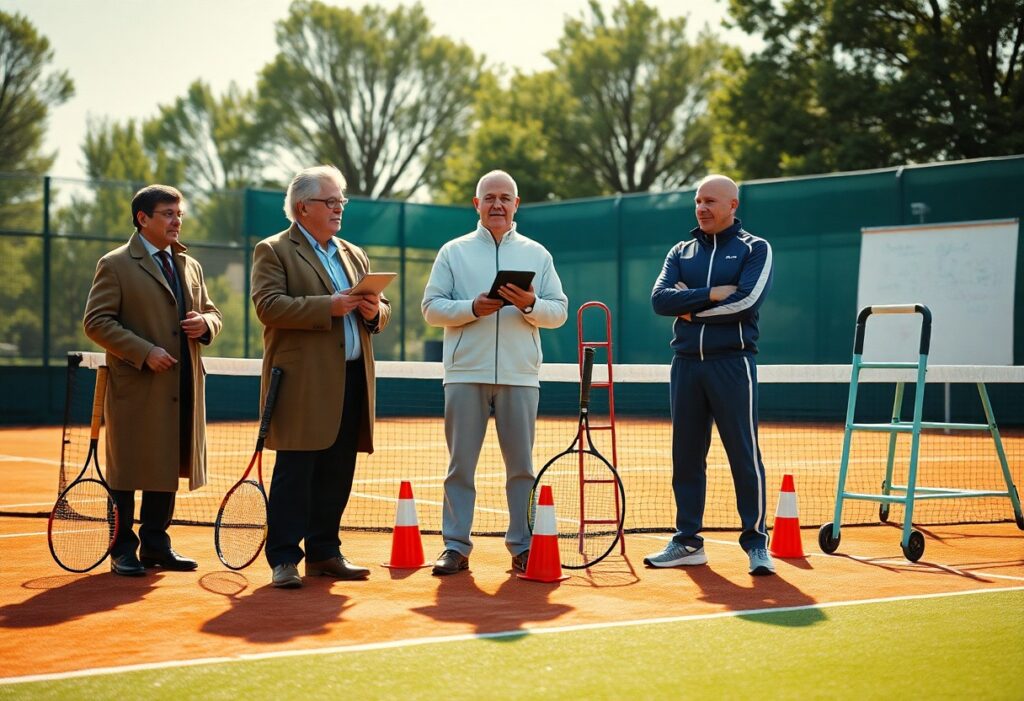

Coaching has transformed from rote drills to an integrated, scientific craft that blends biomechanics, psychology and analytics; this guide distills lessons from the greats to show evidence-based technique, warn about overtraining and tactical rigidity, and celebrate adaptive, player-centered development. Expect concise histories, actionable methods, and clear metrics to raise performance while avoiding outdated dogma.
Types of Tennis Coaching
Different delivery models-from Individual Coaching to Online Coaching and academy squads-vary by coach-to-player ratio, session length and measurement tools; common ratios are 1:1, 1:4 and 1:8, and session lengths typically span 45-120 minutes. Coaches blend technical work, physical conditioning and matchplay; some programs run 8-12 week blocks with weekly test metrics. The
- Individual Coaching
- Group Coaching
- Online Coaching
- Academy/Squad
- Performance Analysis
| Individual Coaching | 1:1 focus, tailored technique, video & biomechanical analysis |
| Group Coaching | Cost-efficient, tactical drills, live-ball patterns, typical 1:4-1:8 ratios |
| Online Coaching | Video feedback, remote plans, sensor data, scalable and lower cost |
| Academy/Squad | Daily multiple-skill blocks, strength & conditioning, tournament prep |
| Performance Analysis | Match stats, GPS/wearables, slo‑mo video for technical and tactical adjustments |
Individual Coaching
One-on-one sessions deliver precise technical correction using high-frame-rate video and targeted drills; typical slots run 45-90 minutes and allow for tailored periodization and strength work. Coaches often use radar and biomechanical cues to adjust serve toss or groundstroke timing, and the focus on repetition reduces time to correct stroke faults while increasing practice specificity. Precision and individualized load management are the main benefits.
Group Coaching
Group sessions emphasize tactical patterns, point construction and competitive drills; common formats are 60-90 minute clinics with 1:4-1:8 coach-to-player ratios, which make development more affordable and foster matchplay instincts. Drills like rotational feeding and situational games build decision-making under pressure, but less individual correction can allow technical flaws to persist if not monitored closely.
High-performance squads layer specialist coaches (technical, fitness, mental) across sessions: for example, a 12-player academy block may schedule 3 coaches for stroke, movement and S&C plus weekly match analysis, enabling integrated periodization and measurable jump in match toughness over 8-12 weeks. Structured workload and role clarity reduce overuse risk.
Online Coaching
Remote coaching combines uploaded video, annotated feedback and progressive plans; many coaches provide turnaround in 24-72 hours and use 120-240 fps smartphone video for frame-by-frame breakdown. This model lowers cost per session and scales to many players, but lack of on-court correction can delay motor-pattern fixes compared with in-person sessions.
Advanced online programs integrate wearables and analytics-stroke-count, ball speed and movement heatmaps-so coaches prescribe data-driven drills and microcycles. Platforms enable weekly checkpoints and video libraries, allowing players to sustain improvement between on-court lessons. The integration of these formats lets coaches combine the best elements for player development.
Key Tips for Effective Tennis Coaching
Adopt proven habits from top coaches to maximize court time:
- Video analysis: 20-30 minute review focusing on 2-3 correction points post-session
- Load management: track hours/week and recovery to reduce injury risk
- Goal setting: set SMART targets with weekly metrics and match-based benchmarks
This integrates technical, tactical and psychological work into repeatable routines.
Communication Skills
Use concise, measurable cues-one- or two-word prompts during live play-to avoid cognitive overload; many elite coaches pair that with a 3:1 praise-to-correction ratio and 20-30 minute video reviews to reinforce change. Coaches like Patrick Mouratoglou favor immediate, specific feedback (e.g., “lower toss” for serve) and short written homework to convert practice into match habits while preserving player confidence.
Building Trust and Rapport
Establish consistency through predictable routines: weekly one-on-one check-ins, transparent selection criteria, and clear role expectations build trust; Toni Nadal’s long-term approach with Rafael Nadal illustrates how loyalty and clear standards yield decade-long performance gains. Prioritize confidentiality and steady support to keep players engaged across seasons.
Deepen rapport by documenting commitments-five-minute pre-session goals and 10-15 minute post-session debriefs-with tangible follow-ups (video clips, drill plans). Involve athletes in planning, track adherence with simple metrics, and address concerns within 24-48 hours to signal reliability; these habits convert short-term buy-in into sustained development.
Step-by-Step Guide to Developing a Coaching Plan
Map the plan into sequential phases: baseline assessment, prioritized goals, drill design, periodized schedule and continuous evaluation. Apply concrete metrics-serve speed (mph), first-serve %, and a 50-ball consistency test-then build a 12-week macrocycle with 3-week microcycles and load limits to minimize injury risk. Prioritize weekly KPIs and immediate feedback loops for faster adaptation.
| Stage | Key Actions |
|---|---|
| Assessment | 50-ball rally, 20-serve accuracy, serve radar, 20m sprint, beep test |
| Goal Setting | SMART targets (e.g., raise first-serve % 55→70 in 12 weeks) |
| Drills & Routines | Target boxes, progressive feeding, 3:1 pattern drills, 20-minute serve blocks |
| Periodization | 12-week macrocycle, 3-week mesocycles, 1 recovery week |
| Monitoring | Weekly KPIs, RPE, injury checklist, match-video review |
Assessing Player Skills
Begin with objective, repeatable tests: a 50-ball consistency rally test, 20-serve accuracy to corners, serve-speed radar, and movement tests (10‑20m sprint, agility T-test). Add physiological measures-beep test or VO2 estimate-and a simple technical checklist scoring 1-5 per stroke. Combine quantitative results with video analysis to produce a prioritized deficits list within one assessment session.
Setting Goals
Translate assessment gaps into SMART targets: for example, cut unforced errors by 30% in 12 weeks, increase first-serve rate from 55% to 70%, or add 6-8 mph to serve speed over a season. Anchor goals to tournament dates and split into weekly KPIs so progress is measurable and actionable.
Set layered milestones: short-term (weekly ball counts, technique cues), medium-term (12-week performance gains), and long-term (seasonal ranking moves). Use historical examples-one U16 player raised national rank from 120 to 45 in nine months by targeting a +15% first-serve and weekly target of 300 quality serves. Guard against overly aggressive timelines to avoid overload and tendinopathy by adjusting targets after each mesocycle.
Creating Drills and Practice Routines
Design drills that directly map to goals: serve blocks of 20 quality serves to specific boxes, 3:1 pattern rallies for point construction, and footwork ladder intervals (4 x 30s). Structure sessions: 15-20 minute warm-up, 30-45 minute technical block, 20-30 minute match-simulation, and a 10-minute recovery routine to reinforce transfer to competition.
Progress drills via overload and specificity: start technique at ~60% intensity with 4 sets of 8 reps, advance to 80-90% intensity match scenarios and random feeding. Plan 2 high-intensity and 2 low-intensity sessions weekly, include at least one complete recovery day, and log reps and RPE. Emphasize target boxes and constrained constraints (e.g., one‑bounce target) to accelerate motor learning while monitoring for signs of overuse.
Factors Influencing Successful Coaching
Athlete outcomes hinge on alignment between training and game demands: physiology, psychology and technique. Toni Nadal molded Rafael Nadal’s heavy-topspin, endurance profile that underpinned 14 French Open titles by prioritizing high-load drill repetition and footwork. Modern teams layer video analysis with wearables-GPS and heart-rate-to individualize load and recovery. Program design must balance technical reps, tactical simulation and rest. Any coach who ignores these interacting elements risks short-term gains at the expense of long-term performance.
- Player’s Learning Style
- Coach’s Experience and Philosophy
- Technical Training
- Mental Conditioning
- Physical Periodization
Player’s Learning Style
Players process information differently: some respond best to visual cues, others to kinesthetic repetition or auditory instruction. Coaches deploy video breakdowns, mirror demonstrations and high-rep ball feeding to match preferences; for example, juniors showing kinesthetic bias benefit from 8-12 short, focused drill repetitions per set, while analytic players get extended tactical walkthroughs and match-simulation sets to consolidate decision-making.
Coach’s Experience and Philosophy
Veteran coaches convert tour knowledge into distinct philosophies: Brad Gilbert emphasized tactical simplicity and error management, while academy models of the 1980s-90s prioritized aggression and power. Philosophy dictates practice ratios (live points vs technical reps), in-match tactics and player management, and experienced coaches detect opponent patterns faster and adapt game plans between sets.
Deep experience shows in concrete structures: many pro-level coaches use periodization with macro-, meso- and microcycles-common microcycles run 2-3 high-intensity sessions, 2 technical sessions and 1 recovery day weekly. Emphasizing load monitoring reduces injury risk and overuse injuries, and targeted 6-8 week technical blocks often accelerate serve-speed and consistency while preserving long-term availability.
Pros and Cons of Different Coaching Approaches
| Pros | Cons |
|---|---|
| Stability of fundamentals through repetition and drill-based progression | Can resist necessary tactical or technical change, creating rigidity |
| Emphasis on discipline and habit formation (e.g., Toni Nadal’s early work) | May suppress on-court creativity and adaptive shot-making |
| Strong coach-player relationship and clear hierarchical guidance | Risk of authoritarian dynamics that impede player autonomy |
| Low-cost, scalable for junior programs with limited resources | Limited objective feedback without video or biometric data |
| High-volume drilling builds reliable muscle memory | Increases potential for repetitive-stress and overuse injuries |
| Data-driven tools (Hawk-Eye, PlaySight, wearables) give precise metrics | High implementation cost and risk of data overload or misinterpretation |
| Biomechanics and sports-science integration can reduce injury risk | Requires specialists and time to translate lab findings to court |
| Analytics enable opponent pattern recognition and match-plan optimisation | Dependence on algorithms may weaken on-court intuition under pressure |
Traditional Coaching
Coaches who favor classic methods focus on repetition, footwork drills, and live-ball patterns; examples include long rally work and technical hours on serve mechanics. Players gain dependable strokes and mental toughness through high-volume practice, while programs stay affordable. Downsides include limited objective feedback and a measurable increase in repetitive strain when volume isn’t managed, so pairing tradition with periodised load is often necessary to avoid overuse injuries.
Modern Techniques
Contemporary coaching layers video analysis, shot-tracking (Hawk-Eye, PlaySight), and wearables to quantify spin, speed, and physiological load, enabling targeted adjustments. Coaches like Patrick Mouratoglou use these tools to refine tactics and recovery; the payoff is measurable performance gains and smarter practice planning. However, overreliance on data can obscure feel-based decisions and create analysis paralysis during matches.
In practice, successful teams combine methods: use 3D motion-capture or inertial sensors to correct biomechanical faults, then validate changes on-court with situational drills. Sports scientists implement load-management protocols informed by heart-rate and accelerometer data to reduce injury risk, while video scouting isolates opponent tendencies for tactical sessions; striking that balance between metrics and court-time preserves instinctive play and avoids the danger of data-driven rigidity.
Lessons Learned from Great Tennis Coaches
Coaching evolution reveals a few repeating principles: technical mastery through deliberate repetition, individualized physical periodization, and psychological preparation. Nick Bollettieri’s 1978 academy popularized the intensive, production-line training that produced stars like Agassi and Seles. Toni Nadal prioritized heavy topspin and relentless conditioning, underpinning Rafael Nadal’s clay supremacy (14 Roland Garros titles). Contemporary coaches blend sports science, analytics, and situational drilling to improve longevity and match intelligence.
Iconic Coaching Strategies
Bollettieri leaned on high-volume drill blocks and competitive sparring to accelerate skill acquisition, while Brad Gilbert (author of the 1993 guide “Winning Ugly”) emphasized tactical simplicity and point construction. Patrick Mouratoglou introduced systematic video analysis and tailored biomechanical tweaks for Serena Williams, and Toni Nadal favored progressive overload and pattern-based rallying to build a relentless forehand and superior footwork.
Influence on Professional Players
Coaches have directly altered career trajectories: Ivan Lendl’s methods helped Andy Murray capture his first major titles (2012 US Open, 2013 Wimbledon) and Olympic gold in 2012, and Mouratoglou’s partnership aided Serena Williams’ comeback to World No.1 and multiple majors. Those interventions combined tactical clarity, fitness redesign, and match-simulation to convert potential into consistent Grand Slam results.
Examining Lendl’s approach shows concrete changes: he introduced rigorous off-court conditioning, extended baseline match-simulations, and a focus on serve aggression that addressed Murray’s tactical gaps. Conversely, the high-volume academy model accelerated skill but increased overuse risk, prompting modern coaches to balance intensity with periodized recovery and data-informed load management.
Summing up
Ultimately, the evolution of tennis coaching, traced through lessons from the greats, shows how melding technical fundamentals, strategic insight, and modern sports science elevates performance. Coaches who combine disciplined pedagogy, data-informed planning, and tailored mental and physical preparation produce resilient, adaptable players. This continuum-from classical drills to individualized analytics-defines contemporary coaching excellence and guides the sport’s future development.
FAQ
Q: How has the role of the tennis coach evolved from a stroke technician to a full performance architect?
A: Historically coaches focused on technique and repetition; modern coaches integrate biomechanics, strength and conditioning, nutrition, sports psychology and match analytics. Great coaches such as Nick Bollettieri emphasized early technical shaping and competitive environment, while later figures like Patrick Mouratoglou combined tactical planning with data-driven adjustments and psychological preparation. The lesson is to coordinate specialists, use objective feedback (video and stats) to refine technique, and design long-term development pathways that balance skill acquisition, physical conditioning and match experience.
Q: What technical and tactical principles passed down by legendary coaches remain central to contemporary training?
A: Core technical principles include stable base and footwork, efficient kinetic chain for serve and groundstrokes, early preparation, and hitting to depth with varied spin. Tactically, classics taught by the greats stress point construction, control of court geometry (depth and angles), intelligent aggression and effective transition to the net when appropriate. Training methods that endure are progressive drill design (isolation → pattern → situational points), deliberate serve-return routines, pressure-simulation drills and consistent video analysis to link feel with measurable outcomes. Coaches adapt these principles to modern racket and string technology and to each player’s morphology and strengths.
Q: How do top coaches cultivate mental resilience and manage a player’s long-term progress?
A: Top coaches create environments that build accountability, incremental goal-setting, and coping strategies for pressure. Methods used by successful mentors include structured routines, debriefing after sessions and matches, exposure to progressively higher-pressure situations, and integrating mental skills training (visualization, arousal control, focus cues). Examples from the greats show a spectrum: disciplined, process-focused coaching that enforces habits; strategy-focused coaching that simplifies decision-making under stress; and confidence-building that empowers autonomy. Effective long-term planning layers physical periodization, tactical evolution and phased competitive targets so development is sustainable and measurable.