
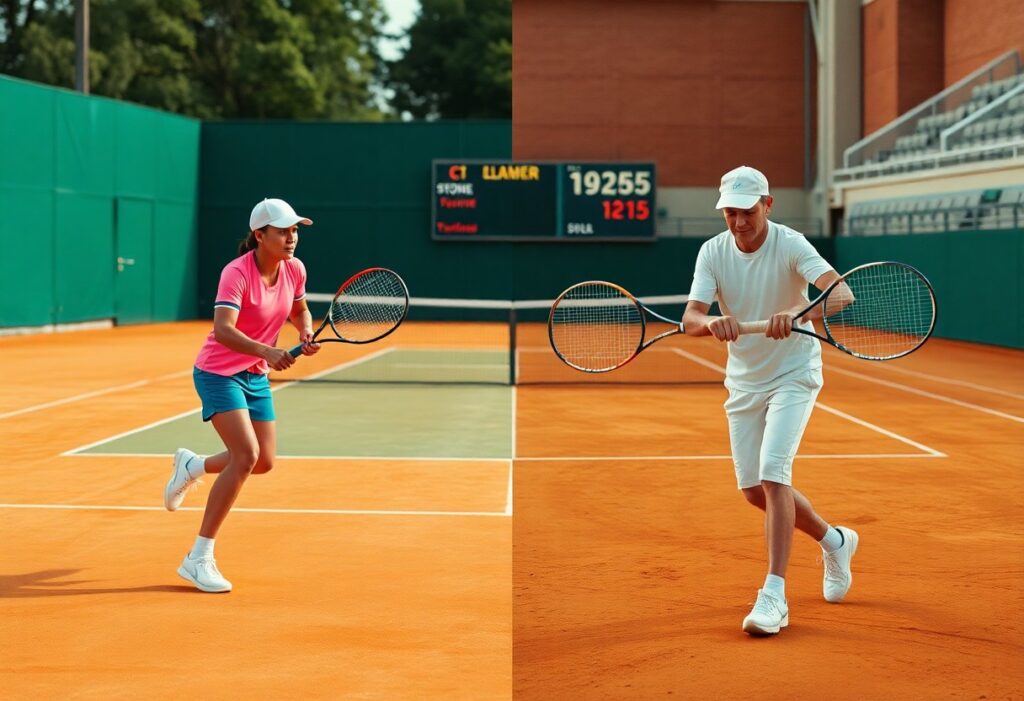

There’s an evidence-based comparison of modern champions and classic greats, using match data, era-adjusted metrics, and tactical breakdowns to weigh strengths such as power and athleticism, the persistent threat of evolving serve-and-volley strategies, and enduring qualities like consistency and mental resilience, providing a clear framework for readers to judge how equipment, surfaces, and training reshape competitiveness across generations.
Types of Tennis Eras
Equipment, surfaces and tactics mark distinct phases: the Wooden Racket Era emphasized touch and net play, the Open Era (since 1968) professionalized events, and the Power Baseline Era (2000s-present) stresses topspin, speed and endurance. Hawk-Eye’s 2006 rollout and racket head growth from ~65 to 95+ in² changed match outcomes. Any era can be quantified by its dominant players, tactical norms and measurable rule or tech shifts.
- Wooden Racket Era – finesse, small head sizes
- Open Era – 1968 onward, full professionalism
- Serve-and-Volley Era – grass/net-focused tactics
- Power Baseline Era – heavy topspin, conditioning
- Modern Era – analytics, sports science, Hawk-Eye
| Wooden Racket Era | Pre-1980s: ~65 in² heads, champions like Rod Laver (calendar Grand Slam 1969), emphasis on touch and net play. |
| Open Era | From 1968: prize money growth, pro circuits; WTA formed 1973 (Billie Jean King) expanded women’s pro tennis. |
| Serve-and-Volley Era | 1970s-1980s: faster grass, players like McEnroe and Laver used aggressive net tactics to shorten points. |
| Power Baseline Era | 2000s: heavier topspin, longer rallies; Rafael Nadal’s clay dominance and baseline attrition patterns exemplify the shift. |
| Modern Era | 2000s-today: Hawk-Eye (2006), analytics, sports science, longer careers and emphasis on recovery and load management. |
Golden Age of Tennis
During the 1960s-1970s the Golden Age fused iconic rivalries and structural change: Rod Laver’s 1969 calendar slam and Billie Jean King’s activism (WTA, 1973) elevated the game. Grass and fast courts rewarded serve-and-volley specialists, while wooden frames demanded precision; attendance and media coverage grew sharply as Grand Slams became global spectacles.
Modern Era of Tennis
Since the 2000s the Modern Era has been defined by power, data and the “Big Three”: Roger Federer (20 majors), Rafael Nadal (22 majors) and Novak Djokovic (24 majors) reshaped records and longevity. Larger rackets, refined string tech and Hawk-Eye (2006) lengthened baseline rallies, and top serves routinely exceed 200 km/h in key moments, increasing match intensity and recovery demands.
Teams now deploy player tracking, load monitoring and biomechanical analysis to eke out margins; for example, service-placement analytics have boosted break-point conversion at Slams. Tournament surfaces have converged-slower grass, modified clay and firmer hard courts-so match outcomes hinge more on endurance, periodized scheduling and injury management than on singular shot-making prowess.
Key Factors in Comparing Eras
Several overlapping variables shape era-to-era comparisons: physicality, equipment, surfaces, analytics, and rules. Modern players log about 20-30 hours/week of structured training plus sports-science recovery, while innovations like polyester strings and electronic line-calling shifted match outcomes. Case studies – Nadal’s extreme topspin vs. Federer’s control-oriented frames – show how one change can amplify others, raising both performance and injury risk. This
- Physicality
- Equipment
- Surfaces
- Analytics
- Rules
Factor vs Impact
| Factor | Impact |
|---|---|
| Physicality | Longer rallies, greater baseline endurance, structured periodization and recovery |
| Equipment | More spin and pace from graphite frames and polyester strings; larger sweet spots |
| Surfaces | Faster hard courts and homogenous conditions favor big servers |
| Analytics | Data-driven tactics, opponent scouting, and in-match adjustments |
| Rules | Challenge systems and scheduling affect momentum and recovery windows |
Physicality and Training
Today’s top players combine strength, mobility, and endurance training with GPS monitoring, lactate testing, and individualized periodization; many maintain 20-30 hours/week plus targeted recovery modalities like cryotherapy and physiotherapy. Examples: Djokovic’s flexibility program and Nadal’s gym routines extend careers, while juniors increasingly adopt early specialization and load management to balance performance and injury risk.
Equipment and Technology
Racket evolution from wood to high-modulus graphite and wider heads increased power and forgiveness; polyester strings (1990s onward) boosted spin, and ball-tracking plus Hawk-Eye since the mid-2000s changed officiating. Resulting metrics: serve speeds and topspin RPMs rose, altering point construction and emphasizing athleticism.
Delving deeper, frame stiffness (RA ratings), head size (now commonly 95-100+ sq in), and string choice create measurable trade-offs: stiffer frames yield more ball speed but transmit greater shock, while lower tension and polyester blends produce higher spin at the cost of feel. Case in point: Nadal’s heavy-spin game exploits strings and open stringbeds to reach >3,000 RPM on clay, and Sam Groth’s 263.4 km/h serve highlights how equipment plus technique pushed absolute pace. This
Step-by-Step Comparison of Stats
| Metric | Modern vs Classic |
|---|---|
| Grand Slams (career) | Modern: Djokovic 24, Nadal 22, Federer 20. Classics: Sampras 14, Borg 11, Laver 11. |
| Serve & aces | Modern players show higher serve speeds and ace counts (typical big-servers average 5-10 aces/match); classics relied more on placement with 1-4 aces/match. |
| Rally style | Modern baseline aggression and athletic defense shorten some rallies; classic eras featured more serve-and-volley and longer net approaches, shifting point construction. |
| Surface splits | Surface influence grew-hard-court dominance benefits modern baseline grinders, while clay historically magnified specialists like Nadal and grass rewarded classic serve-and-volleyers. |
Titles and Achievements
Grand Slam totals give immediate context: Djokovic 24, Nadal 22, Federer 20 stand out against classic tallies like Sampras 14 and Borg 11. Season title counts and year-end rankings also matter: modern stars accumulate many masters-level trophies and prolonged stints at No.1, while classics often concentrated dominance into fewer seasons but with high-impact major runs.
Head-to-Head Records
Direct matchups reveal styles and edges: Nadal leads Federer 24-16, while Djokovic leads Nadal 30-29 and Djokovic leads Federer 27-23. Surface splits flip these numbers-clay skews toward Nadal, hard courts toward Djokovic-so raw head-to-head totals require context about venue and stage.
Digging deeper shows that many decisive meetings occurred in Slams and finals, where mental resilience mattered as much as tactics. For example, Nadal’s clay dominance (heavy winning margin against Federer on clay) contrasts with Djokovic’s superior return game in long hard-court duels; therefore comparing head-to-heads demands factoring in surface, tournament round, and players’ peak condition rather than treating totals as absolute proof.
Pros and Cons of Each Era
Different eras trade off technique, athleticism, and context: older periods emphasize courtcraft and variety while modern tennis favors power, conditioning, and data-driven tactics. The table below breaks down those trade-offs so you can compare strengths like volleying or sports science side-by-side with drawbacks such as reduced stylistic diversity or increased physical attrition.
| Pros | Cons |
|---|---|
| Superior net play and serve-and-volley tradition | Baseline power has marginalized classic approaches |
| Refined touch, slice and variation | Less emphasis on athletic edge and recovery science |
| Long-standing rivalries shaped technique (e.g., Laver era) | Equipment limits reduced pace and topspin |
| Modern conditioning and injury prevention | Higher physical toll from faster rallies and scheduling |
| Racket/string tech enables more spin and power | Can produce homogeneous baseline-heavy play |
| Analytics and Hawk-Eye improve strategy and fairness | Technology can reduce on-court spontaneity |
| Greater global depth; more competitive fields | Fewer prolonged single-player dynasties |
| Higher prize money and professional support | Intense calendar increases burnout risk |
Strengths of Classic Players
Classics excelled in courtcraft, timing and transitional volleying-skills embodied by Rod Laver’s two calendar Grand Slams (1962, 1969) and Björn Borg’s grass-soaked dominance (Wimbledon 1976-80). Their games favored variety: adept slice, frequent net approaches, and strategic touch that forced opponents into uncomfortable patterns rather than outright power exchanges.
Advantages of Contemporary Stars
Contemporary players benefit from sports science, advanced gear and match analytics, which translate into longer careers, greater recovery and consistently higher intensity; teams now optimize nutrition, biomechanics and scheduling to extract marginal gains across seasons.
For example, Hawk-Eye reviews (widely adopted since the mid-2000s) altered tactical risk-taking, while racket and string innovations increased topspin and ball speed, reshaping point construction. Players like Roger Federer and Serena Williams extended elite longevity into their mid- to late-30s through tailored conditioning, and today’s deeper fields force champions to win more matches against high-level opponents week after week.
Tips for Analyzing Player Performance
Distill comparisons into layers: match-level metrics, surface splits and tactical profiles. Use concrete contrasts – Djokovic’s return pressure versus Federer’s net work, Nadal’s 14 Roland Garros titles showing clay specialization – and normalize for era-driven equipment and schedule differences. This method keeps headline counts like Grand Slams (Djokovic 24, Nadal 22, Federer 20) grounded in match evidence.
- Serve
- Return
- Movement
- Surface
- Stats
- Intangibles
Metrics to Consider
Focus on surface-specific win-rate, Elo or rating-based indexes, first-serve percentage, return games won, breakpoint conversion, winners-to-unforced-error ratio and net-approach frequency; include clutch indicators like tiebreak win% and five-set winning rate for Grand Slam comparisons to capture endurance and match-play resilience.
Contextual Influences
Account for equipment (wooden vs composite rackets), string technology, ball type, court-speed and rule changes plus advances in coaching, nutrition and recovery; for example, polyester strings and modern rackets since the 1990s increased topspin and baseline rallies, shifting the balance away from classic serve-and-volley styles.
Surface nuance matters: clay slows the ball and extends rallies, creating more breakpoint opportunities and favoring high-topspin grinders – a key factor behind Nadal’s 14 Roland Garros wins. Altitude, court maintenance and ball models also alter serve speeds and rally length, so adjust raw metrics by venue-specific conditions when comparing players across eras.
Summing up
Presently, evaluating today’s tennis stars against the classics demands accounting for equipment, training, athleticism, depth of field and rule changes; modern players often excel in power and consistency, while earlier champions showed tactical ingenuity and adaptability on varied surfaces, so fair assessment relies on contextual metrics and career-adjusted comparisons rather than simple head-to-head tallies.
FAQ
Q: How can analysts make fair comparisons between players from different tennis eras?
A: Fair comparisons require adjusting for context rather than relying on raw numbers alone. Start by normalizing statistics against contemporaries (win percentage, dominance over top-10 peers, titles per season) and using era-adjusted metrics such as Elo ratings or wins above replacement to account for field depth. Factor in equipment and surface evolution: wooden racquets, slower balls and grass characteristics favored serve-and-volley in older eras, while modern rackets and string tech amplify power and spin. Also weigh conditioning and sports medicine advances that extend careers and change recovery patterns. Qualitative elements-tactical versatility, clutch performance in majors, head-to-head matchups when available-round out the view. Finally, acknowledge uncertainty: any cross-era ranking should present ranges of likely outcomes rather than definitive placements.
Q: If a top player from today faced a classic champion under both players’ original conditions, who would have the edge?
A: Outcomes depend on which conditions are used. In modern conditions (current rackets, faster string beds, contemporary fitness and analytics), today’s stars generally benefit from greater baseline power, defensive retrieval and recovery, and optimized training, giving them an edge in sustained high-intensity rallies. In a classic-era environment (wooden racquets, heavier balls, slower surfaces), older champions regain advantages from specialized net play, slice variety and tactical experience with those conditions. Adaptability matters: the most likely winners are those who can adjust technique and tactics quickly. Historical examples show mixed results in exhibition or simulated matches because small rule and equipment shifts disproportionately affect playing styles, so a definitive universal winner is unlikely.
Q: Which elements of tennis greatness translate across eras, and which are era-specific?
A: Timeless elements include mental toughness, competitive intelligence, shot selection under pressure, consistency in major tournaments, and an ability to evolve tactics during matches-these shape legacy regardless of equipment. Era-specific traits encompass serve speeds, average rally length, physical conditioning norms, and dominant stroke patterns driven by racquet and string technology; for example, extreme topspin baseline games are largely a modern phenomenon, while classical serve-and-volley dominance was more viable on mid-century grass. Records such as total Slam count or consecutive weeks at No. 1 must be interpreted with context: scheduling, draw size and surface variety differ across decades. A holistic assessment combines the timeless qualities with an understanding of era-driven advantages to judge greatness fairly.