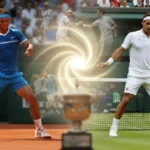



Why the Nadal–Federer Grand Slam rivalry matters to your understanding of modern tennis
You may know Roger Federer and Rafael Nadal as two of the greatest players in tennis history, but their Grand Slam meetings did more than produce trophies — they changed how you view surface specialization, match resilience, and tactical evolution. When you study their Grand Slam matches, you’re not just reading scores; you’re tracing shifts in momentum across a decade, the rise of baseline power versus all-court finesse, and how one rivalry pushed both players to redefine excellence.
This section helps you place those headline matches in context: where they happened (clay, grass, hard courts), how often they met in semis and finals, and why certain scorelines became shorthand for dominance or endurance. Understanding the backdrop prepares you to appreciate individual scorelines and the pivotal moments that follow in later sections.
How surface and timing shaped the earliest Grand Slam encounters you’ll study
In their early Grand Slam meetings, patterns became clear and instructive. You’ll notice that:
- Clay court meetings often favored Nadal’s heavy topspin and relentless defense, which repeatedly tested Federer’s ability to construct points and finish at the net.
- Grass and some hard-court clashes highlighted Federer’s precision serving, forehand timing, and variety — his ability to shorten points often neutralized Nadal’s baseline pressure.
- Many of their Grand Slam encounters occurred in late rounds — semifinals and finals — so the stakes amplified every momentum swing and tactical adjustment you watch in the scorelines.
Early highlights and a landmark match scoreline you’ll want to remember
Rather than a long list of statistics, focus first on the narratives the early scorelines told. Early on, Nadal established himself as the clay specialist who could unsettle Federer’s rhythm; Federer, in turn, showed how to dominate on faster surfaces. These contrasting strengths produced a series of compelling meetings that alternated the upper hand and exposed each player’s limits.
One pivotal match that you’ll repeatedly encounter in analyses of their rivalry is the 2008 Wimbledon final — widely regarded as one of the greatest tennis matches ever played. The scoreline itself reads like a drama: 6–4, 6–4, 6–7(5), 6–7(8), 9–7. You can study that sequence and see how momentum swung, how nerves affected serving in the tiebreaks, and how endurance decided the final set.
As you move into the match-by-match breakdown that follows, you’ll watch how early Grand Slam meetings set tactical precedents, how both players adapted over time, and how specific scorelines signaled turning points in their rivalry.
Next, you’ll get a chronological look at each Grand Slam meeting, with exact scorelines, key moments, and match highlights that explain how the rivalry evolved match by match.
2009–2011: Nadal proves Grand Slam range, Federer looks for answers
By 2009 the rivalry had outgrown the clay-versus-grass narrative and moved to one crucial test of adaptability: could Nadal beat Federer on the biggest hard‑court stage? The answer came in a marathon at the Australian Open, where Nadal edged Federer in a match that underlined his improved offense and Federer’s resilience: 7–5, 3–6, 7–6(3), 3–6, 6–2. That scoreline tells you what watching the match felt like — see‑saw momentum, punctuated by sudden bursts of control.
Key moments to watch in this period: Nadal’s returns and passing shots in the decisive fifth set, which neutralized Federer’s serve-and-volley forays; Federer’s ability to find rhythm in the third and fourth sets, keeping the match alive with surgical forehand winners; and the physical toll of a five‑setter that seemed to favor the younger, grinding Nadal by the end. Tactically, Nadal started shortening points on hard courts more often, adding depth and flatter winners to complement his trademark topspin. Federer’s response was to reclaim court position more aggressively, but subtle footspeed differentials and Nadal’s relentless ball-bouncing consistency tilted the late stages in Rafa’s favor.
Across 2010–2011 their Grand Slam meetings continued to reflect this tug-of-war: Nadal’s expanding shot repertoire versus Federer’s attempts to shorten rallies and play the net more. Even when Federer did win sets — often in bursts of clinical serving and forehand precision — the scorelines frequently showed a pattern of alternating dominance rather than one player imposing continuous control. For you, these years are where you should watch how small tactical changes (a different return position, a new serve pattern, or more angled backhands) flip set scores and ultimately decide matches.
2014–2017: Late-career sparks — refinement, rivalry, and another five-set classic
Their meetings in the later decade are instructive for another reason: they show how elite players reinvent themselves as physical edges narrow. The 2017 Australian Open final is the clearest example — Federer reclaimed a major in front of Nadal in a five-set tactical chess match that reads 6–4, 3–6, 6–1, 3–6, 6–3. That scoreline masks a match of micro-adjustments: Federer’s retooled backhand, improved second-serve reliability, and willingness to flatten out the forehand; Nadal’s continued excellence in defense and his sharper offense during momentum swings.
What to focus on when you watch these later matches: how Federer cuts points down with aggressive placement and how Nadal counters with depth and variation to stay alive in rallies. Notice also the psychological ebb — both players trade early ownership of sets, but the player who sustains intensity in the decisive games takes the match. The late-career scorelines therefore read less like surface scripts and more like tests of timing, recovery, and shot selection under pressure.
For the chronicle you’re building, these matches show an evolution from surface-dictated outcomes to contests decided by nuance: serve patterns, transitional movement, and split-second tactical pivots. Scorelines in this era — often tight, frequently five sets — highlight not just who won, but how both men adapted to keep the rivalry as compelling as ever.
Further viewing and study tips
If you want to deepen your understanding beyond the scorelines, focus on a handful of matches and watch them with a few specific questions in mind:
- 2008 Wimbledon Final — watch late-set serve patterns and point construction in decisive games.
- 2009 Australian Open Final — study momentum swings and how aggression on return changed outcomes.
- 2017 Australian Open Final — note tactical adjustments and how experience altered shot selection.
- When rewatching, pay attention to first-serve percentages, points won at net, and the length of rallies in pivotal games — these often explain scoreline swings better than headline stats.
Enduring lessons from their Grand Slam duels
What endures from Nadal and Federer’s Grand Slam encounters is less about who led the head‑to‑head at any moment and more about how elite rivalry accelerates evolution in the sport: technique adapts, tactics sharpen, and mental resilience is repeatedly tested. Their matches give you a practical template for reading scorelines as living narratives — each set score hints at strategy, momentum, and turning points that matter for fans, coaches, and players alike.
If you want a single, reliable source to explore match records and head‑to‑head details further, see the comprehensive rivalry entry here: Nadal–Federer rivalry (Wikipedia).