

Why Roland Garros Stands Apart From Every Other Grand Slam
Of the four Grand Slam tournaments, Roland Garros demands the most complete recalibration of a professional tennis player’s game. The Australian Open, Wimbledon, and the US Open each have their own character, but Paris presents something fundamentally different — a surface that slows the game down, rewards patience over power, and exposes weaknesses that other courts simply mask. Players who dominate on hard courts or grass can arrive as favorites and exit before the second week, humbled by red clay and the relentless grind it demands.
Red Clay: A Surface That Changes the Rules of the Game
Clay courts are not simply slower versions of hard courts. The crushed brick and shale surface interacts with the tennis ball in ways that fundamentally reshape every tactical exchange. When a ball lands on clay, it loses pace and generates a significantly higher bounce than on any other Grand Slam surface. A flat serve that tears through a hard-court returner becomes manageable on clay because the surface absorbs energy, giving the receiver extra time to prepare.
The high bounce shifts rallies away from low, penetrating groundstrokes and toward heavy topspin exchanges from the baseline. Players who thrive on clay generate large amounts of topspin — brushing steeply upward through the ball — because that spin keeps shots controlled at uncomfortable bounce heights. A flat hitter who struggles to redirect a ball sitting above their shoulder is at a structural disadvantage before a point even begins.
There is also the matter of sliding. Clay allows players to slide into their shots rather than planting a firm foot before striking. This skill, practiced extensively by clay-court specialists from a young age, reduces joint impact and improves court coverage. Players who grow up on hard courts often struggle to slide naturally when they arrive in Paris.
Court Philippe-Chatrier: A Physical and Psychological Environment
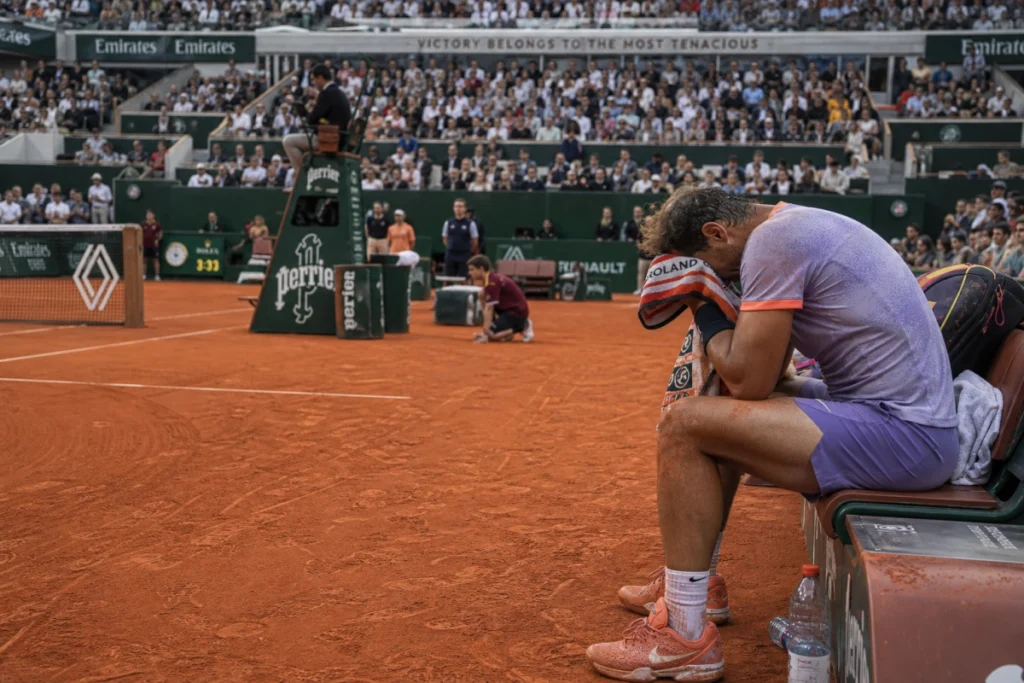
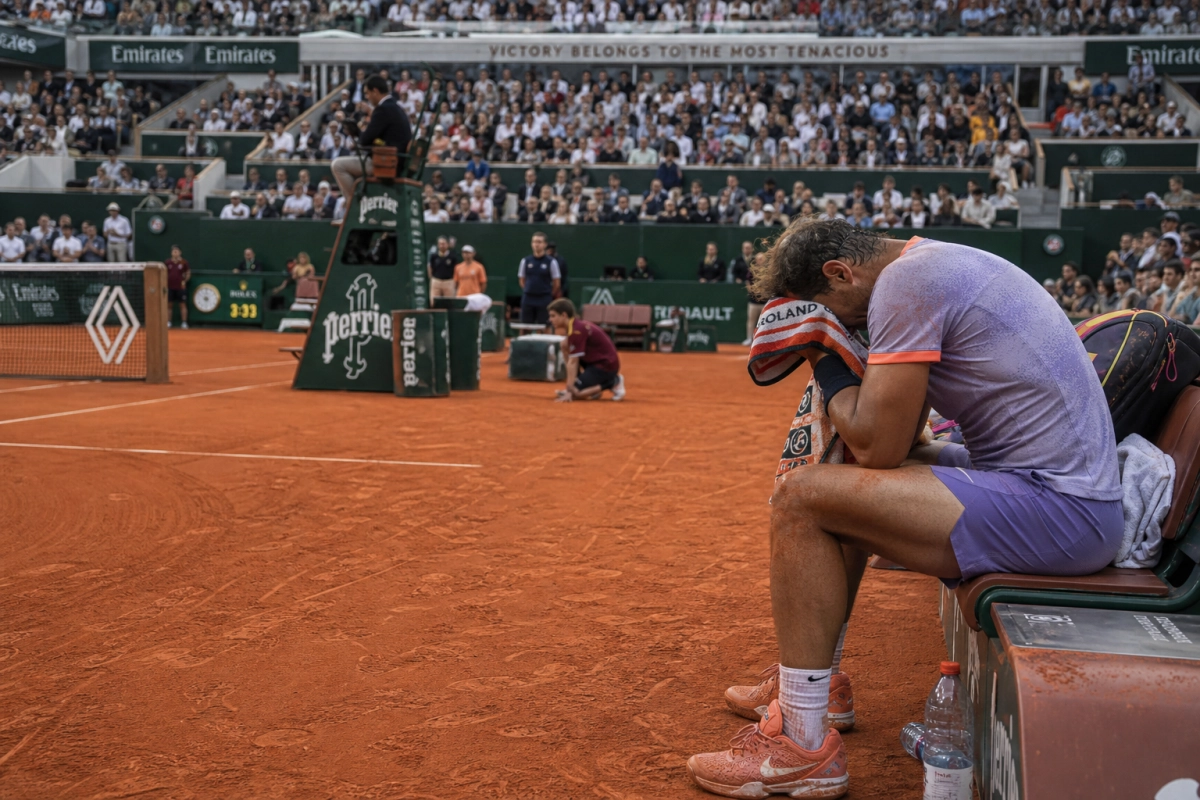
The main show court at Roland Garros adds another layer of challenge beyond the surface. Sitting in a bowl-shaped stadium, Philippe-Chatrier creates unusual wind conditions — gusts swirl in unpredictable directions, forcing players to adjust their ball toss on serve and constantly recalibrate groundstroke depth and direction. What works tactically in calm conditions may fall apart entirely when the wind picks up mid-match.
The crowd — passionate, knowledgeable, and vocal — responds sharply to momentum swings. Matches on this court have a long history of dramatic reversals, and the surface’s slow pace means leads are never truly safe. A player who drops concentration for a few games can watch a two-set advantage evaporate across five sets, something that happens at Roland Garros with a regularity rarely seen elsewhere.
Those conditions combine with the best-of-five format to make Philippe-Chatrier one of the most physically punishing arenas in sport. A deep run means potentially playing four to five hours per match across consecutive days with limited recovery. The clay doesn’t just test how a player performs — it tests how long they can sustain that performance under mounting fatigue.
The Physical Toll Clay Extracts Over Two Weeks
What separates Roland Garros from other majors isn’t the difficulty of any individual match — it’s the accumulative weight of the tournament as a whole. Clay demands a style of play that is inherently more physically expensive than on faster surfaces. Rallies are longer, baseline exchanges more intense, and the sliding movement pattern places significant strain on the hip flexors, adductors, and lower back across multiple extended matches. By the second week, the physical toll is visible in ways a hard-court tournament rarely produces.
Because the surface neutralizes pace so effectively, players cannot rely on a single aggressive shot to end rallies cleanly. They must construct points through sustained pressure — working opponents side to side, building angles, and waiting for a short ball to attack. That process burns more energy per point than on faster surfaces, where a well-struck winner can end an exchange in two or three shots. At Roland Garros, those same shots often represent just the opening of a rally lasting fifteen or twenty strokes.
Conditioning becomes a genuine differentiator at the French Open in a way it simply isn’t at Wimbledon or the US Open. A player who arrives in Paris carrying any physical issue — a hamstring tightness, shoulder strain, or accumulated fatigue — will feel it magnified over seven rounds. The court insists on physical endurance as a baseline requirement.
Tactical Adjustments That Define Clay-Court Tennis
Adapting to clay requires deliberate and sometimes significant changes that would be counterproductive on any other major surface.
Serve strategy shifts substantially. On hard courts and grass, a flat, powerful first serve generates free points regularly. On Philippe-Chatrier, that same delivery presents far less danger because the receiver gains time from the slower bounce. Successful clay-court servers lean on heavy kick serves — pronounced topspin deliveries that bounce high and push the returner deep behind the baseline. The goal shifts from outright aces to positioning: starting rallies on favorable terms rather than ending points immediately.
Groundstroke construction changes just as meaningfully. On clay, depth and spin carry more tactical weight than raw pace. A ball landing near the baseline with heavy topspin is genuinely difficult to handle because it sits up at an uncomfortable height and limits aggressive reply options. Players who succeed in Paris prioritize high, heavy, and deep groundstrokes over the flatter shots that win points on hard courts by staying low through the strike zone.
Patience also functions as a conscious tactical choice. Elite players who struggle at Roland Garros are often those who become frustrated when aggressive shots fail to produce clean winners. On clay, a shot that would end a rally on a faster surface simply draws a good defensive reply. Players must internalize a different standard for what constitutes a good shot and resist the impulse to take unnecessary risks when the first aggressive option doesn’t produce an immediate result.
How Roland Garros Exposes Weaknesses Other Surfaces Conceal
Perhaps the most revealing quality of the French Open is its ability to strip away the technical cover that faster surfaces quietly provide. A player with a weak backhand can survive at the Australian Open or Wimbledon if their serve and forehand are dominant enough to end points early. At Roland Garros, that same weakness becomes structurally exploitable. Because rallies are longer and opponents have time to reposition, a vulnerable shot will be targeted with a consistency that faster courts simply don’t allow.
The same principle applies to movement. A player who is slightly slow can compensate on hard surfaces by taking the ball early, shortening their opponent’s recovery time. On clay, that early-ball option is less available because the high bounce pushes players deeper into the court. A player who has lost a step due to age or injury will cover noticeably more ground at Roland Garros than anywhere else.
Mental composure under sustained pressure is tested in a way no other Grand Slam quite replicates. The slow surface means errors of impatience — going for too much too soon, abandoning a sound tactical plan because it hasn’t produced quick results — are punished more severely. A player who wins points easily elsewhere through aggression must remain disciplined across long rallies, often for three, four, or five hours at a time.
Why Roland Garros Remains the Truest Test in Professional Tennis
Every Grand Slam tests something essential. Wimbledon tests a player’s ability to serve big and react quickly on an unforgiving surface. The US Open tests nerve under noise and heat. The Australian Open tests endurance in a more straightforward physical sense. But Roland Garros tests something harder to define and harder still to manufacture: the ability to grind, to construct, to wait, and to sustain all of that across two full weeks without the surface ever offering a shortcut.
The red clay of Court Philippe-Chatrier has no interest in convenience. It will not reward a powerful serve if the returner has time to settle. It will not reward a flat forehand if the ball sits up at shoulder height and invites a heavy reply. What it rewards, consistently and without exception, is completeness — a game built on technical depth, physical resilience, tactical intelligence, and the mental discipline that holds up not just through one difficult match but through seven of them.
That completeness is why the Roland Garros champion is so often considered the most credible all-around player in the world at the moment of their victory. Winning in Paris cannot be engineered through one dominant weapon or one favorable draw. It requires a player to have solved the specific, unforgiving puzzle that red clay presents, repeatedly, across the full breadth of a major tournament, on the most storied clay court the sport has ever known.
No other venue in professional tennis asks quite so much, or makes the asking feel quite so inevitable.