


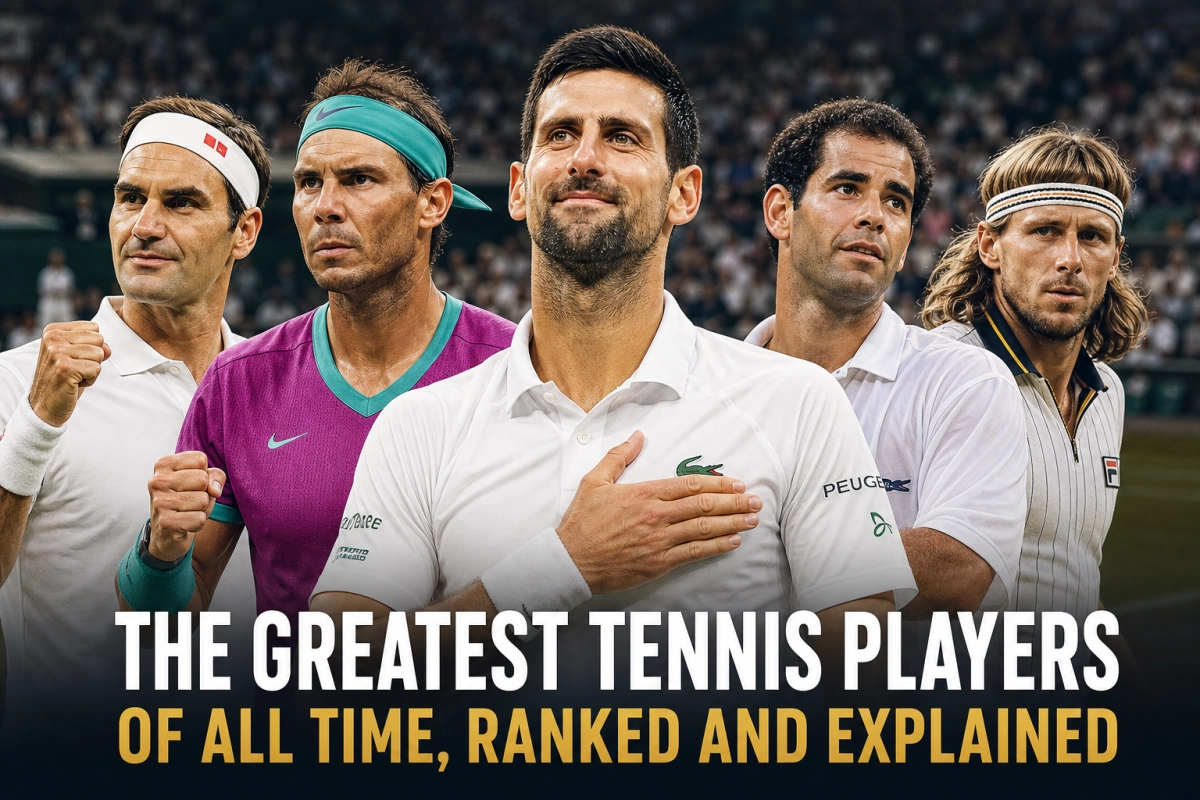
Why Ranking the Best Tennis Players in History Is More Complex Than It Looks
Settling on a definitive list of the best tennis players ever requires more than counting Grand Slam titles. Tennis spans over a century of competitive play, multiple surfaces, shifting equipment technology, evolving training science, and separate tours for men and women. A player who dominated the wooden-racquet era faced a fundamentally different sport than one competing today on carbon-fiber frames with engineered string setups. Ignoring those differences produces rankings that feel satisfying on the surface but collapse under scrutiny.
Rather than reducing greatness to a single statistic, this guide examines the full body of evidence: major titles, longevity, dominance relative to each era’s competition, consistency across surfaces, and lasting influence on how the game is understood and played. Both the ATP and WTA tours are represented, because confining this conversation to one tour tells only half the story.
The Criteria That Actually Define All-Time Greatness
Several factors consistently separate the truly exceptional from the merely excellent.
Grand Slam performance
The four Grand Slams — the Australian Open, French Open, Wimbledon, and the US Open — remain the clearest benchmarks of sustained excellence. Each is played on a different surface: hard courts in Melbourne and New York, clay in Paris, grass in London. Winning multiple majors across surfaces demonstrates a range of skill that winning repeatedly on one surface alone does not. A player who collects titles on clay but struggles at Wimbledon is a specialist; a player who wins on all four is something rarer.
Dominance within an era
Raw title counts can mislead. A player who accumulates majors over fifteen years in a relatively open era may have had more opportunities than one who won fewer titles but held the world number one ranking for consecutive years against a dense field of elite competitors. Era context matters enormously. The depth of the men’s tour during the 1970s and 1980s was formidable in a way that makes titles earned during that period especially meaningful.
Longevity, consistency, and peak level
Sustaining excellence over a decade or more is arguably the hardest achievement in professional tennis. The physical toll of the tour — frequent travel, hard-court hours, year-round competition — tests even the most gifted athletes. Players who remain competitive into their mid-thirties while still reaching major finals demonstrate physical conditioning, tactical adaptation, and mental resilience that short-term peaks cannot match. Peak level also matters independently: a player who reached a quality of tennis that contemporaries considered almost untouchable leaves a mark that outlasts their ranking points, and combined with surface versatility, this quality often distinguishes true icons from very good champions.
How the Men’s and Women’s Tours Require Separate but Equal Consideration
One persistent failure in tennis history debates is treating the ATP and WTA tours as incomparable, then quietly ranking only the men. The criteria already outlined — major titles, era dominance, longevity, surface versatility, peak level — apply with equal force to both tours.
What differs is structural context. The WTA was founded in 1973, giving it a somewhat shorter professional history. Prize money parity, scheduling pressures, and the physical demands specific to the women’s game have shaped careers in ways that deserve acknowledgment. A player who navigates pregnancy, returns to the tour, and reaches major finals again is achieving something the men’s history simply does not contain.
The most intellectually honest approach recognizes each tour’s internal standards while holding players across both to the same qualitative framework. When applied consistently, certain names emerge with such clarity that debating their inclusion becomes almost redundant. The more interesting arguments live in the tiers below — and that is precisely where careful analysis earns its keep.
The Role of Era in Shaping What Greatness Actually Looked Like
Tennis across different decades was not simply the same game played at varying speeds. The shift from wooden to composite rackets beginning in the late 1970s transformed baseline rallies, serve velocities, and the tactical premium placed on net play. Court surfaces have evolved too. Wimbledon’s grass now plays significantly slower than it did in the 1980s and 1990s when big servers dominated. The Australian Open moved from grass to hard courts in 1988, changing the character of the major entirely. These are structural realities that alter what any given title actually required.
The amateur-to-open era transition
Pre-Open Era players — those competing before 1968 when Grand Slams finally admitted professionals — require particular care. Several of the most talented players in tennis history spent their prime years as professionals barred from the majors entirely. Judging those players solely by titles they were structurally prevented from entering would be like evaluating a novelist by awards they were ineligible to enter. Their legacies deserve acknowledgment within the honest constraints of the historical record.
The compression of modern competition
Contemporary players face a different challenge. Global talent scouting, sports science, and professional academies have distributed elite-level development more broadly than at any previous point in the sport’s history. Winning a major today means defeating a draw populated with physically prepared, tactically sophisticated opponents from dozens of countries, many groomed for professional competition from childhood. This compression of competitive quality is itself a form of context that modern champions deserve to have acknowledged.
What Separates the Truly Iconic From the Merely Historic
Championships alone have never been sufficient to elevate a player to genuine icon status. Iconic players reshape the way the game is played, thought about, or followed — they change the sport’s trajectory, not merely accumulate evidence of their excellence.
- Tactical innovation that changed how the game was taught and played at all levels
- Rivalries that elevated the sport’s visibility and competitive standard simultaneously
- Cultural significance beyond the sport itself, including representation and social impact
- The ability to perform under the highest-pressure conditions consistently across a career
These qualities do not override the hard evidence of titles and rankings, but they explain why certain players occupy a different category of historical memory than others with comparable statistics. The most complete all-time rankings hold both dimensions in view — the measurable and the irreducible — and resist collapsing a rich historical record into a single satisfying number.
The Players History Will Always Argue About — and Why That Argument Has Value
Any ranked guide to the greatest tennis players ever will generate disagreement, and it should. A list that produces unanimous consensus has almost certainly defaulted to the safest answers rather than doing the harder analytical work.
The names at the very top are relatively few and relatively clear. Serena Williams built a career of sustained dominance across surfaces and decades against consistent elite opposition that places her beyond reasonable dispute in any serious all-time conversation. On the men’s side, Roger Federer, Rafael Nadal, and Novak Djokovic represent a concentration at the summit so extraordinary that historians will be untangling its implications for decades. Steffi Graf’s achievement of winning all four Grand Slams and an Olympic gold medal in a single calendar year remains one of the most demanding feats in the sport’s history. Margaret Court’s title count is the largest the women’s game has produced. Martina Navratilova’s combination of titles, finals appearances, and longevity across surfaces has no clean equivalent on either tour.
Further down, the arguments become richer and more contested. Rod Laver’s claim rests partly on titles and partly on what he was prevented from winning during his professional exile — a structural injustice any honest ranking must acknowledge. Pete Sampras won fourteen majors but never claimed the French Open, a gap that colors every era-dominance argument made in his name. Chris Evert and Navratilova defined a rivalry so central to the WTA’s identity that evaluating either without the other misses something essential about what made both of them great.
These are not edge cases. They are the substance of the conversation, and the willingness to sit with their complexity rather than resolve it artificially is what separates a thoughtful guide from a list assembled for easy consumption. The criteria matter. The era context matters. The totality of a career — its peaks, its longevity, its rivalries, its influence on the game’s evolution — matters more than any single statistic presented as a verdict.
Tennis has produced, across both its major tours, a depth of all-time talent that rewards sustained attention. The players who belong in this conversation earned their place through careers that were, in almost every case, far more complicated and more interesting than their final title tallies suggest. Engaging with that complexity honestly is not a concession to subjectivity. It is the only way to do justice to what those careers actually were.