

The Grand Slam That Opens the Season
Every January, the tennis world turns its attention to Melbourne. The Australian Open is the first Grand Slam of the calendar year, and that timing gives it a distinctive energy — players arrive with rankings to prove, fresh from offseason training, and the pressure of a new season on their shoulders. For fans, it marks the return of elite tennis at its highest level.
But the Australian Open is far more than a curtain-raiser. It is one of the most-watched sporting events in the Southern Hemisphere, with a rich history, a playing surface that rewards specific skills, and atmospheric quirks that make it genuinely different from Wimbledon, Roland Garros, and the US Open. Understanding those differences adds appreciation that casual viewing rarely provides.
From Grass Courts to Melbourne Park: A Brief History
The Australian Open was first held in 1905, making it the oldest of the four Grand Slams. In its early decades it was played on grass and rotated between cities — Melbourne, Sydney, Adelaide, Brisbane, and even Christchurch. That nomadic format meant the event lacked the fixed identity that Wimbledon and Roland Garros had built around their permanent venues.
For much of the mid-20th century, the tournament struggled for legitimacy. Many top players skipped it, deterred by the cost of traveling to Australia during the Northern Hemisphere holiday season. Prize money lagged, and scheduling inconsistencies made it difficult to establish a stable audience or coherent place in the professional calendar.
The turning point came in 1988, when the tournament relocated permanently to Melbourne Park and transitioned from grass to hard court. Covered stadiums, improved infrastructure, and growing prize money attracted every top player in the world, and television audiences expanded across Asia, Europe, and North America. That transformation reshaped the tournament’s reputation entirely.
The Significance of Melbourne Park
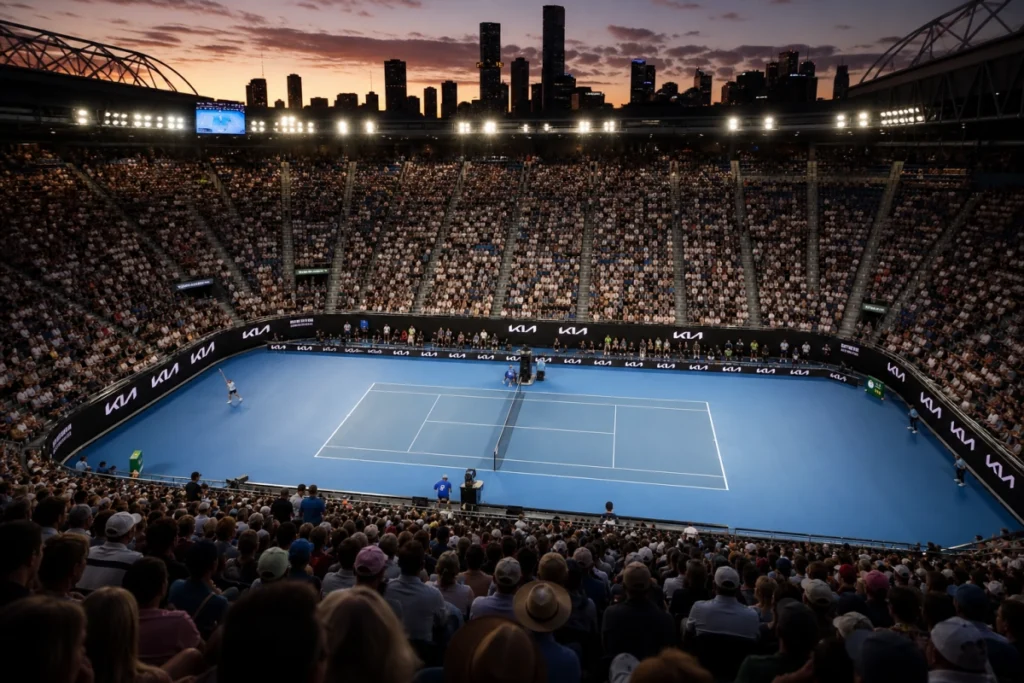
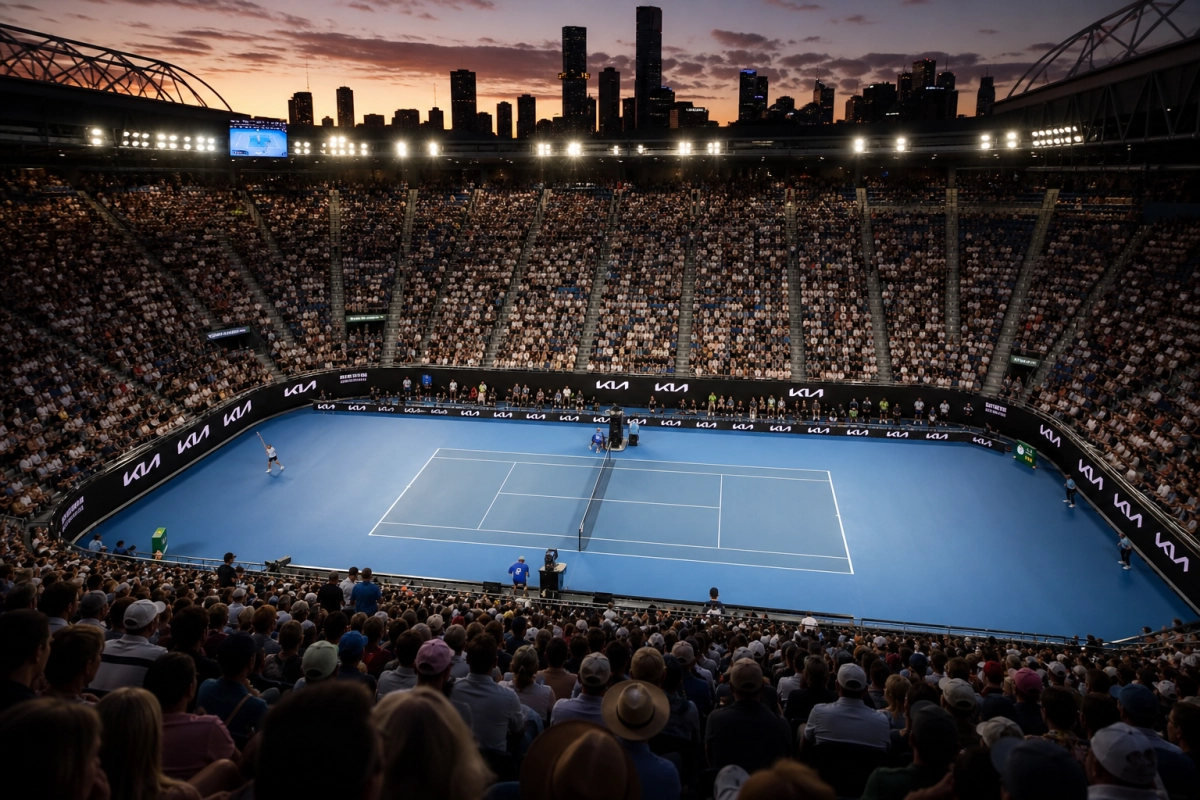
The venue itself deserves attention. Melbourne Park’s most prominent show court is Rod Laver Arena — named after the Australian legend who won all four Grand Slams in a single calendar year twice. Its retractable roof, operational since 2000, allows play to continue during rain and shields players from extreme heat. Margaret Court Arena and John Cain Arena serve as secondary show courts throughout the fortnight.
The site’s compact, walkable layout gives Melbourne Park a social atmosphere that distinguishes it from larger venues. Fans can move between courts with ease, catching matches across multiple sections of the draw in a single afternoon — something far more difficult at Roland Garros or Wimbledon.
Hard Courts, Heat, and Playing Conditions Unlike Any Other Slam
The Australian Open is played on Plexicushion, a hard court surface developed specifically for Melbourne Park. It sits roughly in the middle of the speed spectrum — faster than Roland Garros clay, slightly slower than Wimbledon grass — tending to favor all-court players who can serve effectively and transition comfortably between offensive and defensive play.
What truly sets Melbourne apart, however, is the heat. January falls in the height of the Australian summer, and temperatures regularly exceed 35 degrees Celsius. The tournament operates an Extreme Heat Policy allowing officials to suspend play on outside courts when conditions cross a defined threshold, though covered arenas continue regardless.
That heat shapes the tournament in ways statistics alone don’t capture. Longer rallies become physically draining faster than at any other Slam. Players who build their conditioning around endurance often find Melbourne suits them well, which partly explains why certain competitors have built extraordinary records there.
Tournament Format and the Road to the Title
The men’s and women’s singles draws each consist of 128 players, with the tournament running over fourteen days. Men’s singles matches are played as best-of-five sets, women’s as best-of-three. To win the title, a player must win seven consecutive matches — a requirement demanding physical durability, tactical adaptability, and psychological resilience across nearly two weeks of competition.
Seedings are determined by ATP and WTA world rankings at the time of the draw. Top seeds receive favorable bracket positioning, separated from one another until the later rounds, ensuring the tournament’s best players meet under the highest-stakes conditions. In practice, upsets can disrupt those projections entirely, which is part of what makes deep Slam runs compelling to follow.
Tiebreaks, Scheduling, and the Final Set
Since 2019, Melbourne has used a match tiebreak at six games all in the deciding set — played to ten points rather than seven — preventing marathon final sets that extend matches into the early hours. Managing that schedule is a genuine concern given the demands placed on players across a packed draw.
Melbourne Park regularly schedules marquee matches under lights on Rod Laver Arena, running deep into the evening and sometimes past midnight. While this creates an electric atmosphere and accommodates primetime audiences across Asia and Europe, it can leave players finishing matches in the small hours before returning within a compressed recovery window — one of the quieter strategic challenges coaches navigate throughout the fortnight.
What Separates the Australian Open From the Other Three Grand Slams
Every Grand Slam claims a distinct identity, but the differences go beyond surface and geography. Roland Garros on red clay neutralizes power, extends rallies, and rewards stamina and heavy topspin. Wimbledon favors flat striking, aggressive serving, and net play, wrapped in formal tradition. The US Open shares Melbourne’s hard court surface but brings a louder urban atmosphere and the physical accumulation of an entire season in players’ legs.
The Australian Open sits apart in several meaningful ways:
- It is the only Grand Slam played in genuinely extreme summer heat, adding a physical variable with no equivalent at the other three events.
- Its position at the start of the season means players arrive fresher than at any other Slam, often producing sharper, more aggressive tennis in early rounds.
- Melbourne Park’s festival-style layout encourages a relaxed crowd atmosphere that feels more accessible than Wimbledon’s formality or the sprawling scale of Flushing Meadows.
- A strong Asian and Pacific television audience gives the tournament a global reach that shapes its commercial priorities and broadcast scheduling in ways distinct from the European-centric focus of its counterparts.
Those distinctions combine to give Melbourne its own particular rhythm — high-energy, heat-tested, and shaped by a setting unlike anywhere else the sport visits at this level.
Why the Australian Open Rewards Closer Attention
There is a tendency to treat the Australian Open as a warm-up whose results will be recontextualized by the clay and grass seasons that follow. That reading underestimates what Melbourne actually tests. Hard courts, punishing heat, a compressed early-season schedule, and best-of-five sets for the men produce outcomes that reveal which players have genuinely arrived — and which have papered over weaknesses during the offseason.
Following the tournament with some knowledge of its structural logic — the seeding system, the final-set tiebreak, the heat policy, the night session scheduling — transforms what can feel like disconnected results into something with a legible shape. A third-set tiebreak at midnight after a weather delay carries different weight when you know the same player must return within forty-eight hours against a fresher opponent.
The Australian Open has traveled a long distance from its itinerant, grass-court origins to its current standing as one of the most-watched events in world sport. That journey produced a tournament that earned its place at the top of the calendar not by mimicking its counterparts, but by building something unmistakably its own. Melbourne in January remains, for anyone paying close attention, one of the finest fortnight’s sport the year has to offer.