

Why Tactical Intelligence Separates Good Players from Great Ones
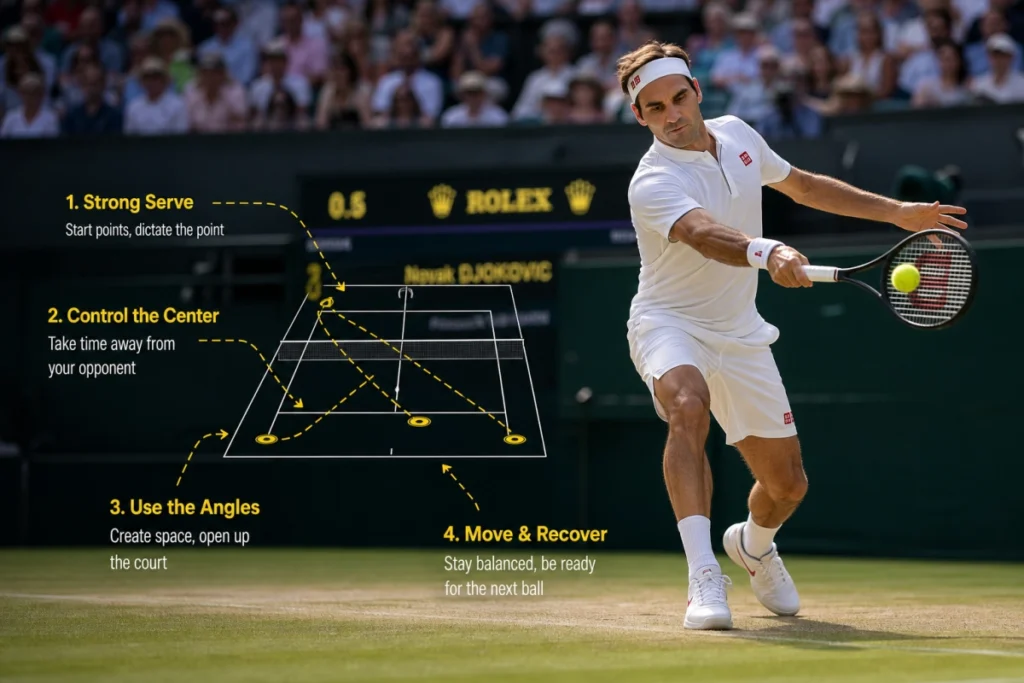
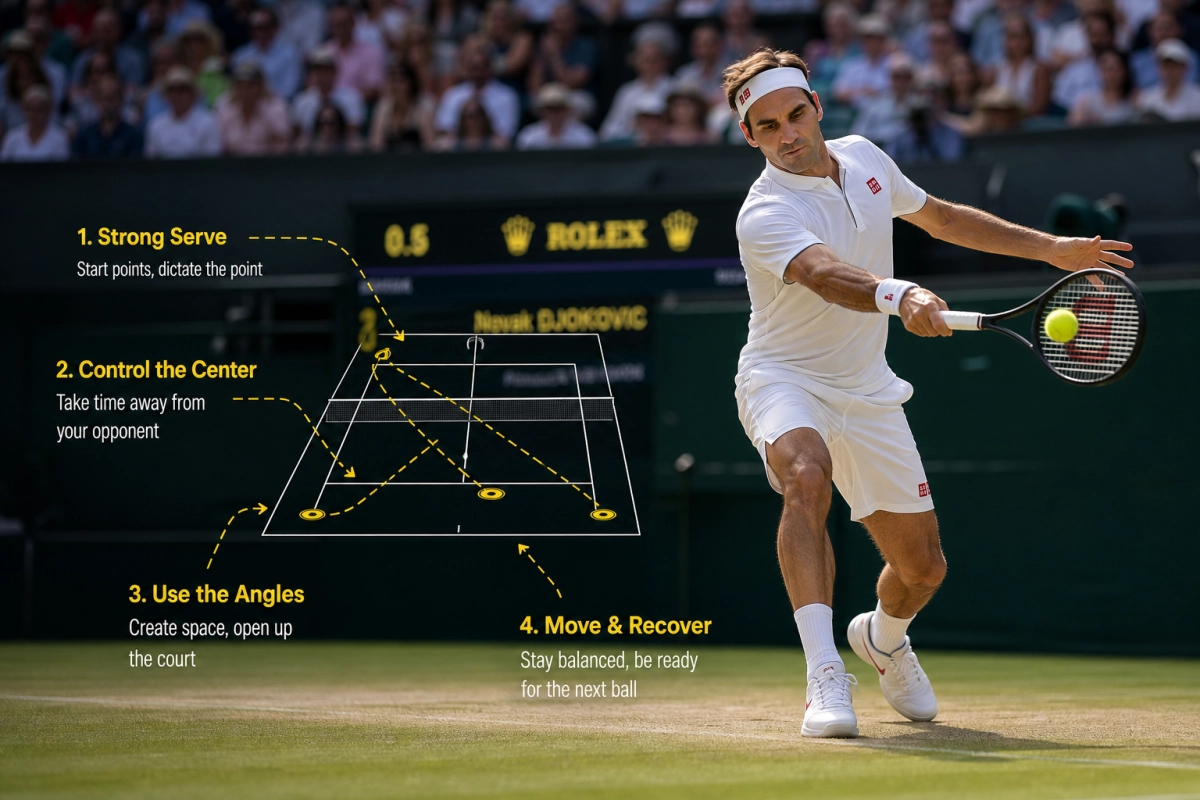
Raw power and athleticism will carry a tennis player only so far. At the professional level, where the physical gap between competitors narrows, tactical intelligence consistently makes the difference. The best tennis strategies are not improvised under pressure — they are carefully developed systems that players rehearse, refine, and adapt depending on opponent, surface, and conditions.
Understanding these strategies transforms how you watch the game. A baseline rally is often a precisely constructed sequence designed to open the court, force a defensive reply, and create a high-percentage opportunity. A serve directed at the body is rarely accidental. Every meaningful shot in professional tennis carries intent.
Baseline Play: The Foundation of Modern Professional Tennis
Baseline play has become the dominant tactical identity of the professional game over the past three decades, driven by advances in racquet technology and physical conditioning that allow players to generate extraordinary topspin and pace from deep positions.
The core logic is control through consistency. A player who sustains long rallies, redirects the ball with precision, and physically outlasts an opponent puts enormous pressure on their rival to take uncharacteristic risks or simply make more errors. Novak Djokovic is widely regarded as the most complete baseliner in ATP history, capable of defending seemingly unreachable balls and transitioning instantly from defense to offense within the same rally.
On the WTA Tour, Iga Świątek illustrates aggressive baseline play at its highest level. Her forehand generates heavy topspin that pushes opponents far behind the baseline, and her court positioning creates angles most players cannot neutralize. She rarely needs to come forward because the baseline itself is an offensive weapon.
Constructing Points from the Back of the Court
Effective baseline play is not passive hitting. Professional baseliners typically build points around a recognizable pattern:
- Opening with a directional serve or return to establish court position
- Using crosscourt exchanges to move the opponent laterally without exposing the center
- Introducing a change of direction when the opponent is off balance
- Finishing with a penetrating shot into open court or drawing a short reply that allows an approach
The sequence matters. Hitting hard without purpose rarely produces clean winners at the professional level; hitting with clear construction creates the situation where a winner becomes possible.
Surface plays a significant role. Clay slows the ball and amplifies topspin, giving baseliners more time to reset. Hard courts reward both consistency and pace. Grass keeps the ball low and fast, compressing rally time and historically exposing pure baseliners to serve-and-volley threats.
Serve-and-Volley: A Classic Approach Reimagined
Serve-and-volley was once the defining identity of professional tennis. Players like John McEnroe and Stefan Edberg built entire careers around rushing the net immediately after serving, cutting off angles before an opponent could recover, and finishing points with precise volleys before a rally began. The modern game largely moved away from pure serve-and-volley as racquet technology allowed baseliners to hit passing shots with pace and heavy dip that made net approaches far more dangerous. Yet the smartest contemporary players have reintegrated its core principles selectively.
What makes serve-and-volley work is the combination of time pressure and geometric domination. By moving forward immediately after the serve, the approaching player forces the returner into a compressed decision window — less time to set up, less court to aim at, and the psychological weight of executing a precise pass under pressure. On grass, where the ball skids through quickly, this time compression becomes severe, which is why Wimbledon remains the surface where serve-and-volley strategies resurface most reliably.
How Contemporary Players Selectively Use the Net
Rather than committing to serve-and-volley as a complete system, today’s professionals deploy it as tactical disruption — an unexpected deviation that forces an opponent to recalibrate mid-match. Roger Federer demonstrated this throughout his career, mixing net approaches into baseline-oriented points to prevent opponents from settling into comfortable return positions. The unpredictability itself became a weapon.
Current professionals are most likely to attack the net directly:
- After a wide serve on grass or fast hard courts that pulls the returner far off court
- Following a short ball hit from a defensive position
- On second serves against opponents who struggle with passing shots under pressure
- As a deliberate psychological disruption after an extended baseline exchange has grown predictable
Aggressive Returning: Converting Defense into Instant Offense
The return of serve receives less tactical attention than it deserves. In practical terms, returning is half of every match — and players who elevate it beyond survival into a genuine offensive platform gain a structural advantage that compounds over the course of a match.
Aggressive returning means taking the ball earlier in its bounce cycle, maintaining a forward body position, and targeting zones of the service box that immediately put the server on the defensive. Andre Agassi was perhaps the first player to fully articulate this approach at the elite level, standing several feet inside the baseline to rob opponents of recovery time. Servers who anticipated a free point on first serve suddenly found themselves scrambling instead.
On the contemporary WTA Tour, elite returners use chip-and-charge returns, redirected slice returns to wrong-foot net-rushing opponents, or deep topspin returns aimed at the server’s weaker wing. The most sophisticated returners adjust their aggression level based on their read of the server’s pattern — identifying whether a player favors a wide serve on the deuce side, for example, and pre-positioning to intercept it with more authority.
Reading Patterns and Breaking Serve Rhythms
Professional returners invest considerable effort in understanding serve tendencies before and during a match. A server who always goes wide on the ad side under break-point pressure becomes predictable over a set. A player who telegraphs their toss position before a body serve gives the returner a fraction of additional preparation time. These marginal advantages accumulate into genuine strategic leverage over three or five sets.
Breaking a server’s rhythm also extends beyond the return shot itself. Deliberate use of time between points, stepping out of the box to delay momentum, and demonstrating comfort under pressure all contribute to destabilizing a server’s confidence. The mental dimension of returning is as consequential as the mechanical execution.
Surface Intelligence: How Court Conditions Shape Every Tactical Decision
No tactical framework exists in isolation from the surface beneath a player’s feet. The same strategy that produces a convincing victory on clay can become a liability two weeks later on grass, and the best professionals are defined in part by how fluently they adapt to these environmental shifts throughout the season.
Clay rewards patience, physical endurance, and heavy topspin that climbs high above the opponent’s shoulder. The surface punishes impatience — a player who forces the point too early gifts the opponent a recovery opportunity. Rafael Nadal’s record on clay is the most extreme illustration in tennis history, built on a tactical system that used the surface’s inherent properties as an extension of his own game.
Hard courts reward versatility above everything else. The bounce is consistent and predictable, and neither pure baseliners nor serve-and-volley specialists hold an inherent advantage. This is why the Australian Open and US Open fields frequently deliver unexpected deep runs from players with diverse tactical identities.
Grass remains the surface most hostile to purely defensive approaches. The low, skidding bounce compresses time dramatically, and the premium on a powerful, precise first serve is higher than on any other surface. Players who compete at Wimbledon without any willingness to move forward concede a meaningful structural disadvantage before the first point is played.
Tactical Mastery as a Continuous, Evolving Practice
What emerges from examining these frameworks together is that tactical excellence in professional tennis is never static. Baseline play, serve-and-volley, aggressive returning, and surface adaptation are not separate choices — they are interconnected tools that the best competitors deploy in combination, adjusting emphasis based on the score, the opponent’s tendencies, and the conditions of a specific match on a specific day.
The most tactically sophisticated players maintain the discipline to execute a planned structure under pressure while holding the awareness to abandon that structure the moment evidence suggests it is not working. Djokovic adjusting his court position mid-set, Świątek changing rally pace after losing consecutive points, a serve-and-volley variation introduced at 4-5 in the third — these are not random decisions. They are the visible outputs of a trained tactical mind reading a competitive situation in real time.
Watching professional tennis through this lens changes the experience entirely. Every serve, every return stance, every decision to move forward or hold the baseline carries a logic that extends beyond the single point being played. The best players are not simply executing shots — they are authoring arguments, building cases over the course of a match, and using every tactical resource available to make their version of the game the one that ultimately prevails.
That is what tactical intelligence in professional tennis ultimately looks like: not genius improvised in the moment, but disciplined preparation meeting sharp in-match awareness, expressed through every shot in every rally across every surface the sport demands.