
Why the US Open Stands Apart from Every Other Grand Slam
The US Open is the final Grand Slam of the calendar year, held each August and September in New York City, and it carries an energy no other tennis tournament quite replicates. From the roar of Arthur Ashe Stadium under the lights to the thunder of jets passing overhead, the tournament is loud, fast, and unapologetically urban. But beyond the atmosphere lies a tournament with genuine historical depth, pioneering records, and a format that has shaped the modern game in ways casual fans may not immediately recognize.
From Newport to Flushing Meadows: A Brief History
The US Open traces its origins to 1881, making it the oldest of the four Grand Slams. It began as the U.S. National Championship, held on grass courts at the Newport Casino in Rhode Island, open only to members of American tennis clubs. The modern era began in 1968, when tennis entered the Open Era and Grand Slams began allowing professionals to compete alongside amateurs. That first open edition welcomed all players regardless of status — a principle the tournament has upheld ever since.
In 1970, the US Open became the first Grand Slam to adopt the tiebreak, reflecting a willingness to prioritize both player welfare and spectator experience. While other majors resisted the format for years, Flushing Meadows had been using it for decades. Then in 1973, the tournament made history again by becoming the first Grand Slam to award equal prize money to men and women — a decision made under pressure from players including Billie Jean King, and one that set a standard the other majors took years to follow.
The USTA Billie Jean King National Tennis Center
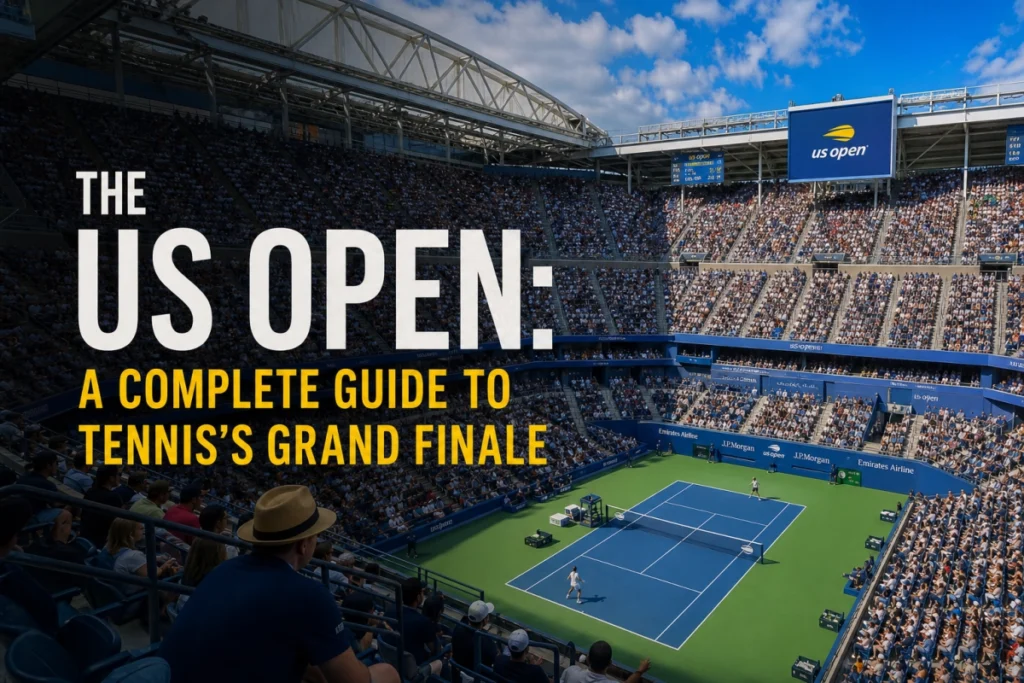
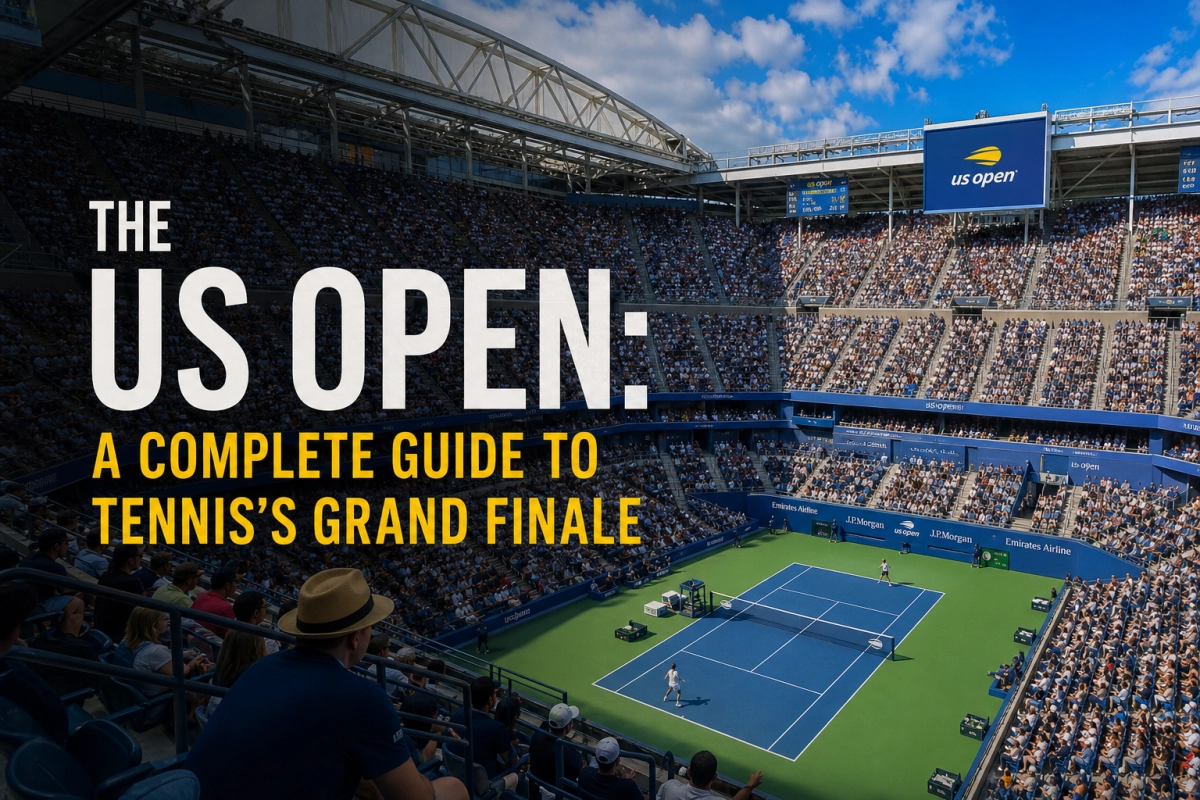
Since 1978, the US Open has been held at the USTA Billie Jean King National Tennis Center in Flushing Meadows-Corona Park, Queens. The facility is the largest public tennis complex in the world, with 34 courts in total. Its centerpiece, Arthur Ashe Stadium, seats 23,771 spectators — the largest tennis stadium on the planet. Named for the American champion who became the first Black man to win the US Open singles title in 1968, it received a retractable roof in 2016, eliminating rain delays during the tournament’s signature night sessions. Louis Armstrong Stadium followed with its own roof in 2018.
The 2023 tournament set an all-time attendance record of 957,387 spectators, underscoring how the US Open has grown into something larger than a sporting competition. For much of its audience, attending is as much a New York cultural experience as a tennis event — part of what separates it from the more restrained settings of Wimbledon or Roland Garros.
Hardcourt, Speed, and the Science of the Surface
The US Open is played on DecoTurf, a layered acrylic hardcourt surface used since 1978. Surface speed can be adjusted by altering the texture of the acrylic coating, and the US Open’s courts have traditionally sat on the faster end of the hardcourt spectrum — rewarding big servers and flat ball-strikers while placing a premium on aggressive baseline play.
The bounce at Flushing Meadows is higher and more predictable than on clay, but more penetrating than on Wimbledon’s grass. Hardcourt also transmits more shock through the body, which partly explains why joint and lower-limb injuries are a persistent concern, particularly for players arriving after a demanding summer hardcourt swing. Late August heat and humidity add further strain during day sessions, while cooling temperatures and a charged crowd create an almost entirely different environment for night matches — making scheduling placement on Ashe Stadium a functionally significant factor in any player’s tournament.
Format and Draw Structure
The men’s and women’s singles draws each contain 128 players, seeded according to ATP and WTA rankings. Players must win seven consecutive matches to claim the title. Top seeds receive protected draw positions to prevent early meetings between the best players, though upsets are a fixture at Flushing Meadows — hardcourt conditions suit a wider range of playing styles, and the New York crowd is capable of lifting lower-ranked players to performances that exceed their seeding.
One format distinction sets the US Open apart from every other major: its use of a conventional final-set tiebreak. Wimbledon employs a tiebreak at 6-6 in the final set, and the Australian Open uses a match tiebreak at 5-5, but the US Open has used a standard tiebreak to decide the final set since the Open Era began. Critics argue this undermines the drama of a prolonged decider; proponents contend it is fairer and more manageable within a strict broadcast schedule. The doubles and mixed doubles draws run concurrently throughout the fortnight and remain a fully promoted part of the tournament’s identity.
Prize Money and What It Reflects
The US Open consistently offers the largest total prize pool among the four Grand Slams, surpassing $65 million in recent editions, with singles champions in both draws receiving equal shares. That commitment to pay parity dates to the landmark 1973 decision and remains one of the tournament’s defining values. Distribution also extends meaningfully to early-round losers, partly in response to player advocacy for fairer compensation across the tour — lower-ranked players bear significant costs without the sponsorship income available to established names, and Grand Slam prize money is often their most important income source in a season.
The financial scale of the US Open reflects the commercial infrastructure surrounding it: corporate partnerships, broadcast rights, hospitality, and merchandise revenue make it one of the most lucrative sporting events in the United States. That revenue base funds both prize money increases and facility improvements, sustaining the tournament’s position at the top of professional tennis.
What the US Open Reveals About Tennis at Its Most Human
Every Grand Slam has its defining quality. Wimbledon has tradition and quiet authority. Roland Garros has clay, grinding attrition, and the long shadow of Rafael Nadal. The Australian Open has southern summer heat and a city that genuinely embraces the sport. The US Open has something different — a productive tension between the game’s demands and the world pressing in from every direction.
The planes overhead, the night sessions stretching past midnight, the crowd that cheers for both underdog and spectacle, the heat that turns afternoon matches into endurance tests — none of it is incidental. It is the environment the US Open has always offered, and the champions it produces are defined in part by how well they perform inside it. That is not a flaw in the tournament’s design. It is the design.
The US Open has consistently been the Grand Slam most willing to change — adopting the tiebreak first, awarding equal prize money first, building retractable roofs on two show courts, and embracing prime-time scheduling when other majors were still organized around afternoon tea. Some decisions have drawn criticism, but taken together they reflect a tournament that has always treated tennis as a living sport rather than a preserved institution. The result is a two-week event that feels genuinely unpredictable, where the surface, the crowd, the scheduling, and the sheer metropolitan energy have a way of equalizing players that more controlled environments do not. For anyone looking to understand professional tennis more deeply, the US Open is an essential case study — an annual measure of what the game is capable of producing when everything is turned up to full volume.