

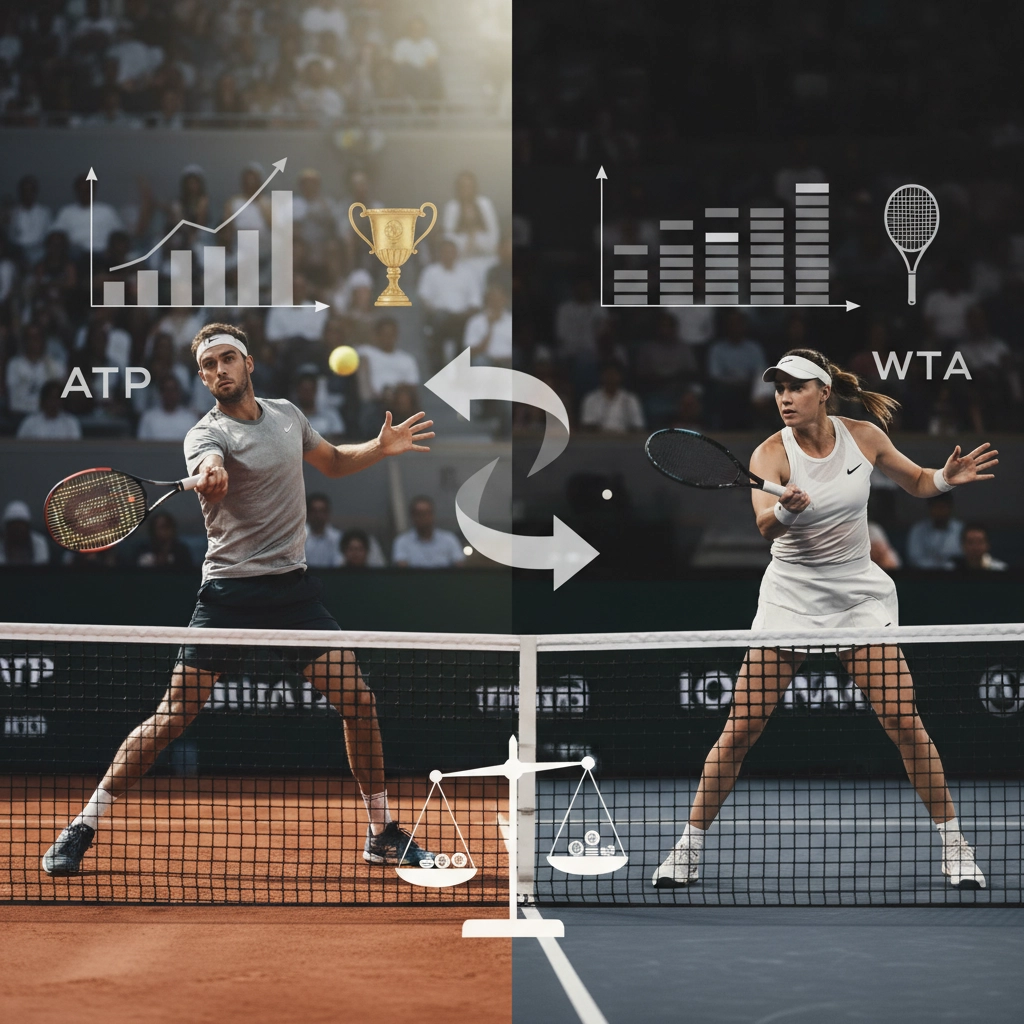
How ATP and WTA structures influence the prices you see
When you open a tennis market, the numbers on the board are a reflection not just of two players’ recent form but of deeper structural differences between the ATP and WTA tours. You’ll quickly notice that identical matchups can produce different price dynamics depending on whether you’re betting on a men’s or women’s match. Understanding why — and how ranking systems and tour depth feed into those prices — gives you a clearer edge when hunting value or sizing stakes.
Why rankings matter beyond a simple seed
Rankings are shorthand for quality, but they’re not neutral. The ATP and WTA use similar point-based systems, yet you should treat their numbers differently when you evaluate odds. The ATP tour often displays wider spreads between top-ranked players and the rest because depth and match-up volatility differ across events and surfaces. On the WTA side, the ranking bands can compress more frequently, which affects how books set favorites and underdogs.
As you assess a market, keep these ranking-related realities in mind:
- You can’t equate rank-to-rank probability across tours; a top-20 ATP player may be a steadier favorite than a top-20 WTA player in comparable fields.
- Recent ranking movement (big jumps or drops) often signals changeable form. Books adjust faster on the ATP for clear form trends because of higher media and statistical coverage.
- Surface-specific ranking points matter; look at how a player’s ranking splits by surface rather than relying only on overall rank when judging matchup odds.
How tour depth shapes volatility and value opportunities
Depth of field — how many genuine match-winners are active on tour — affects the volatility of odds you’ll encounter. If a tour has greater parity, you’ll see tighter markets and more frequent short-priced favorites being upset. When depth is shallower, favorites tend to hold more consistently and prices reflect that stability. Recognizing depth differences between ATP and WTA events helps you decide whether to back favorites, target overlays, or use live-betting strategies.
Practical indicators of depth you should watch
- Frequency of upsets: High upset rates mean underdogs carry more value; check historical event data for patterns.
- Seed performance: If lower seeds regularly beat higher seeds at a certain tournament or surface, expect more compressed odds.
- Turnover in later rounds: A draw that produces many first-time deep runs suggests volatile pricing you can exploit with careful research.
By combining your reading of ranking signals with an eye on tour depth, you’ll be better positioned to interpret bookmaker prices and identify where markets may be mispricing risk. Next, you’ll look at how match-level factors — like recent form, head-to-heads and surface preference — interact with ranking and depth to change the odds you should target.
Match-level variables that amplify or mute ranking signals
Rankings give a baseline but match-level context is what often flips a market. A top-ranked player can look vulnerable if several micro-factors line up against them, while a lower-ranked opponent can be underpriced when those same factors favour their game. Focus on these actionable variables when comparing odds to implied probability:
- Recent match load and recovery: Consecutive long matches before a tournament, or a late-night win with little recovery time, materially increases upset risk. Books price fatigue into favourites unevenly across tours—ATP players tend to recover better from long matches due to physical conditioning norms; the WTA can see sharper short-term drops in level.
- Head-to-head by surface and time window: H2H is only useful when filtered for surface and recent form. A one-off clay result three years ago is irrelevant for an indoor hard match today. Look at H2H across the past 18 months and weight surface-specific meetings more heavily.
- Injury and fitness signals: Walkovers, shortened matches, or visible movement issues in prior rounds should push you to reassess implied odds. Markets often lag on subtle fitness news, creating pre-match value if you’re quick and informed.
- Mental momentum and match flow: Players returning from a slump or on a multi-match winning streak often outperform their ranking for a short period. Books are increasingly responsive on the ATP to streaks; the WTA shows more abrupt swings, especially in early rounds.

How style and serve/return dynamics diverge between ATP and WTA markets
The raw mechanics of the men’s and women’s games—serve speed, break-point frequency, rally length—produce different market shapes and prop opportunities. Understanding those stylistic differences helps you pick the right market to target.
- Serve dominance vs return depth: On the ATP, big servers create more 1-serve points and tiebreaks, increasing the value of set betting (straight sets vs three). On the WTA, returners win more service games overall, making games totals and break markets more fruitful.
- Frequency of three-set matches: WTA matches often show higher short-term volatility and a greater share of third-set deciders in certain events. That favors live-betting strategies or pre-match lay-bets on short-priced favourites.
- Prop market edge: Props tied to break points, total games, or first-serve percentage can be mispriced when books apply generic models across tours. For example, a WTA player with an elite return stat against a shaky server may offer value on over break points won—something the board might under-cook if it leans on ATP-style assumptions.
Market timing, live play and where mispricings appear
When you enter a market matters as much as which market you choose. Books price in different information at different times, and tour-specific rhythms create predictable windows where mispricings cluster.
- Pre-match windows: Early lines (overnight or morning) often reflect ranking-led probabilities. If you see news—withdrawals, practice reports, weather changes—late shifts can present value for quick movers.
- Live-betting opportunities: Momentum swings in WTA matches (break-back, short rallies) can cause sharper in-play price moves. ATP in-play pricing tends to be steadier but offers opportunities on tiebreak and set markets due to serve skew.
- Bookmaker biases and public money: The public favors big names and favourites; this bias is stronger on high-profile ATP events. On smaller WTA draws, books may overreact to short-term narratives, creating overlays for disciplined bettors who use statistical checks.
- Horizon of bet (match vs futures): Futures and outright markets more heavily reflect ranking and tour depth. If you’re targeting value across a season, adjust your staking according to how shallow or deep the field is—shallower ATP fields reward backing clear favourites over long samples, while WTA futures can present long-shot value thanks to turnover.
Before you close your notebook, one practical way to finish preparing a market is to run a short checklist: calibrate implied probability against ranking and surface split, factor in match-level context (fatigue, H2H by surface, injury signs), choose the market that matches style dynamics (set betting, games total, prop), and pick a staking plan that reflects tour depth and your edge. Keep records so you can test which adjustments—surface weighting, H2H window, or live-entry rules—actually improve your return over time.

Putting the framework into action
Betting on tennis isn’t about finding a single holy grail number; it’s about consistently applying a framework that respects differences between the ATP and WTA. Treat rankings as a starting point, let tour depth adjust your expectations for volatility, and use match-level signals to tilt into or away from a line. Maintain discipline: small, repeatable edges compounded over a season beat occasional lucky wins.
For up-to-date rankings, tournament fields and official match information that will help you execute this approach, consult the official tour site and the equivalent WTA resources before locking a bet.
Frequently Asked Questions
How should I change stake size between ATP and WTA bets?
Adjust stake size based on your measured edge and the tour’s volatility. If your model shows a smaller, less reliable edge on WTA matches because of higher short-term swings, reduce stakes relative to ATP bets where the same edge may be more stable. Use a percentage of bankroll or Kelly-fraction approach and track outcomes by tour to refine sizing.
Do head-to-head records matter equally for ATP and WTA match predictions?
H2H matters on both tours but must be filtered for surface and recency. On the WTA, short-term form swings can make older meetings less predictive; on the ATP, stylistic matchups (big serve vs strong returner) often persist longer. Weight H2H more heavily when meetings are recent and surface-aligned.
When are live-betting opportunities typically better on ATP versus WTA?
WTA matches often offer sharper in-play price movements around momentum events (breakbacks, mini-streaks), so quick live entries or lays can pay off. ATP live value frequently appears around serve-dominated situations—tiebreaks, deciding-set serve holds—where probabilities are stable and easier to model. Adapt your live rules to the tour and the specific player styles.