
When two legends met on the grass: why Federer vs Nadal at Wimbledon matters to you
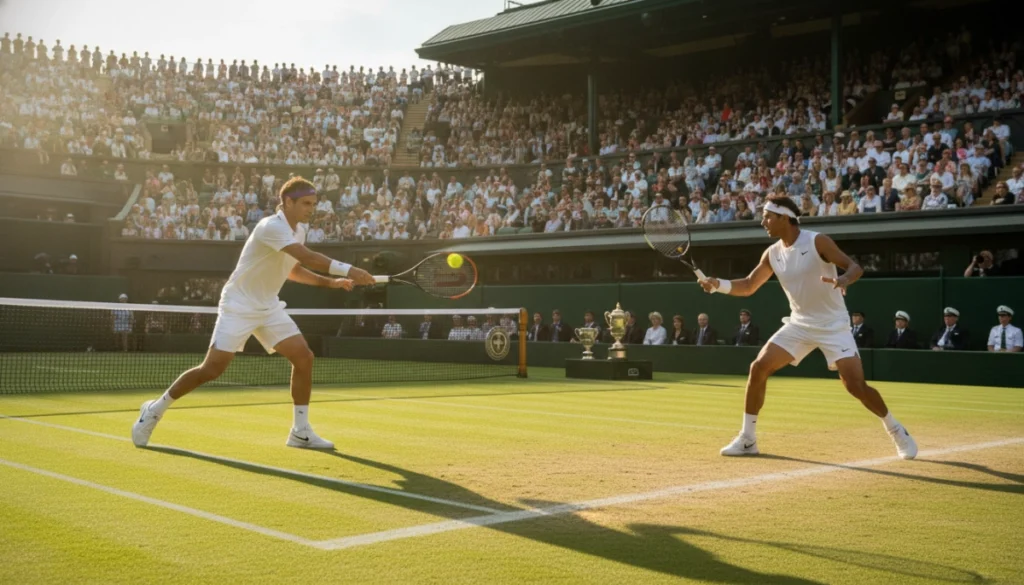
You may already know that Roger Federer and Rafael Nadal created one of the most compelling rivalries in tennis history. At Wimbledon—tennis’s most storied venue—their clashes carried extra weight: pristine lawns, royal attention, and a surface that traditionally favored Federer’s fluid serve-and-volley elegance over Nadal’s heavy-topspin baseline game. Understanding their Wimbledon duels helps you appreciate how elite players adapt tactics, mental approach, and shot selection to a specific stage.
In these early chapters of their Wimbledon story, you’ll see two defining themes: a stylistic collision that forced each champion to evolve, and matches that changed public perception of what was possible on grass. Those themes set the stage for the matches that followed and for how both players are remembered.
How their styles created a tactical chess match
When you watch Federer and Nadal at Wimbledon, notice how differently they construct points. Federer’s game on grass is built around precision serves, aggressive court positioning, and effortless slice that shortens rallies. Nadal brings heavy topspin forehands, relentless court coverage, and a willingness to trade baseline exchanges—even on grass, where low bounces typically favor shorter points.
- You’ll see Federer use angled serves and quick approaches to shorten points and exploit Nadal’s movement to the net.
- Nadal counters by taking the ball early, chasing down short balls with extraordinary footwork, and stepping inside the baseline to redirect pace.
- Mental resilience becomes critical: on grass, a handful of service breaks can decide a match, so both players sharpen focus on key moments like return games and tiebreaks.
Beyond technique, the rivalry pushed both players to tweak equipment, footwork, and tactics. If you pay attention, you’ll spot how Federer adjusted his return positioning and how Nadal improved his slice and serve to handle low, fast rallies.
Early Wimbledon finals that defined momentum: 2006 and 2007
Their first Wimbledon finals meetings marked the transition from clay-dominated contests to grass-borne drama. In their initial center-court showdown, Federer’s mastery of the surface was on full display; he executed surgical serving and aggressive net play that kept Nadal on the defensive. That match underscored Federer’s grass-court supremacy while also revealing Nadal’s growing ability to challenge Federer’s rhythm.
The rematch the following year widened the narrative. You’ll notice a tougher, more tactical Nadal—more willing to extend rallies and attack Federer’s backhand—while Federer responded with greater patience and strategic variety. The second final stretched into a longer, more fluctuating affair, showing that Nadal could push Federer physically and mentally even on grass.
These back-to-back finals didn’t just hand Federer titles; they signaled a rivalry that would escalate, both in intensity and historical significance. The adjustments you witnessed in 2006 and 2007 foreshadowed the dramatic shifts to come.
Next, you’ll examine the 2008 Wimbledon final—often cited as the single greatest match in tennis history—and break down the turning points, momentum swings, and moments that made it unforgettable.
2008: the final that redefined modern tennis
The 2008 Wimbledon final between Federer and Nadal is more than a match in their rivalry; it’s the watershed moment that shifted tennis narratives. You remember why: two bulls of the baseline and the net met in a contest that blended artistry and attrition. Nadal’s straight-sets start stunned Centre Court; Federer’s recovery through two tense tiebreaks dragged the fight into a fifth set that would become the stuff of legend. Add a rain delay, falling light, and almost five hours of play, and you get a drama that read like a classical symphony with crescendos and hushes.
What made this match unforgettable wasn’t just the final scoreline but the texture of its swings. Nadal’s heavy, penetrative forehand repeatedly tested Federer’s single-handed backhand; Federer’s variety—slices, inventive angles, sudden net forays—kept squeezing. The evening’s darkness and the visible fatigue on both champions amplified every point, every error, every roar from the crowd. When Nadal finally closed out 9–7 in the fifth, it felt like more than a victory: it was a changing of expectations about who could win on grass and how.
Turning points and momentum swings that decided the 2008 final
To appreciate why the scoreboard reads the way it does, watch these decisive stretches closely:
- Early pressure from Nadal: his first-set breaks were more than scoreboard advantages—they set a psychological tone. Federer had to chase rhythm for most of the afternoon.
- Federer’s tiebreak resilience: winning the third and fourth sets in tiebreaks shifted momentum and suggested a late comeback. Those tiebreaks were tight, high-quality snapshots of both players’ nerve and shotmaking under duress.
- The rain interruption and resumption: play stopped and then resumed in changing light; disruptions like that often favor the mentally tougher player. On that evening, Nadal’s focus after the break was razor-sharp.
- Endurance in the fifth: as both men tired, Nadal’s willingness to push for depth and to run down Federer’s sharpening angles paid off. Small unforced errors from Federer at critical games—coupled with Nadal’s clutch serving—tilted the balance.
Each swing mattered not just for the set but for momentum across hours of play. In matches of this magnitude, a single break or mini-run can compound into decisive advantage because both players are so efficient at capitalizing on even the smallest lapse.
What the match taught you about adapting on grass
If you study this final with an eye for learning, two lessons stand out. First, raw power and topspin—Nadal’s signature—can be modified to beat a grass expert: he flattened trajectories more frequently, improved first-serve placement, and targeted Federer’s backhand to generate shorter replies. Second, tactical variety remains crucial: Federer’s slices and approaches kept points unpredictable, but on that day Nadal’s passing consistency and retrieval depth neutralized many of those gambits.
Beyond tactics, the match reinforced a broader truth about elite rivalry: fitness, patience, and psychological composure are as decisive as shot selection. The 2008 final didn’t just hand Nadal a Wimbledon crown; it showed you how champions evolve to win where they were once at a perceived disadvantage.
After 2008: the match’s long shadow on grass-court tennis
The 2008 final did more than hand a trophy to Nadal: it reshaped how players approach grass. Coaches and pros took note of the success of heavy, penetrating groundstrokes on a surface long thought to reward only low-risk serving and net play. You can see echoes of that evolution in how younger players mix topspin depth with tactical variety, and in how established champions diversified their returns and slice to handle changing pace. Beyond tactics, the match set a template for stamina and mental focus under extreme conditions—lessons that continue to inform training and match preparation at Wimbledon and elsewhere.
Why their Wimbledon duels endure
These matches transcend scorelines because they combined contrasting artistry with sheer competitive will—Federer’s balletic precision versus Nadal’s ferocious intensity—on tennis’s most iconic stage. For fans and players alike, the duels on Wimbledon’s grass remain a masterclass in adaptation, resilience, and sportsmanship. If you want to relive the atmosphere and the pivotal points that made those afternoons unforgettable, the Wimbledon official site hosts archival highlights and essays that capture the spectacle and significance of those meetings.