
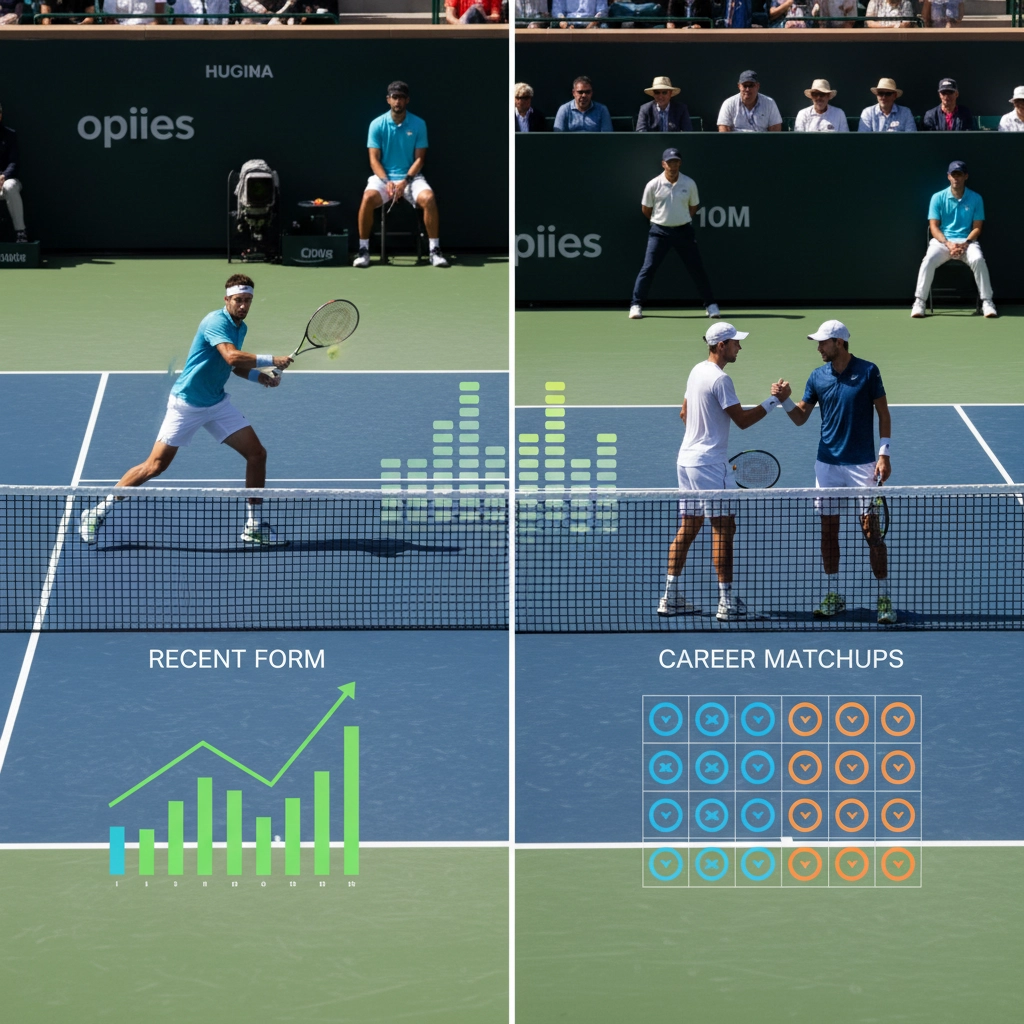
How recent form and career matchups influence head-to-head betting
When you bet on a tennis match, two types of evidence will usually compete for your attention: the player’s recent form and their career head-to-head (H2H) record. Recent form gives you a snapshot of current fitness, confidence, and rhythm. Career matchups reveal long-term stylistic advantages or recurring tactical problems. Neither source is automatically superior — what matters is how you read them in context and combine them into a coherent view before you place a wager.
What to check first: quick signs in recent form
Recent form is your early-warning system. You can assess it quickly, and it often explains sudden moves in the market. Look for these practical indicators:
- Sample size: Examine the last 5–10 matches rather than a single result. One upset or retirement rarely defines true form.
- Quality of opponents: Wins against top players are more informative than straight-sets victories over qualifiers.
- Scoreline patterns: Frequent tight deciders may indicate fatigue or mental fragility; dominant straight-sets wins suggest confidence.
- Physical signs: Short matches after long tournaments, frequent retirements, or visible movement issues point to injury risk.
- Surface momentum: Recent results on the same surface as the upcoming match carry extra weight (e.g., clay form before Roland Garros).
Use live interviews, player commentaries, and recent match stats (break points won, serve percentages) as quick corroboration. Recent form matters most when there’s clear evidence of improvement, decline, or a lingering injury.
Why career head-to-head records can be both useful and misleading
Career H2H records are tempting because they seem definitive: Player A beat Player B X times. But that number alone hides context. When you evaluate a career matchup, drill down into these dimensions:
- Surface breakdown: A 6–1 H2H that’s mostly on clay isn’t informative if the upcoming match is on a fast hard court.
- Match stages: Results in finals or Grand Slams often reveal mental toughness under pressure more than early-round meetings.
- Timing and age: Wins from five years ago may reflect different fitness and playing styles; a young player’s improvement can reverse trends quickly.
- Stylistic matchup: Some players inherently trouble others — e.g., a big server who avoids long baseline rallies can neutralize a counterpuncher consistently.
- Tactical patterns: Watch recurring scorelines (early breaks, long third sets) to see if one player creates the same problems repeatedly.
In short, H2H is valuable when you can identify a stable, surface-specific tactical advantage. Otherwise, it can mislead if you treat the raw count as the whole story.
Next, you’ll learn practical ways to weight recent form versus career matchups and a simple checklist you can use before placing a head-to-head bet.
Practical rules for weighting recent form vs career matchups
There’s no single formula, but you can use simple, repeatable rules to assign relative weight to recent form and career H2H. Think in terms of percentages and adjust them based on context:
- Default split: Start with a 50/50 split if nothing obvious stands out — this forces you to examine both sides rather than leaning on an intuition.
- Shift toward recent form (+10–30%): If a player has shown a clear trajectory (several wins over quality opponents, coaching change yielding visible technical improvements, or a sudden injury recovery), give recent form more weight. Also favor recent form when the H2H sample is small (fewer than 3 meaningful meetings).
- Shift toward H2H (+10–30%): If the H2H shows a stable, surface-specific tactical advantage across at least four matches (and those matches include similar court types and stages), favor the career matchup. This is especially true when the matchup exposes a recurring weakness (e.g., one player consistently neutralizes the other’s second serve).
- Surface override: If the H2H advantage is concentrated on a surface that’s not relevant to the upcoming match, reduce H2H weight dramatically (–20% or more). Conversely, if recent form is mostly on different surfaces, downweight it.
- Match format and stakes: Best-of-five and high-stakes events (Grand Slams, finals) tilt toward H2H if it reflects performance under pressure. Early-round, best-of-three matches are more likely decided by immediate form and fitness.
Use these adjustments cumulatively: a young player on a winning streak against weak opponents might get a modest recent-form bump (+10%), but if the H2H includes several recent, surface-relevant losses, that H2H may still justify a larger adjustment the other way.

A pre-bet checklist for head-to-head wagers
Before you click “place bet,” run through a short, practical checklist to make sure your weighting isn’t based on a single tempting data point.
- Last 10 matches: Record outcomes, opponent quality, and scorelines; note retirements and medical timeouts.
- H2H breakdown: List head-to-head results by surface, date, and tournament stage; flag matches older than two years.
- Key stats comparison: First-serve %, break points saved/conceded, return points won — compare recent trends, not just season averages.
- Physical & travel flags: Long flights, consecutive tournaments, and on-site practice reports that indicate fatigue or niggles.
- Weather & court speed: Wind, heat, and surface speed can amplify or negate tactical advantages (e.g., big servers profit on faster courts).
- Odds movement: Check early lines and money flow; sharp movement without news suggests professional interest and possible value shift.
- Alternative markets: If the head-to-head suggests a close stylistic battle, consider set betting, handicap, or total games markets for better value.
As a rule of thumb, if at least three checklist items point clearly in the same direction (injury + poor recent form + unfavorable surface), that should outweigh a stale H2H number.
Market context and tactical betting adjustments
Once you’ve weighted the evidence, use the market to find value rather than to confirm bias. Compare your implied probability to the bookmakers’ odds and ask where the market may be overreacting:
- Exploiting recency bias: Bookmakers and public bettors often overvalue a one-off upset or a hot streak. If your form analysis suggests regression, back the counterplay when odds are inflated.
- Leveraging H2H familiarity: Sharp bettors sometimes underprice a matchup where a player’s style consistently troubles another; small edges here are best taken with cautious stakes or in-play strategies.
- Staking discipline: Size stakes by edge confidence. When the split is close, reduce stake and prefer alternative markets with better expected value.
- In-play opportunities: Use live betting to capitalize on match dynamics that confirm your pre-match read — e.g., a service wobble from the H2H-favored player early in a set can flip the edge quickly.
Balancing recent form and career matchups is part art, part rules-based process. The market reaction often tells you whether your synthesis creates a genuine edge — and whether it’s worth a full stake, a reduced stake, or passing entirely.

Putting the framework into practice
Successful head-to-head betting comes from disciplined application, not one-off hunches. Use the checklist and weighting rules as a repeatable routine: assess recent form, inspect the H2H with surface and timing context, and only then compare your implied probability to the market. Start small, track outcomes, and refine your weightings as you collect evidence about which signals work for you in different tournaments and formats. For reliable match and player metrics, consult official sources like the ATP Tour statistics and incorporate those numbers into your pre-bet checks.
Above all, treat each matchup as a hypothesis to be tested. If your plan anticipates when recent form should dominate and when H2H should prevail, you’ll make clearer, less emotional decisions — and you’ll learn faster from the results.
Frequently Asked Questions
How many recent matches should I evaluate before deciding between form and H2H?
Use the last 5–10 matches as your baseline; five gives a quick read, ten smooths short-term variance. Weight those results by opponent quality and surface relevance, and discount single outliers (an isolated retirement or rare upset) unless there’s corroborating evidence of injury or change.
When is a career head-to-head record more trustworthy than recent form?
H2H is more persuasive when it shows a recurring, surface-specific tactical advantage across multiple meetings (ideally four or more), especially if those meetings include comparable tournament stages. It’s also stronger in longer formats or high-stakes matches where psychological patterns tend to repeat.
Can H2H inform in-play betting, or is it only useful pre-match?
H2H can be useful in-play because it highlights tendencies (e.g., how a player responds after losing the first set or their break-point resilience). Use it alongside live match stats and physical signs: if in-play events match the H2H tendencies, that can create value, but always account for momentum shifts and short-term variance.