
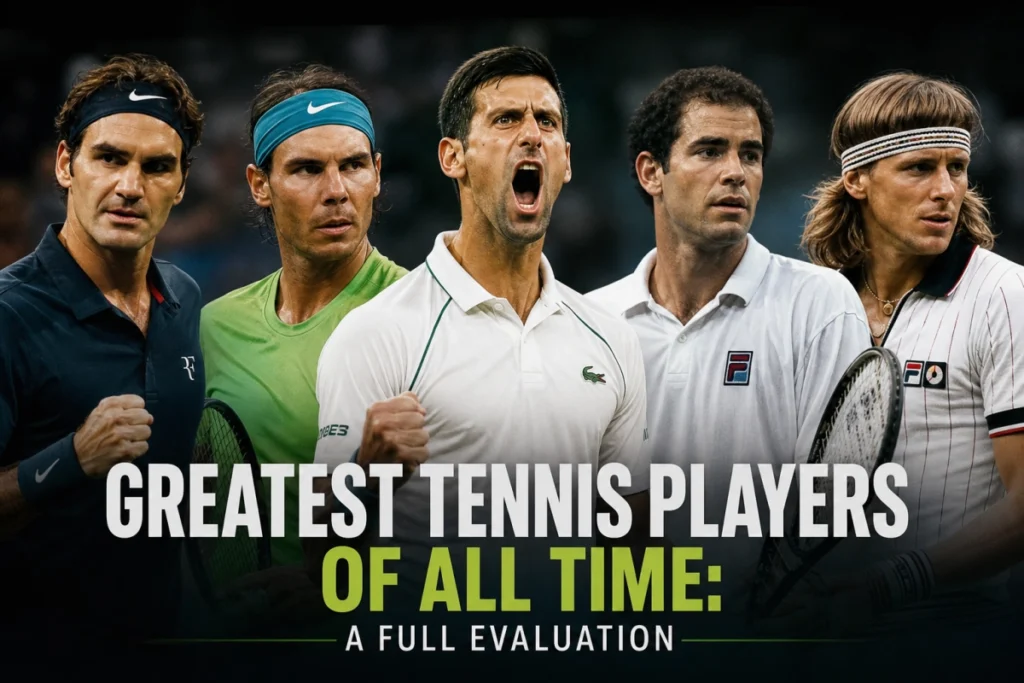

Why the GOAT Debate Deserves a Better Framework
Few conversations in sports generate more heat and less light than the debate over the greatest tennis players in history. Fans trade Grand Slam counts and head-to-head records as though they settle the matter. They rarely do. Tennis has evolved dramatically over more than a century—racquet technology, court surfaces, training science, and the global depth of the player pool have all shifted in ways that make raw number comparisons genuinely complicated.
That doesn’t mean the conversation is impossible. It means it requires a clearer framework. Before placing any player atop an all-time list, it helps to agree on what criteria matter, why each carries weight, and where each has limits. Doing that well means engaging seriously with both the Open Era—which began in 1968 when Grand Slam tournaments first allowed professionals to compete—and the generations before it.
The Criteria That Shape Any Serious All-Time Ranking
A credible evaluation of the greatest players tends to rest on five overlapping pillars. Each tells part of the story. None tells the whole story alone.
Grand Slam Titles
Grand Slam titles are the most widely cited benchmark, and for good reason. These four tournaments carry the most prestige, the largest draws, and the toughest competition. Winning many places a player in a category shared by very few. However, Grand Slam count alone is incomplete. Before 1968, the world’s best professionals were barred from these tournaments entirely. Even within the Open Era, the Australian Open was sparsely attended and often skipped by top players through much of the 1970s and 1980s, which affects how titles from different decades should be weighed.
Dominance Over Contemporaries
Sustained dominance over peers reveals something deeper than peak moments. Weeks at world number one, win percentage against top-ten opponents, and head-to-head records all measure how thoroughly a player controlled their era. A player who accumulated titles against a comparatively shallow field deserves honest acknowledgment of that fact, just as one who lost majors to an unusually stacked generation deserves credit for competing under harder conditions.
Surface Versatility and Longevity
Tennis is unusual in that its four most important tournaments are played on three different surfaces—hard courts, clay, and grass—each rewarding a distinct style. A player who excels on one surface but struggles on others has a narrower claim to all-time greatness than one who can win anywhere.
Longevity adds another dimension. Sustaining elite performance across a decade or more, through physical wear and evolving competition, demonstrates something that short, brilliant careers simply cannot.
The Pre-Open Era Problem
Any honest all-time conversation must grapple with what happened before 1968. Once a player turned professional, they were locked out of the Grand Slams entirely—exiled from the sport’s most prestigious stages at the very moment they proved good enough to earn a living from it.
Rod Laver is the most dramatic example. He won the calendar Grand Slam twice, but his second in 1969 came after years of exclusion from those events. Pancho Gonzales turned professional in 1949 and spent most of his prime dominating professional tours against the best available competition—yet his Grand Slam record reflects almost none of it. Ken Rosewall played at an extraordinary level across four decades, winning majors as a teenager and again in his late thirties, with a long professional stretch in between that the major record books simply erase.
The reasonable response is not to manufacture hypothetical titles. It is to treat professional tour dominance during those years as legitimate evidence of quality, weight it alongside available context, and resist ranking those players purely by the tally their era’s rules allowed them to accumulate.
What Head-to-Head Records Actually Tell Us
Head-to-head results carry genuine weight. When two elite players meet repeatedly across different surfaces and tournament stages, patterns emerge that reflect something real about their competitive relationship. A commanding advantage over a peer widely recognized as exceptional is meaningful evidence of superiority.
The complications arise quickly. Career totals can obscure the fact that matches played during one player’s physical decline skew the record in ways that don’t reflect the rivalry at its peak. Cross-generational comparisons cannot rely on head-to-head data at all, which is precisely why they require the other pillars to carry more of the analytical load.
Era Strength and the Depth Problem
One of the most contentious questions in all-time rankings is whether the competition a player faced was deep enough to make their dominance meaningful. The Open Era has seen the global player pool expand dramatically. Improved coaching, prize money growth, and professional academies across South America, Eastern Europe, and Asia have produced a far broader base of elite competitors than existed fifty years ago.
At the same time, some periods within the Open Era featured an unusual concentration of exceptional talent at the top—multiple players capable of winning majors in the same generation—making title accumulation during such a period genuinely harder. Evaluating era strength means examining:
- The overall depth of the draw beyond the top five or ten ranked players
- How many legitimate major-level threats a dominant player had to overcome repeatedly
- Whether physical and tactical demands placed additional burdens on competitors
- How quickly the sport was evolving technically, since rapid change rewards adaptability
The Players Who Define the Conversation
Laver remains the only player in the Open Era to have won a calendar Grand Slam, and the only man to have done it twice across both structural periods of the sport. The years he spent excluded from the majors don’t diminish that record—they make it more remarkable. Rosewall’s case may be the strangest in tennis history: a player who reached Grand Slam finals across five separate decades, whose professional tour record during his excluded years reads as one of consistent dominance, and whose modest Slam count makes sense only when you reconstruct what his era actually allowed.
Within the Open Era, the conversation arrives at Roger Federer, Rafael Nadal, and Novak Djokovic. Between them, they held a collective grip on men’s tennis for nearly two decades that has no real historical equivalent. Each satisfies the surface versatility criterion to a high degree, each demonstrated exceptional longevity, and the head-to-head results among the three are close enough that they don’t cleanly separate the group. Djokovic’s Grand Slam total has surpassed his rivals numerically, but the analytical question is never purely numerical.
On the women’s side, Steffi Graf’s combination of a calendar Grand Slam, an Olympic gold medal, and 377 weeks at world number one represents one of the most well-rounded career profiles the sport has produced. Serena Williams brought a level of power and competitive intensity that reshaped expectations entirely, winning majors across three separate decades. Martina Navratilova’s nine Wimbledon singles titles and sustained excellence into her mid-thirties argue strongly for her inclusion in any serious list. Margaret Court’s raw title count leads all players in history, though the amateur-era context shapes how that total should be read.
What Serious Ranking Ultimately Requires
The case for any individual player rests on how well they hold up across all relevant dimensions at once—not just the one or two that happen to favor them. A remarkable Grand Slam count with a narrow surface range yields to a player who won across all conditions. Stunning peak results without a sustained competitive window yield to one whose excellence proved it wasn’t circumstantial.
The most defensible all-time evaluations hold this complexity steadily in view rather than collapsing it into a single number. That doesn’t mean the conversation has no answer. It means the answer requires more than a quick glance at a title count—it requires applying criteria consistently across eras and resisting the temptation to let present-tense familiarity do the work that historical rigor should.
Tennis rewards intelligence as much as athleticism, and the debate about its greatest players deserves the same quality of thinking the best of them brought to the court. The framework matters because the players it honors have earned a more careful argument than simple numbers provide.