
Why Roland Garros Stands Apart From Every Other Grand Slam
Of the four Grand Slam tournaments, Roland Garros occupies a category of its own. The Australian Open rewards power and endurance on fast hard courts. Wimbledon demands adaptability on unpredictable grass. The US Open rewards aggressive ball-striking under floodlights and crowd noise. But the French Open — held every May and June in Paris — strips professional tennis down to something rawer: patience, physical resilience, and the ability to construct a point across five, six, or seven grueling exchanges on one of sport’s most demanding surfaces.
From Military Airfield to Tennis Cathedral: The Origins of Roland Garros
The French Championships began in 1891, initially restricted to members of French tennis clubs. It remained a largely domestic event until 1925, when it opened to international players. The name Roland Garros honors a French aviator and World War I hero — the first pilot to cross the Mediterranean Sea. When France needed a stadium to host the Davis Cup tie against the United States in 1928, the French Tennis Federation built a new facility on the western edge of Paris and named it in his honor.
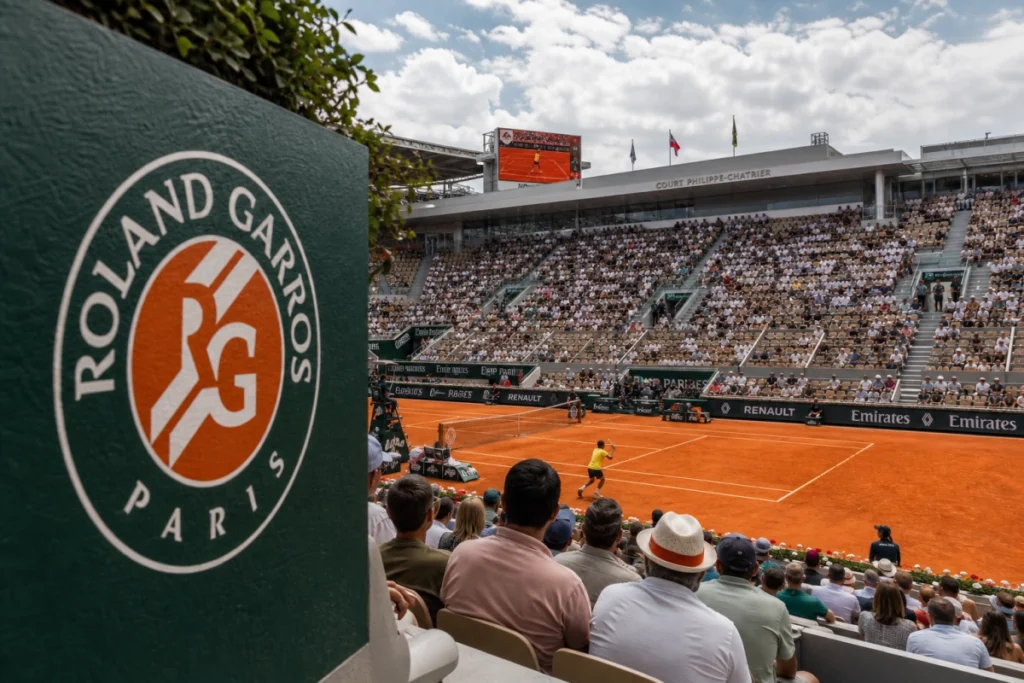
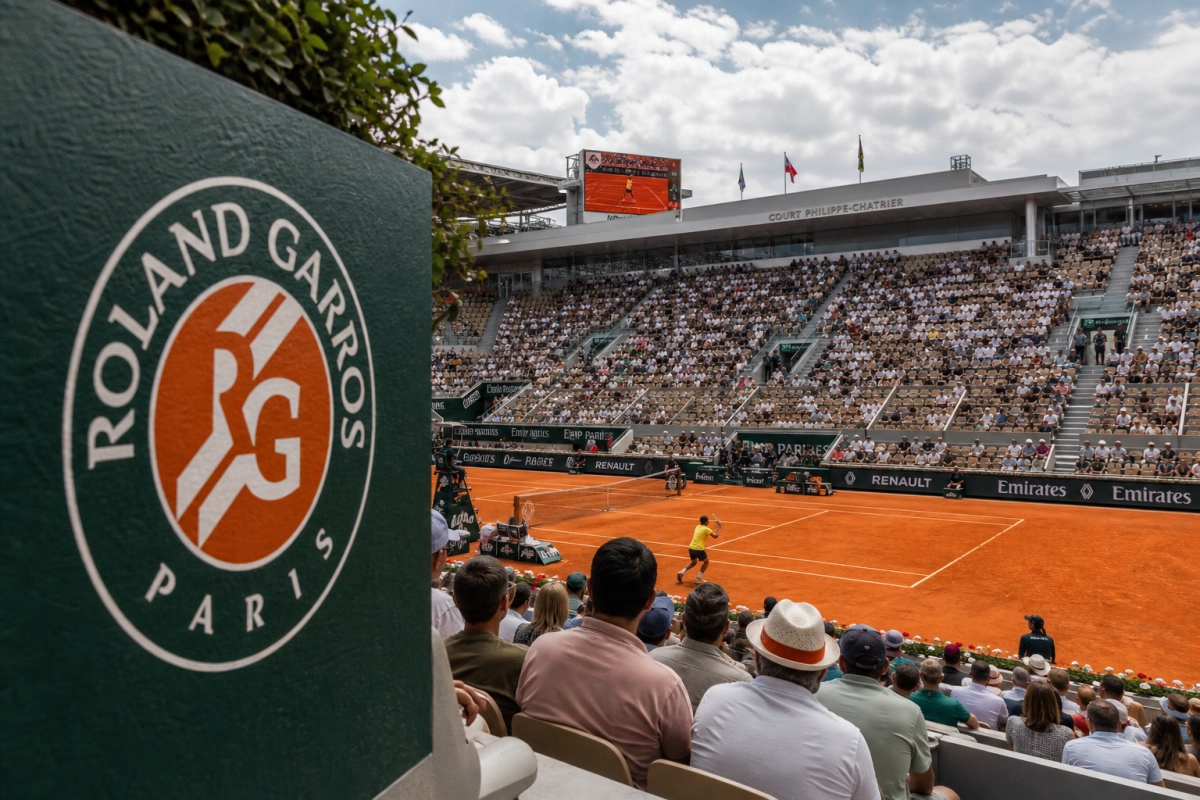
Court Philippe-Chatrier, the main showcase court, is named after the former French Tennis Federation president who helped professionalize the sport in France. Court Suzanne Lenglen — named after the dominant French champion of the 1920s — serves as the second show court. A third major court, Court Simonne Mathieu, opened in 2019, adding meaningful capacity alongside a striking botanical garden design.
What Clay Actually Does to a Tennis Match
The red clay used at Roland Garros is crushed brick, a material that behaves very differently from acrylic hard courts or Wimbledon’s rye grass. When a ball lands on clay, the surface absorbs pace and generates friction, slowing the ball considerably and producing a higher, more predictable bounce. That physical reality changes nearly everything about how the game is played.
On a fast hard court or grass, a well-placed serve can produce an immediate free point. On clay, that same serve loses enough speed that a skilled defender can track it down, return it deep, and begin a baseline exchange. Serve-and-volley tactics rarely succeed at Roland Garros. The baseline becomes the primary battleground.
Points tend to be longer, rallies more sustained, and physical toll accumulates rapidly. A five-set match on clay can last four hours or more, requiring aerobic conditioning and mental endurance that has no real equivalent elsewhere on tour. Clay also rewards heavy topspin — by brushing up the back of the ball aggressively, players generate a kick that rises above shoulder height off the surface, making defense physically demanding and technically awkward. Tall players with strong baseline groundstrokes hold structural advantages here.
The Format: How Roland Garros Is Structured Over Two Weeks
Roland Garros runs across approximately two weeks in late May and early June. The main draw contains 128 players in both men’s and women’s singles, producing seven rounds of single-elimination competition. One loss ends the run entirely — no second chances, no consolation brackets.
Men’s matches are played as best-of-five sets throughout the entire draw. Combined with clay’s punishing physical demands, this makes Roland Garros the most grueling test in tennis. A first-round match can stretch past three hours simply because neither player can put the other away cleanly. By the quarterfinals, a contender may have already spent fifteen or more hours on court.
Women’s matches are best-of-three, standard across all Grand Slams. Even so, sustained clay-court play means women’s matches at Roland Garros routinely produce more extended baseline battles than those on harder surfaces, and three-set contests often feel substantially more demanding than the scoreline suggests.
Scheduling, Weather, and the Unpredictability of Paris in Spring
Unlike the Australian Open’s reliable summer sunshine or the US Open’s late-summer warmth, Roland Garros takes place when cool temperatures, cloud cover, and rain are entirely plausible. Some editions have seen extended interruptions, with matches suspended mid-set and entire days wiped from the schedule.
Weather affects more than logistics. When conditions are cold and damp, the clay becomes heavier and slower, making it extraordinarily difficult to hit through an opponent. On sunny days, the surface dries out, plays faster, and favors more aggressive ball-striking. Players can find themselves disoriented by how differently the court plays from one morning to the next.
The introduction of a retractable roof over Court Philippe-Chatrier — completed in 2020 — addressed the tournament’s most visible weather vulnerability, and night sessions followed shortly after. But the roof covers only the main show court, meaning rain still suspends play across the rest of the grounds and creates scheduling compression that tests both organizers and players.
Why Certain Players Never Solve the Clay
The history of Roland Garros is as much about absences from the trophy cabinet as names engraved on it. Several players who dominated hard-court and grass circuits — collecting multiple Grand Slam titles elsewhere — spent entire careers unable to convert deep Paris runs into championships.
Part of the difficulty is mental. Extended rallies require a particular patience that doesn’t come naturally to players built around aggression and first-strike precision. Accepting that an apparent winner will be tracked down, resetting after a long exchange, sustaining focus across four or five hours — these are psychological skills that must be cultivated specifically for the surface.
Physical specialization adds another layer. The muscle groups most stressed by clay-court movement — hip flexors, adductors, and quadriceps used in wide lateral sliding — differ in emphasis from those prioritized on hard courts. Players who spend most of their season on hard courts may arrive in Paris without the specific conditioning clay rewards.
- Hard-court specialists often struggle to adjust serve-and-volley instincts to a surface that neutralizes first-strike advantages
- Players relying on flat, penetrating ball-striking find their margins reduced when the slower surface gives opponents extra time to set up
- The sliding footwork required on clay takes months of practice to execute safely, leaving late surface-switchers structurally vulnerable
- Mental fatigue from sustained defensive work — retrieving balls that would be winners elsewhere — can erode competitive focus across a long match
Collectively, these factors explain why the Roland Garros trophy has historically concentrated in the hands of players who grew up on clay or dedicated significant portions of their season to the surface.
What Winning Roland Garros Actually Means
There is a reason players speak about the Coupe des Mousquetaires with a reverence they rarely apply to hardware collected elsewhere. Winning Roland Garros does not simply confirm that a player is excellent. It confirms they are complete in the deepest, most demanding sense the sport can impose.
The clay filters out every shortcut. It punishes serve-heavy games, exposes players who can’t slide or construct a long point tactically, and rewards those who have done the patient, unglamorous work of mastering a surface that offers nothing for free. The players who have defined Roland Garros across different eras — Bjorn Borg’s baseline precision, Chris Evert’s groundstroke depth, Steffi Graf’s controlled aggression, Rafael Nadal’s almost implausible fourteen titles — each represented a different expression of the same quality: the ability to impose their game on clay’s terms rather than fighting against them.
For spectators, that difficulty is precisely what makes the tournament worth following. The long rallies are intricate tactical negotiations played at high speed. The match stretching to five sets and four hours is not a sign that neither player is good enough — it is a sign that both are extraordinarily good, and that clay refuses to let either one settle the matter cheaply.
Roland Garros does not reward the best tennis player of a given year. It rewards the most complete one — the player who has prepared most thoroughly, adapted most intelligently, and held their nerve longest across two weeks of accumulating physical and psychological pressure. Arriving in Paris each spring, every player knows the clay will find whatever is missing in their game. The ones who have already found it first are the ones whose names tend to end up on the trophy.