

From Newport to New York: The Origins of the US Open
The US Open is the most distinctly American of tennis’s four Grand Slams — loud, urban, unapologetic, and unlike anything else in the sport. It draws the largest attendance figures of any tennis tournament on earth, unfolds under the lights of New York City, and carries more than a century of history behind every match. For fans trying to understand what makes this tournament so significant, the story begins long before the concrete and crowds of Flushing Meadows.
The championship was first held in 1881 at the Newport Casino in Rhode Island. In those early years, only members of the United States National Lawn Tennis Association could enter, making it more private club competition than national championship. Women’s singles was added in 1887 at the Philadelphia Cricket Club, though it took years before the men’s and women’s draws shared a venue. The two events were eventually unified, and in 1915 the tournament relocated to the West Side Tennis Club in Forest Hills, Queens — the beginning of a genuinely public-facing championship that would grow alongside New York City itself.
Forest Hills remained home for over six decades, its famous horseshoe-shaped stadium hosting legends of the amateur era and then the early Open Era after 1968, when professionals were finally permitted to compete in Grand Slam events. The surface shifted over the years — from grass to clay to synthetic grass — reflecting ongoing debates about what conditions best suited a championship of that scale.
The Move to Flushing Meadows and the Birth of a Modern Grand Slam
By the late 1970s, Forest Hills had outgrown its capacity to host a commercially ambitious event. In 1978, the US Open moved to the USTA National Tennis Center in Flushing Meadows, Queens — adjacent to the site of two World’s Fairs and just minutes from LaGuardia Airport. The location made a deliberate statement: this was a championship built for a modern, global audience.
Hard courts — a cushioned acrylic surface now known as DecoTurf — replaced synthetic grass. That change had real consequences for how the game was played. Hard courts produce a consistent, medium-paced bounce that rewards aggressive baseline play and strong serving. Unlike clay, which slows the ball and rewards endurance, or grass, which favors flat, skidding shots, hard courts are fast enough to be unforgiving on return of serve but bouncy enough to sustain rallies. They also place heavy physical demands on players — the unforgiving surface transfers more impact to joints and muscles than clay does, which is why injury risk is a recurring conversation in the tournament’s second week.
The move also introduced two features that would define the tournament’s character: the roar of passing aircraft overhead, and the energy of a crowd that treats tennis like a contact sport rather than a quiet afternoon pastime.
The Tournament Format and What It Takes to Win
The US Open follows the standard Grand Slam structure — a 128-player main draw, best-of-five sets for men and best-of-three for women — but New York’s specific conditions create a championship that tests athletes beyond the scoreboard. One format detail that sets it apart is its tiebreak policy. The US Open uses a standard tiebreak at six games all in every set, including the final, keeping the schedule moving — a practical necessity when managing an event of this logistical complexity inside a busy metropolitan calendar.
The draw rewards consistency as much as brilliance. In reality, New York’s conditions frequently disrupt seedings. The heat and humidity of late August — the US Open is the last Grand Slam of the calendar year — wear players down across the fortnight. Serving percentages drop, movement becomes labored, and champions are often decided as much by physical resilience as by technical quality.
Night Sessions and the Electricity of Playing Under the Lights
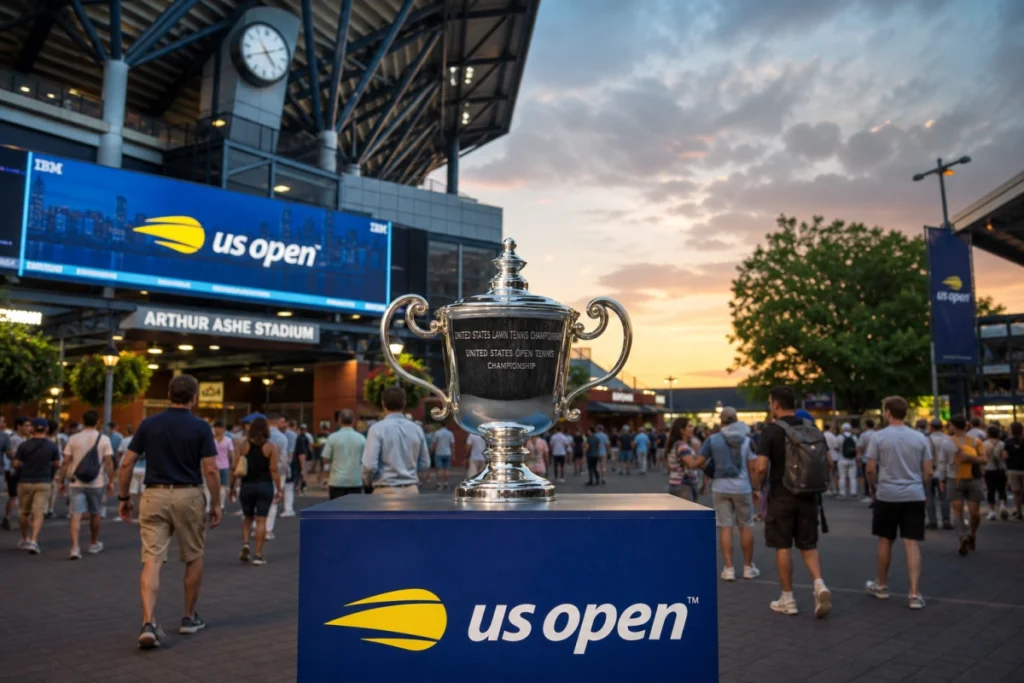
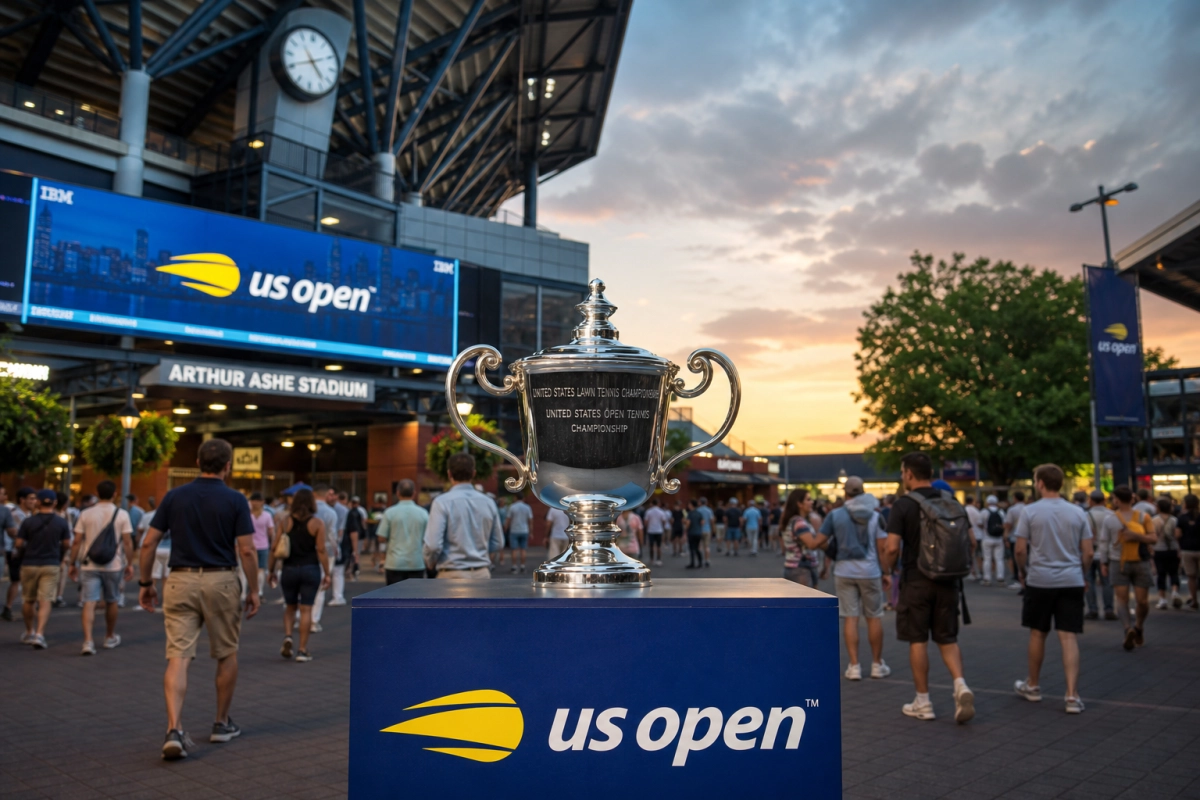
No single feature defines the US Open’s atmosphere more completely than its night sessions. Arthur Ashe Stadium — the largest tennis stadium in the world — regularly hosts prime-time matches that begin in early evening and run well past midnight. This is not an accident of scheduling. It is a deliberate statement about what kind of event the US Open wants to be.
Playing under the lights at Flushing Meadows is an experience players consistently describe as unlike anything else in tennis. The crowd becomes louder and more unpredictable once the sun drops. The artificial lighting subtly flattens depth perception, and the night air tends to slow the ball slightly compared to afternoon heat. These are marginal differences, but at the highest level, margins matter enormously.
For fans, night sessions are the premium experience. Scheduling decisions — which matches get the night slot — are watched closely. A night match assignment signals a player’s commercial profile as much as their seeding. Stars get night slots, and night slots create stars. The feedback loop between spectacle and status is one of the defining dynamics of how the US Open operates as both sporting event and entertainment product.
The Crowd as a Force in Itself
Tennis crowds at the US Open behave differently from those at any other major. At Wimbledon, near-silence between points is expected. At Roland Garros, the atmosphere is passionate but largely respectful of the sport’s rhythms. In New York, the crowd is a participant rather than a witness.
New Yorkers cheer for underdogs loudly and without embarrassment. They respond to shot-making with the instinctive appreciation of a crowd raised on basketball and baseball. Unforced errors draw groans; winners are celebrated with noise that can genuinely unsettle a player mid-service motion. Some players thrive on that intensity — it lifts their game into a higher register. Others find it destabilizing, particularly those accustomed to quieter Grand Slam environments.
That energy is part of why the US Open produces a disproportionate number of dramatic comebacks. There is something in the stadium that makes collapsing leads feel recoverable, and that shared belief between crowd and player has produced some of the tournament’s most memorable moments.
Why the US Open Stands Apart from the Other Grand Slams
Each Grand Slam has its own character. Wimbledon carries British ceremony and reverence for the amateur tradition. Roland Garros is defined by clay’s grinding demands. The Australian Open embraces heat and a welcoming party atmosphere. The US Open is different from all three — and not simply because of geography.
What separates it is the totality of its context. No other Grand Slam is staged inside one of the world’s most energized cities. The tournament does not ask its surroundings to quiet down. Instead, it absorbs New York’s energy and turns it into something that belongs entirely to tennis for two weeks. The hard-court surface reinforces that character — rewarding aggressive, high-tempo play that matches the city’s pace. Players who thrive in New York tend to be those who match that tempo rather than fight it.
The US Open’s willingness to evolve has also distinguished it from more tradition-bound peers. It was among the first majors to embrace night sessions as a core identity feature, and consistently the most commercially ambitious of the four Slams. Critics frame that ambition as tension with sporting purity. Supporters argue it is precisely what has kept the tournament financially powerful enough to invest back into the sport at every level.
A Championship That Has Always Reflected Its Time
From the private grass courts of Newport in 1881 to the floodlit concrete of Arthur Ashe Stadium today, the US Open has never stood still. It has changed surfaces, venues, and formats — always tracking the moment, always reaching for a larger audience. That restlessness is not incidental to its identity. It is its identity.
The tournament has produced defining moments across every era: the early amateur champions, the arrival of Open Era professionals, the rivalries that filled Flushing Meadows through the 1980s and 1990s, and the new generations who have made Ashe their most celebrated stage. Each chapter has added something without erasing what came before.
For anyone seeking to understand why tennis matters as a global sport, the US Open is as instructive as any tournament on the calendar. It is the Slam that most visibly carries the sport’s contradictions: tradition alongside commerce, elegance alongside noise, individual brilliance alongside the sheer, ungovernable energy of a crowd that refuses to be a passive observer. That tension is not a flaw. It is what makes the US Open, year after year, unmistakably itself.