
Why Ranking the Greatest Tennis Players Is More Complicated Than It Looks
Few debates in sports are as genuinely difficult — or as rewarding — as deciding who belongs among the best tennis players in history. Grand Slam tallies make for clean headlines, but they only tell part of the story. A player who dominated on one surface, in one era, against a particular generation of opponents occupies a different kind of greatness than someone who won across all surfaces, sustained excellence for two decades, and broke records that had stood for generations.
Tennis is unusual in that its playing conditions vary more than almost any other major sport. Clay courts reward patience and endurance. Wimbledon’s grass historically favored explosive servers and net players. Hard courts blend elements of both. Era shapes context further — equipment, competition depth, and preparation standards have changed significantly across generations, making direct comparisons genuinely complicated.
What Makes a Tennis Player Historically Great
Before ranking anyone, it helps to establish clear criteria. Grand Slam titles are the most widely cited benchmark, and reasonably so. But relying on that number alone produces incomplete conclusions. A more complete picture considers several dimensions together:
- Major titles and finals reached — both wins and consistent deep runs demonstrate sustained excellence
- Surface versatility — winning on clay, grass, and hard courts signals a more complete game
- World No. 1 tenure — weeks ranked first reflects consistent dominance across a full season
- Head-to-head records against peers — performance against the best opponents matters more than wins over lower-ranked competition
- Longevity — sustaining excellence into the late stages of a career separates the truly elite
No ranking system can be purely objective. The goal here is not to settle the debate permanently but to examine it honestly, weighing what the records actually show while respecting the different contexts each generation played in.
The Big Three and the Era That Redefined the Ceiling
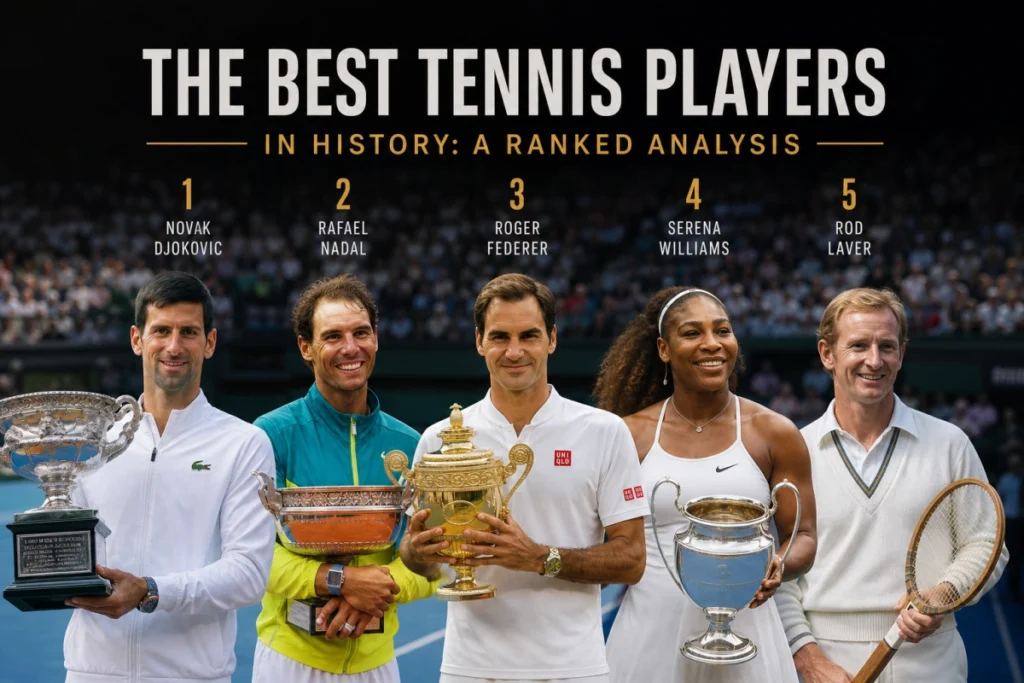
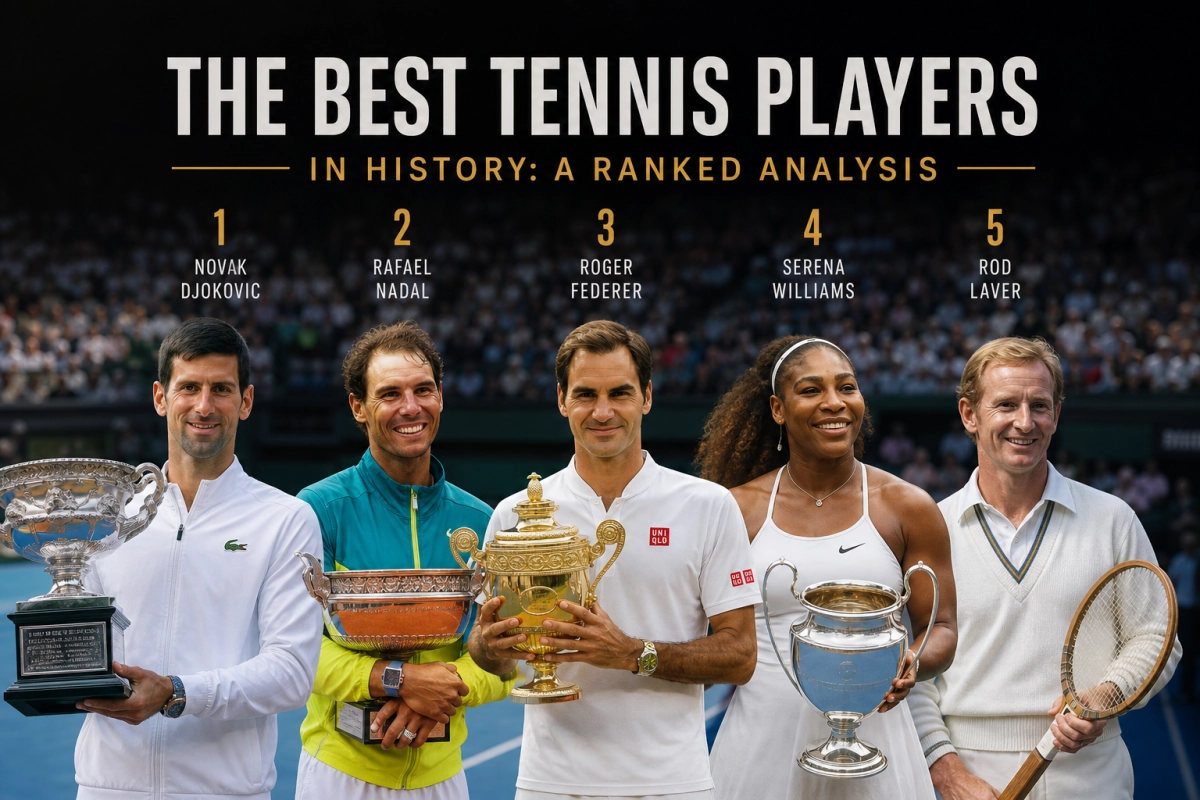
Any honest conversation about historical greatness has to reckon with a remarkable coincidence of timing: Roger Federer, Rafael Nadal, and Novak Djokovic competed at the top of the sport simultaneously for nearly two decades. In almost any other era, any one of them would have dominated the conversation entirely. Instead, they pushed each other to records that would have seemed implausible to previous generations.
Federer’s game was built on elegance and efficiency — fluid shotmaking, exceptional court geometry, and a serve-and-forehand combination that could dismantle opponents before they settled. Nadal operated on entirely different logic. His dominance at Roland Garros is historically unmatched, but what often gets lost is how he rebuilt his game to compete on faster surfaces, winning Wimbledon and multiple hard-court majors while sustaining one of the most physically punishing styles the game has seen.
Djokovic’s case is perhaps the most statistically compelling of the three. His return of serve is widely regarded as the best in the sport’s history. His defensive athleticism fundamentally changed how opponents constructed points against him. His consistency across all four majors, his record weeks at world number one, and his head-to-head record against both Federer and Nadal place him firmly in the conversation for the single greatest player the sport has produced.
Women’s Tennis and a Parallel Standard of Greatness
The women’s game has produced players whose careers demand the same analytical rigor. Serena Williams is the most obvious starting point. Her 23 Grand Slam singles titles in the Open Era are the most by any player, accumulated across extraordinary circumstances — including returning from serious health challenges to reach major finals. Her physical game fundamentally changed what women’s tennis looked like, combining a serve that could end points immediately with groundstrokes of uncommon weight and pace.
But the women’s game offers a deeper historical record than Serena alone. Steffi Graf’s Golden Slam in 1988 — all four majors plus Olympic gold in a single calendar year — remains one of the most complete single-season performances in tennis history. Martina Navratilova’s dominance across the late 1970s and 1980s, including a level of net play and fitness preparation that was genuinely ahead of its time, helped transform how professional athletes thought about training. Chris Evert’s baseline consistency, and her rivalry with Navratilova across 80 matches, produced some of the most technically sophisticated tennis the sport has seen.
Surface Dominance Versus All-Court Mastery
A player who wins the same major eight or nine times demonstrates near-unassailable mastery of specific conditions. A player who wins across all three surfaces in the same season demonstrates something qualitatively different — a game with no structural weakness. Both achievements deserve recognition. The challenge is resisting the temptation to treat one metric as automatically superior without accounting for the context each player competed in.
The Players Who Defined Eras Outside the Obvious Conversation
Pete Sampras dominated the 1990s in a way that fourteen majors and six consecutive year-end number one finishes only partially capture. His grass-court game was arguably the purest expression of serve-and-volley tennis the professional era produced, and his ability to elevate in major finals reflected a competitive temperament many regarded as the defining quality of his generation.
Ivan Lendl, who won eight majors between 1984 and 1990, transformed what professional preparation looked like. His rigorous conditioning and systematic approach to scheduling influenced how the next generation thought about careers as long-term projects. Bjorn Borg compressed an extraordinary career into a short window — six Roland Garros titles and five consecutive Wimbledon championships before retiring at twenty-six, achieving those results on the two most contrasting surfaces in tennis with a single-handed topspin game.
In the women’s game, Margaret Court’s 24 Grand Slam singles titles sit above every other player in recorded history. The different competitive contexts of her era make direct comparisons with modern players genuinely complicated, but her record demands acknowledgment in any serious historical accounting.
Greatness as a Moving Standard, Not a Fixed List
What makes this debate worth returning to is that the answer genuinely changes as new evidence arrives. Djokovic’s late-career major haul has altered conversations that seemed settled a decade ago. Iga Świątek’s emergence as a clay-court force with demonstrable range on other surfaces means the women’s historical record is still being actively written. Carlos Alcaraz’s early title count on multiple surfaces has introduced questions about the next chapter before the current one has fully closed.
Ranking systems can identify patterns — who won the most, who won most consistently, who performed best when it mattered most. What they cannot fully capture is the quality of individual matches, the resolve required to sustain excellence through injury and expectation, or the way certain players elevated the sport simply by playing it at a level others found beautiful to watch. Roger Federer’s retirement provoked the kind of emotional response very few athletes in any sport have generated — not simply because of his titles, but because of what his tennis communicated to people who watched it. That dimension of greatness sits outside any ranking system, but it is not irrelevant to the full picture.
The Role of Head-to-Head Records in Settling Disputes
When overall statistics fail to separate two players clearly, direct competition offers the most honest available evidence. Head-to-head records are imperfect — affected by career stage, surface distribution, and individual circumstances — but they reflect something real. Djokovic’s advantages over both Federer and Nadal in direct meetings have become central to placing him at the top of men’s historical rankings. Navratilova’s narrow career edge over Evert across more than a decade of competition similarly carries analytical weight that title counts alone cannot provide.
What the Full Arc of Tennis History Actually Tells Us
The greatest tennis players in history did not simply accumulate titles. They each redefined what the sport’s outer limits looked like. Borg made topspin dominance possible at Wimbledon when it should have been impossible. Navratilova made athletic conditioning a professional standard. Federer demonstrated that economy of movement could be as powerful as raw force. Nadal showed that relentless aggression and genuine resilience were not mutually exclusive. Djokovic proved that defensive excellence, taken far enough, becomes its own form of offense. Serena shifted the physical template of women’s tennis in ways that continue shaping the players who followed.
Ranking them is an exercise worth doing seriously, with clear criteria and genuine respect for context. But the deeper value of the debate is what it reveals about the sport itself — the range of ways excellence can be expressed, and the persistent human fascination with watching individuals push the limits of what talent and disciplined effort can produce together. That the argument remains genuinely unresolved is not a flaw in the conversation. It is precisely what keeps it worth having.