
Why the Australian Open Stands Apart From the Other Grand Slams
The Australian Open is more than just the first Grand Slam of the calendar year. Held each January in Melbourne, it opens the professional tennis season while most of the northern hemisphere remains deep in winter, giving it an energy no other major can quite replicate. Its distinct identity is shaped by geography, climate, surface, and a history stretching back to 1905.
For fans newer to tennis, understanding what makes each Slam unique puts individual performances in proper context. Winning on hardcourt in the Australian summer demands very different physical and tactical qualities than winning on clay in Paris or grass at Wimbledon. This guide works through the tournament’s foundations to give readers a clear understanding of one of sport’s most prestigious events.
From Colonial Beginnings to a Modern Grand Slam
The Australian Open first ran in 1905, making it the youngest of the four Grand Slams — Wimbledon predates it by nearly three decades. Known in its early years as the Australasian Championships, the event spent much of the twentieth century rotating between cities including Melbourne, Sydney, Adelaide, and Brisbane. That nomadic existence made international travel genuinely demanding and caused some of the sport’s biggest names to skip it altogether, a historical irregularity worth keeping in mind when comparing all-time records across the Slams.
The tournament found its permanent home at Melbourne Park — originally named Flinders Park when it opened in 1988 — and that move transformed its status almost immediately. A purpose-built venue with retractable roofs, modern facilities, and a central urban location gave the Australian Open the infrastructure it needed to compete with Wimbledon and the US Open as a global spectacle. By the 1990s it had firmly established itself as a marquee event on both the ATP and WTA calendars.
Melbourne Park and the Surface That Defines the Tournament
The Australian Open is played on Plexicushion, an acrylic hardcourt surface installed over an asphalt base. It sits at a medium pace — faster than Roland Garros clay but generally considered slightly slower than the US Open’s hardcourts. The cushioning reduces physical impact on players’ joints across two weeks of competition, which matters significantly when men can face up to seven best-of-five-set matches in summer heat.
The bounce is predictable and medium-high, suiting players with strong groundstrokes and the stamina to sustain baseline rallies. Flat hitters who generate heavy pace and powerful servers who can limit rally length have historically performed well here. The surface rewards athleticism and consistency in roughly equal measure.
Heat is perhaps the defining environmental factor. January temperatures regularly climb above 35 degrees Celsius during the first week, and Tennis Australia’s Extreme Heat Policy allows match suspension or indoor scheduling when conditions become dangerous. Understanding how heat affects play — accelerating fatigue, influencing ball bounce, slowing movement — is essential context for reading Australian Open results.
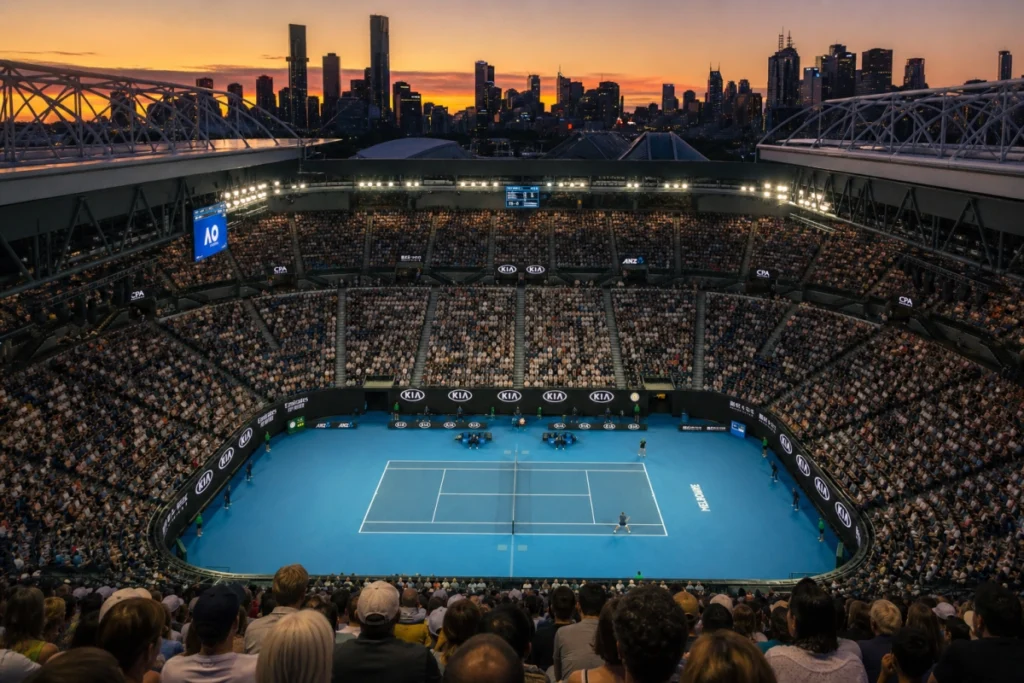
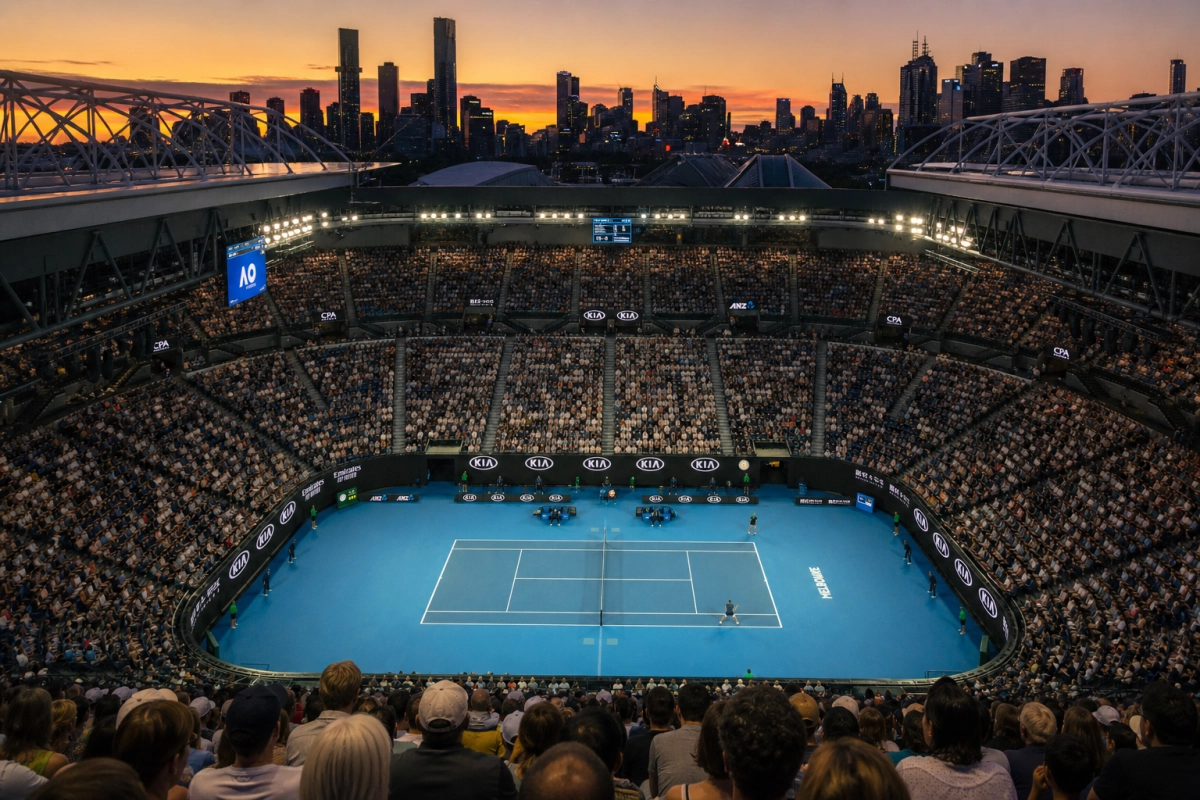
All three main showcourts — Rod Laver Arena, John Cain Arena, and Margaret Court Arena — feature retractable roofs, giving the tournament a structural scheduling advantage that Roland Garros and Wimbledon have only recently begun to match.
Tournament Format and the Logic Behind the Draw
The Australian Open follows the standard 128-player singles draw format, with men competing in best-of-five sets and women in best-of-three. Seven rounds separate the first-round handshake from the trophy ceremony. Seeding is determined by ATP and WTA world rankings at the time of the draw, with 32 seeds placed into the bracket to prevent top players from meeting before the later rounds.
One feature that distinguishes the Australian Open from its European counterparts is the use of night sessions as a genuine programming centrepiece. Prime-time slots on Rod Laver Arena attract strong television audiences across Asia and generate an atmosphere that daytime matches rarely match. Floodlit conditions, cooler evening temperatures, and crowd energy can visibly lift performance levels — a factor experienced players factor into their mental preparation across a long draw.
How the Australian Open Compares to the Other Three Majors
Roland Garros is the obvious contrast. Clay in Paris produces a slow, high-bouncing surface that rewards heavy topspin, exceptional footwork, and physically grinding rallies. Players who thrive there often find Melbourne’s faster, lower-skidding hardcourt an uncomfortable adjustment. Clay exhausts the legs more thoroughly through additional lateral movement, while hardcourt punishes the joints over time.
Wimbledon presents a different kind of contrast. Grass rewards low-bouncing ball flight, aggressive net approaches, and serving ability that can minimise an opponent’s involvement in points altogether. The Australian Open shares Wimbledon’s tendency to favour big servers and flat-ball strikers, but the extended baseline exchanges common in Melbourne are far rarer on grass.
The US Open is the closest stylistic cousin, given both are contested on hardcourt. However, DecoTurf at Flushing Meadows plays noticeably faster, and New York’s late-summer humidity creates a physically different challenge than Melbourne’s dry heat. Night matches at the US Open are famously rowdy in a way that feels distinct from Melbourne’s more partisan but generally measured crowds.
Scheduling Quirks That Shape the Fortnight
The Australian Open’s position at the start of the calendar year creates scheduling dynamics with no equivalent at the other Slams. Players arrive having had varying amounts of off-season rest, and the disparity in readiness can produce surprising early-round results, particularly in the men’s draw where physical conditioning proves decisive in long matches.
The time zone plays a subtle but real role. Matches played during Melbourne’s afternoon and evening hours broadcast live during prime viewing hours across East Asia, driving the tournament’s enormous popularity in China, Japan, and South Korea. That audience reach shapes how the event is packaged globally and ensures Australian Open results travel rapidly across platforms in time zones other Slams struggle to reach.
What the Australian Open Rewards in the End
Strip away the scheduling details and surface specifications, and the Australian Open ultimately rewards a particular kind of player: one who combines physical durability with tactical versatility and the mental composure to perform across two full weeks in genuinely demanding conditions. That combination is rarer than it sounds, which is why the list of multiple Australian Open champions is so short relative to the number of players who have arrived in Melbourne as genuine contenders.
The champions who defined the tournament’s modern era tended to share certain qualities. They handled the heat without visibly wilting. They managed their energy across the draw rather than spending themselves in early rounds. They performed on the night-session stage when the atmosphere was loudest and the margins narrowest.
For spectators, understanding those demands makes the fortnight far more interesting to follow. An early-round match played in 38-degree heat tells a different story than a semifinal contested under lights on a cool Melbourne evening. Reading those nuances correctly separates informed viewers from casual ones.
The Australian Open has spent the better part of four decades building toward its current standing. The permanent Melbourne home provided the infrastructure. The retractable roofs provided scheduling reliability. The time zone provided the audience. The surface provided the stage. What the players bring to all of that — ambition, preparation, resilience under pressure — is what turns a well-organised fortnight into one of sport’s genuinely compelling annual events.
It is the first Grand Slam of the year, but it has long since outgrown that label as its primary identity. Melbourne in January is now a destination in its own right, and the trophy lifted at Rod Laver Arena carries weight that the tournament’s early, itinerant decades could never have promised.