
The Grand Slam That Thrives on Energy and Noise
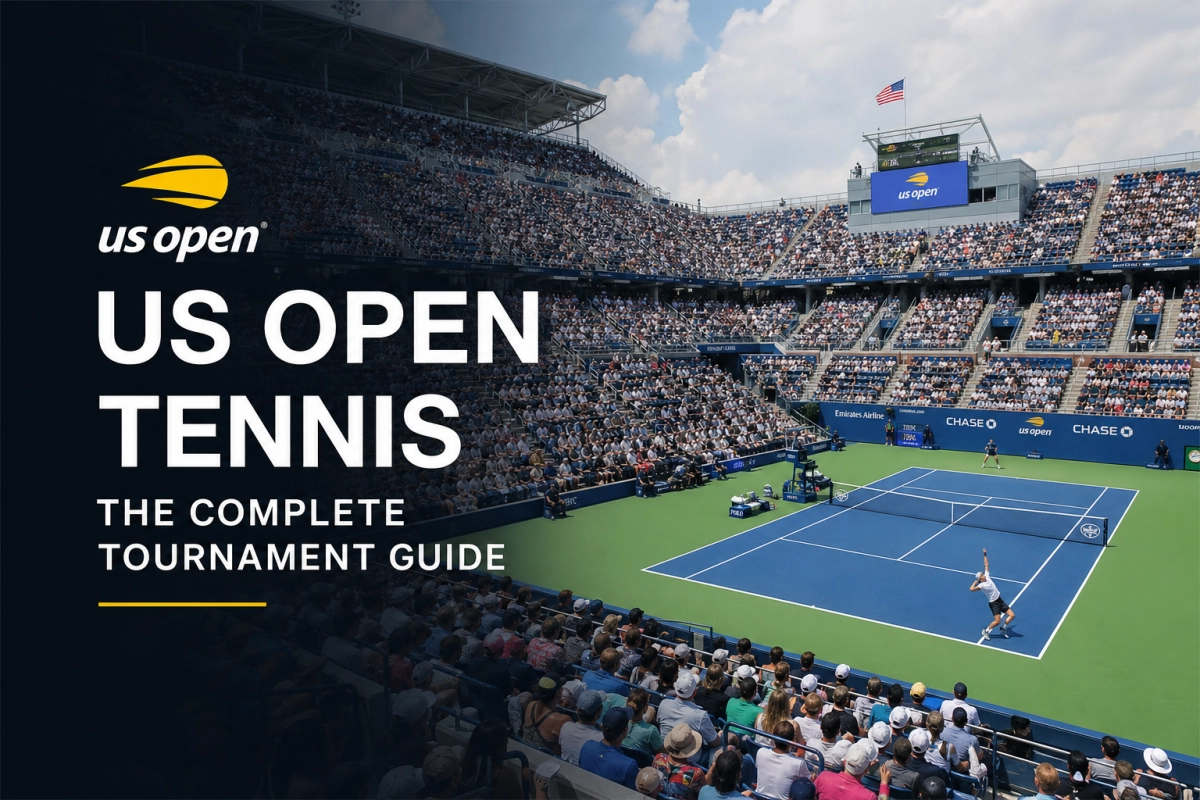
The US Open is unlike any other tennis tournament on the planet. Held annually at the USTA Billie Jean King National Tennis Center in Flushing Meadows, New York, it closes the Grand Slam calendar with a level of noise, color, and drama that feels entirely its own. Planes pass overhead. Crowds cheer between points. Night sessions run deep into the evening under floodlit skies. For many players and fans, the US Open represents tennis at its most electric — a tournament where the atmosphere itself becomes part of the match.
Understanding what makes this tournament tick requires more than knowing the draw size or prize money. It means looking at where it came from, how it is structured, what the surface demands, and why its identity differs so sharply from Wimbledon, Roland Garros, and the Australian Open.
From Newport to New York: A Brief History of the US Open
The US Open traces its origins to 1881, making it one of the oldest tennis tournaments in the world. The early editions were known as the U.S. National Championships and were held at the Newport Casino in Rhode Island — a far cry from the sprawling 46-court complex that hosts the modern event. The tournament moved several times over the following century before settling at Flushing Meadows in 1978, a move that coincided with a change in playing surface from grass to clay, and then to hard courts.
The Open Era began in 1968, when Grand Slam tournaments were opened to professional players for the first time. The US Open was among the first majors to embrace this change and quickly established itself as a progressive force in the sport. It was also the first Grand Slam to offer equal prize money to men and women, doing so in 1973 — a landmark decision that reflected the tournament’s broader cultural positioning in New York City.
The Move to Flushing Meadows and the Hard Court Era
When the tournament relocated in 1978, it marked a turning point both logistically and competitively. The switch to hard courts changed which players thrived. Powerful baseliners and big servers found the surface more to their liking than the grass specialists who had historically dominated. Arthur Ashe Stadium — named after the American champion who won the 1968 US Open — became the centerpiece of the complex when it opened in 1997. The later addition of retractable roofs to both Arthur Ashe and Louis Armstrong Stadium addressed one of the tournament’s long-standing vulnerabilities: rain delays that had repeatedly disrupted the schedule.
Hard Courts and High Bounce: Understanding the US Open Surface
The US Open is played on DecoTurf, a layered acrylic hard court surface applied over an asphalt base. It sits in the medium-to-fast range on the court speed scale, between the slower clay of Roland Garros and the faster grass of Wimbledon. The ball bounces with moderate pace and at a height that favors players with heavy topspin groundstrokes or an aggressive serve-and-return game.
Heat and humidity are significant variables at Flushing Meadows. Late August and early September in New York can bring sweltering conditions, and the hard court surface absorbs and radiates heat in a way that clay and grass do not. Tournament organizers have introduced heat rules allowing a ten-minute break between the third and fourth sets under severe conditions. The surface is also harder on the body than clay, with cumulative joint impact across two weeks — one reason players with strong fitness foundations have historically performed well in the later rounds.
Draw Structure, Scheduling, and the Rules That Shape the Tournament
The US Open fields 128 players in both the men’s and women’s singles draws. Seven rounds of single-elimination play determine the champion, with seedings assigned to the top 32 players in each draw. Wildcards, qualifiers, and lucky losers fill out the remaining spots, giving emerging players a route into the main draw without the ranking to earn direct entry.
Where the US Open distinguishes itself structurally is in its scheduling philosophy. The tournament has long leaned into its night sessions as a commercial and cultural draw, scheduling marquee matches under the lights at Arthur Ashe Stadium to capture prime-time television audiences. This creates a bifurcated rhythm: day sessions that can feel relatively quiet, followed by evening matches that are louder, looser, and far more theatrical. For players unaccustomed to performing at eleven o’clock at night before a crowd that treats tennis like a sporting event rather than a formal occasion, the adjustment can be considerable.
The US Open also applies a final-set tiebreak across all singles formats — a notable departure from Wimbledon and Roland Garros, which resisted the format for years. At Flushing Meadows, a standard tiebreak is played at six games all in the final set, reflecting the tournament’s broader orientation toward television schedules and logistical efficiency.
How the US Open Differs From the Other Grand Slams
Each major carries its own identity, but the contrasts run deeper than surface or geography. Wimbledon is defined by tradition and restraint. Roland Garros rewards patience across slow clay. The Australian Open brings a warm carnival atmosphere that remains measured. The US Open operates at a different frequency entirely.
The New York crowd is famously vocal and opinionated. Spectators cheer errors, react audibly to line calls, and bring a sports-stadium mentality that players from quieter tennis cultures can find jarring. This is not a flaw in the tournament’s design — it is arguably the feature. The US Open complex is also compact and dense, meaning ambient noise from adjacent matches bleeds into the atmosphere and players on outer courts are never far from the roar of Arthur Ashe Stadium.
Prize Money, Points, and Commercial Scale
The US Open consistently ranks among the highest-paying tournaments in tennis, with total prize money that has grown substantially over the past two decades. Players accumulate 2,000 ranking points for a singles title — the maximum available at Grand Slam level — which means the US Open carries decisive weight in the year-end rankings race, particularly for players defending a title or chasing a top position heading into the off-season.
- Singles champions receive 2,000 ATP or WTA ranking points
- Prize money is distributed across all rounds, including qualifying
- Equal pay across men’s and women’s singles has been in place since 1973
- Night session scheduling is a deliberate broadcast and commercial strategy
- Final-set tiebreaks apply across all singles formats
Why the US Open Endures as Tennis at Its Most Human
Strip away the prize money figures, the ranking points, and the broadcast deals, and what remains at the core of the US Open is something harder to quantify: a tournament that refuses to be still. The heat, the noise, the planes overhead, the late finishes past midnight — none of these are accidents. They are the texture of the event, woven into two weeks of tennis that demand adaptability from every player who walks onto its courts.
The best champions at Flushing Meadows have tended to share a particular quality. They do not merely tolerate the chaos; they absorb it and convert it into something useful. Serena Williams treated Arthur Ashe Stadium as a home court in a way that felt almost territorial. Pete Sampras, Roger Federer, and Novak Djokovic each found ways to impose their own order on a venue that routinely tries to impose its own. The list of players who arrived as favorites and were undone by the conditions — physical, atmospheric, and psychological — is equally long.
That tension between control and disorder is what makes the US Open compelling year after year. Roland Garros tests endurance. Wimbledon tests precision and tradition. The Australian Open tests consistency across a long, hot fortnight. The US Open tests something closer to nerve — the ability to compete at full intensity when everything around you is loud, unpredictable, and alive. No other Grand Slam asks quite the same question, and no other Grand Slam delivers quite the same answer when a champion finally raises the trophy on a warm September evening in New York.