
How clay reshapes rallies and what that means for your bets
Clay is the slowest of the main tennis surfaces, and that alone changes the way matches unfold. When you bet on clay-court matches, you’re not just comparing rankings — you’re assessing how playing style interacts with surface traits. Clay cushions pace, produces higher bounces, and rewards heavy topspin and patience. That tends to favor players who construct points from the baseline, extend rallies, and force opponents into errors. As a bettor, recognizing these differences helps you avoid overvaluing big servers whose weapons are neutralized by the surface.
Surface mechanics that alter value in markets
Understand these core mechanics so you can read odds with context:
- Reduced serve dominance: Powerful first serves produce fewer free points on clay, increasing returner opportunities.
- Longer points: Points last longer on average, making endurance and point construction more influential than short-point brilliance.
- Higher bounce and topspin reward: Players with heavy topspin that pushes opponents back or opens up angles gain tactical edges.
- Sliding and movement: Players comfortable sliding conserve energy and recover quicker between shots — a subtle but decisive factor over best-of-three matches.
Evaluating servers versus baseliners before placing a wager
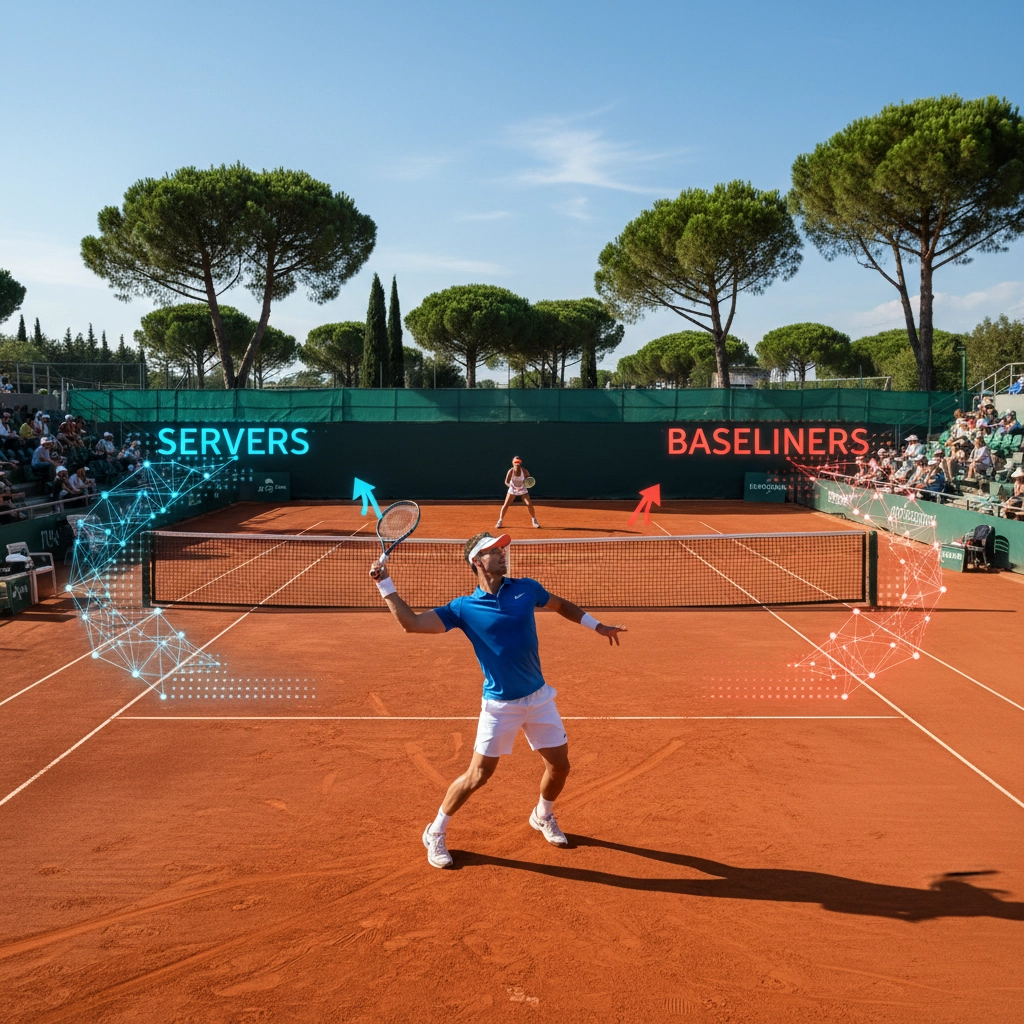
When you compare a server-style player to a baseliner on clay, look beyond headline metrics. Serve speed alone is a poor predictor on this surface. Instead, focus on clay-specific indicators and match-up context so your stake sizing and market choice reflect real value.
Server strengths that still matter on clay
- Variation and placement: Servers who mix slice, kick, and body serves disrupt rhythm even on slow courts.
- Return games held under pressure: Look for servers who convert few breakpoints and hold serve consistently despite clay.
- Net proficiency and transition: Servers who can finish points at the net force shorter rallies, which can counteract the baseline advantage.
Baseline attributes to favor on clay
- Topspin and depth: Heavy, deep groundstrokes keep opponents pinned and create short ball opportunities to finish points.
- Return consistency: Baseliner returners who win high percentages of second-serve points tilt the matchup toward breaks.
- Physical resilience: Look for players with a proven record in long matches and good recent fitness reports.
Quick checklist you should run pre-bet
- Head-to-head on clay (not overall H2H)
- Serve and return stats specifically on clay courts
- Recent match lengths and signs of fatigue
- Patterns in breakpoint conversion and save rates
- Weather and court conditions that can alter speed (wet clay plays slower)
With these concepts in mind, you’ll be ready to weigh matchups more accurately — in the next section you’ll see how to convert this assessment into concrete betting choices and market selection tactics.

Market selection: picking bets that reflect clay dynamics
Once you’ve identified which player-style matchup is in play, the next step is choosing markets that let you exploit the surface tilt. On clay, the smartest market choices are those that account for the higher likelihood of breaks, longer sets, and momentum shifts. Don’t default to match-winner lines if the market hasn’t priced in clay-specific strengths.
- Match winner with context: Back baseline grinders when odds understate their clay form — especially if they hold a superior clay return % and the server’s clay hold % is below par. Conversely, if a server mixes kick/slice effectively and finishes at net, the market may undervalue them; look for slight plus-money edges.
- Set betting and sets handicap: Clay often produces 6-4 style sets rather than dominant 6-1 blowouts. If you expect breaks, consider set handicaps (e.g., -1.5 games in the first set) or backing a player to win in three when you foresee long, attritional rallies favoring the fitter baseliner.
- Total games (over/under): Longer points and more breaks typically inflate total games. When both players are return-oriented, the over is frequently the value play. Conversely, if both have unusually weak return games even on clay, the under can appear.
- Games handicaps and live next-game markets: Use games handicaps to capture small edges (e.g., +2.5 games for the server-heavy player) and exploit live next-game markets after a long game or injury timeout — servers often show reduced hold % after extended rallies.
- Prop markets to avoid/target: Avoid raw ace props for baseline-heavy matches. Target double-fault and breakpoint conversion props: clay amplifies the importance of converting break chances and makes double faults more punishing.
Reading live indicators: when to strike during a match
Live betting is where clay knowledge pays off handsomely. The surface creates momentum swings that are visible within games — learn to recognize and act on them.
- First-serve percentage trend: A server who drops several percentage points on first serve usually sees hold probability plummet on clay. That’s a cue to back the returner in live moneyline or next-set markets.
- Rally length and error pattern: If one player consistently wins long exchanges and forces errors, that player’s implied odds should shorten. Steam into live lines when the market lags behind observable dominance (deep, heavy balls, shorter recovery from opponent).
- Movement and sliding efficiency: Watch how a player moves. Missing slides, over-committing, or reduced lateral speed often precede a sudden number of lost games. Markets will react after the scoreboard moves — there’s value in acting earlier if you’ve noted the decline.
- Weather and court moisture: After rain or heavy watering, clay plays slower and accentuates breaks. Live markets rarely adjust immediately for damp conditions, creating opportunities on the more patient, fitter baseliner.

Simple staking rules for clay match volatility
Clay matches can be swingy. Apply conservative staking discipline to protect your bankroll while capturing value.
- Size stakes smaller on pre-match bets for server-versus-baseliner matches where uncertainty is high; increase sizing modestly on baseliner plays when their clay metrics are clearly superior.
- Use smaller, frequent live stakes to exploit in-match evidence rather than committing large pre-match sums to a single prediction.
- Consider a fractional Kelly approach for clear edges (e.g., 10–25% of the Kelly stake) to balance growth with downside protection given clay’s higher variance in breaks and long rallies.
These practical market and live-betting rules help convert your matchup assessment into repeatable, disciplined actions — in Part 3 we’ll synthesize these into a simple pre-bet checklist and model bets to run during a clay season.
Putting the insight into practice
You now have the surface-specific lenses and market tactics to trade clay-court matches with more confidence. The next step is experimentation: apply the checklist from earlier to a small sample of bets, track outcomes, and iterate on market selection and stake sizing. Keep records of clay-specific stats (first-serve %, second-serve points won, breakpoint conversion on clay) so your edge becomes measurable over time. For ongoing reference and deeper surface data, consult official tour resources like ATP Tour statistics.
Stay disciplined, favor live evidence over hunches during matches, and treat clay-season strategies as an evolving process rather than a one-off formula. That approach preserves your bankroll and increases the chance of turning surface awareness into repeatable value.
Frequently Asked Questions
Should I always favor baseliners over servers on clay?
No. While baseliners often have a surface advantage, specific serve skills (effective kick, placement, and transition play) and matchup context can keep servers competitive. Evaluate clay-specific serve/return stats and recent form before making that call.
Which live indicators on clay are most actionable for in-play bets?
Key live indicators are a sustained drop in first-serve percentage, consistently longer rally winners by one player, visible movement breakdowns (poor sliding/recovery), and changes in court moisture after rain. These often precede shifts in hold/break probability and create live value.
How should I size stakes for clay matches compared to other surfaces?
Use smaller pre-match stakes when uncertainty is high and consider increasing live stakes when clear in-match evidence appears. Many bettors use fractional Kelly (10–25% of full Kelly) for identified edges on clay to balance variance from extra breaks and longer matches.