
How two contrasting champions rewrote modern tennis
You can’t understand 21st-century tennis without tracing the early arc of Rafael Nadal and Roger Federer. In the early 2000s, you witnessed a changing of the guard: Federer established an era of graceful, attacking all-court play while Nadal emerged as a relentless clay-court force. That contrast — Federer’s fluid variety vs. Nadal’s heavy topspin and intensity — is the engine that turned occasional matches into a defining rivalry.
Why their styles made every meeting feel like a mini-eras showdown
When you watch Federer and Nadal at their peaks, you see more than technique: you see two complete philosophies. Federer’s game was built around effortless serve, forehand precision and a willingness to finish points at the net. Nadal answered with extreme left-handed topspin, physical defense, and an unmatched ability to grind on clay. Because each player’s strengths exposed the other’s vulnerabilities, every match carried strategic significance — not just for a title, but for the broader narrative of who could best adapt.
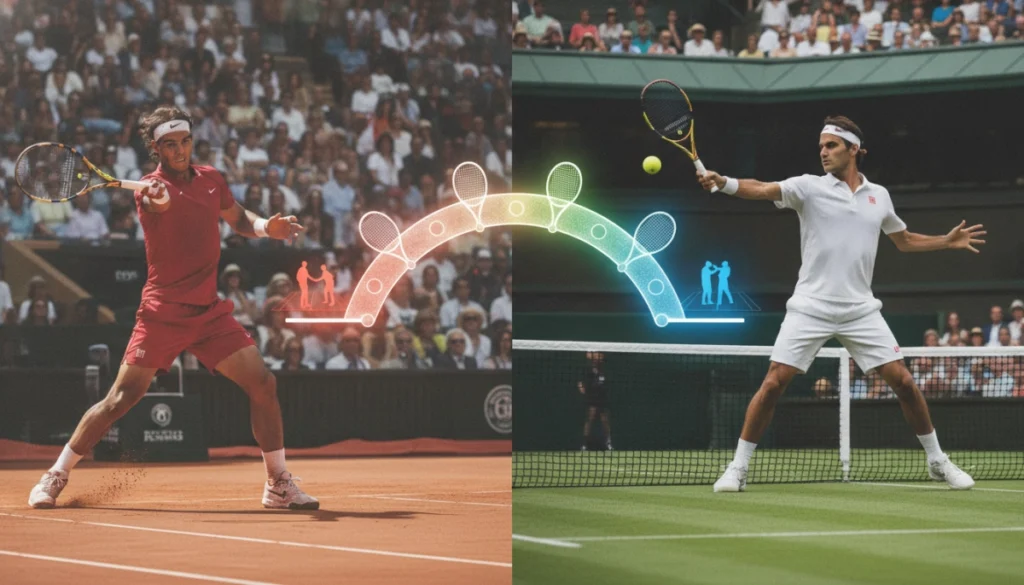
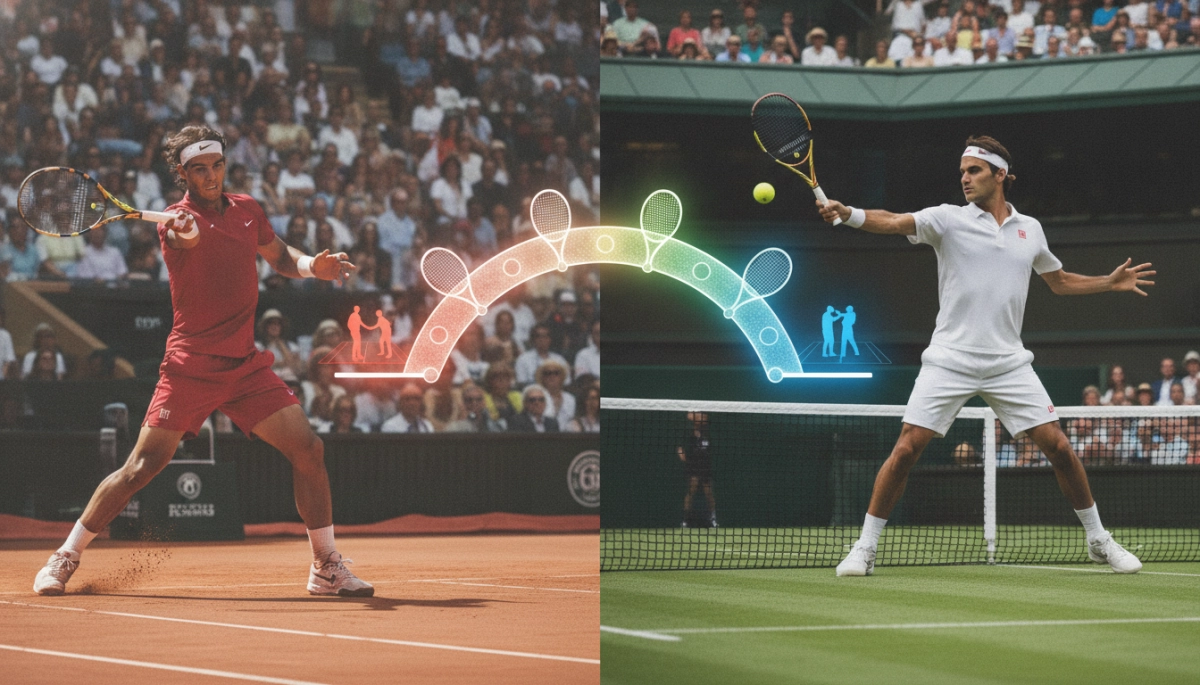
- Surface dynamics: You quickly learn that surface matters. Nadal’s dominance on clay limited Federer’s margin for error, while Federer’s mastery of grass and fast hard courts rewarded his precision and variety.
- Mental stakes: Early victories set psychological patterns. When Nadal beat Federer on clay, it reinforced the idea that Federer had a nemesis at Roland Garros; when Federer beat Nadal on grass, he reaffirmed his control at Wimbledon.
- Fan and media interest: Because both were generational talents, every high-profile match created global attention — amplifying what might otherwise have been a routine tour result into a historic moment.
Early marquee meetings that signaled a long rivalry
You can point to a handful of early matchups that signaled this was more than a short-term rivalry. Their first Grand Slam final meeting came at Roland Garros in the mid-2000s, and soon after they began to clash regularly in big finals and ATP Masters events. Those early encounters established two clear patterns: Nadal would dominate on clay and frequently claim the French Open, and Federer would continue to collect titles on grass and many hard-court events.
- Roland Garros battles: Nadal’s repeated French Open successes in the mid-2000s made him the benchmark on clay and gave you a clear sense of momentum in that domain.
- Wimbledon duels: Federer’s grass-court superiority produced high-stakes finals where you could see him use pace and touch to disrupt Nadal’s rhythm.
- Masters and early tour clashes: Outside the Slams, their meetings in Masters tournaments quickly became tactical masterclasses that offered early clues about how each would try to counter the other.
Having set the stage — the contrasts in style, the early territorial dominance on different surfaces, and the first major finals that framed their rivalry — you’re ready to move into the defining head-to-head matches that turned personal competition into sporting legend. In the next section, you’ll examine the breakthrough finals and the matches that became touchstones for players and fans alike.
Breakthrough finals that swung momentum
Once the rivalry moved from promising to perennial, a handful of finals became the hinge points you remember when describing both careers. Nadal’s ascendancy on clay reached a tipping point in the mid-2000s — his repeated Roland Garros victories didn’t just add trophies, they altered the tennis map. Each French Open final against Federer reinforced the idea that Nadal owned clay, forcing Federer to rethink how to construct points on slower surfaces and accept that an opponent had his number at Paris.
On the flip side, Federer’s dominance at Wimbledon in the same period represented a different kind of statement. Matches on grass let him showcase the variety and instant-fire finishing that had made him the sport’s standard-bearer. Wins over Nadal at Wimbledon were reminders that, despite Nadal’s physicality and topspin, Federer’s touch and court sense remained supreme on fast grass.
Then there are the finals that transcended sport and entered popular culture. The 2008 Wimbledon final is the clearest example: a match that stretched tradition and imagination, ending in a dramatic fifth-set triumph for Nadal and leaving a sense that the rivalry had produced one of the greatest sporting contests ever. A year later, at the Australian Open, Federer answered with a five-set victory that rebalanced the narrative — showing that he could still match Nadal’s intensity and adapt his game to the modern era. And nearly a decade later, Federer’s 2017 Australian Open win over Nadal served as a late-career punctuation mark: a signal that adaptations and persistence could revive old rivalries even after time and injuries had changed both men.
Turning points: matches that reshaped tactics and confidence
Beyond trophies, certain meetings acted as laboratories where tactics evolved. Early on, Nadal’s heavy lefty topspin and relentless retrieval forced Federer to temper his inclination to dominate with the forehand and to develop more patience on clay. Conversely, Federer’s willingness to shorten points and attack the net on grass and fast hard courts pushed Nadal to improve his serve and flatten out more shots to finish points.
- Psychological shifts: A single brutal defeat on a favored surface could linger; conversely, pulling off a gutty comeback — particularly in Grand Slam finals — could swing confidence for months.
- Technical adjustments: You can trace tweaks in Federer’s backhand and Nadal’s serve directly to meetings between them. They forced each other to widen their shot repertoires and to become more aggressive at different times.
- Legacy-defining moments: Matches that ended in five sets, or that punctuated a streak (like Nadal’s French Open run or Federer’s grass-court reign), became shorthand for who each player was and how the other had to respond.
These turning points did more than decide trophies: they nudged both players into new eras of their careers, prompting tactical reinvention, fueling rivalrous psychology, and giving fans a series of moments that continue to define tennis storytelling. In Part 3, you’ll see how those moments accumulated into a rivalry measured not only by head-to-head numbers but by influence on the sport itself.
Legacy in motion: what the Nadal–Federer era leaves behind
Their rivalry didn’t end with a single match; it left an ongoing ripple through coaching, equipment choices, and how players prepare mentally for the biggest moments. Beyond trophies and records, the most lasting element is a template for greatness built on contrast — two different approaches that pushed each other to evolve and, in doing so, raised standards across the tour. That influence shows up in the way young players train for surface-specific demands and in how epic matches are framed by commentators and fans alike.
Enduring markers of influence
- Technique and tactics: Coaches still point to specific exchanges between Nadal and Federer when teaching spin, footwork and netcraft.
- Cultural impact: Their matches broadened tennis’ global audience, creating moments that are referenced beyond sport.
- Sportsmanship and respect: Their mutual admiration set a tone for rivalry that prioritized performance and character over animosity.
The rivalry also remains a resource for anyone wanting a detailed match history or statistical breakdown — the official ATP head-to-head pages offer comprehensive data on their meetings and outcomes. See the official ATP head-to-head for match-by-match records and context.
In the end, what endures is not just who won or lost on any given day, but the standard they set together: a living chapter of tennis history that continues to inform how the sport is played, watched and celebrated. Their rivalry is less a closed book than a reference that future generations will read, study, and try to surpass.