

The Grand Slam That Opens the Tennis Year
Every January, Melbourne transforms into the center of the tennis world. The Australian Open is the first of the four Grand Slam tournaments on the annual calendar, and that timing gives it a character unlike any other major. Players arrive fresh from the off-season, rankings are reshuffling, and the air carries a genuine sense of possibility. For fans, it signals that competitive tennis is back in full force.
What makes the Australian Open compelling is not just its place on the schedule but its identity. Held in the Southern Hemisphere’s summer, it combines intense heat, a fast hard court surface, a world-class stadium complex, and a devoted crowd into an experience that feels entirely its own. The tournament has evolved dramatically over the past century, growing from a modest domestic event into one of the most-watched sporting spectacles on the planet.
From a Domestic Championship to a Global Major
The tournament’s origins date back to 1905, when it was established as the Australasian Championships. In those early decades, it was a regional competition held across different cities in Australia and occasionally New Zealand. Transcontinental travel was costly and time-consuming, which meant the world’s best players rarely made the journey south.
That limited participation shaped the tournament’s early reputation. It was not consistently elevated to Grand Slam status in the modern sense until the Open Era began in 1968, when professional players were finally permitted to compete alongside amateurs. The transition to a true global major accelerated in the 1980s. A pivotal shift came in 1988, when the tournament moved permanently to Melbourne Park and switched from grass to hardcourt. The new venue provided the infrastructure necessary to host a major international event, and the surface change attracted a larger, more consistent field of top professionals.
Why the Move to Melbourne Park Mattered
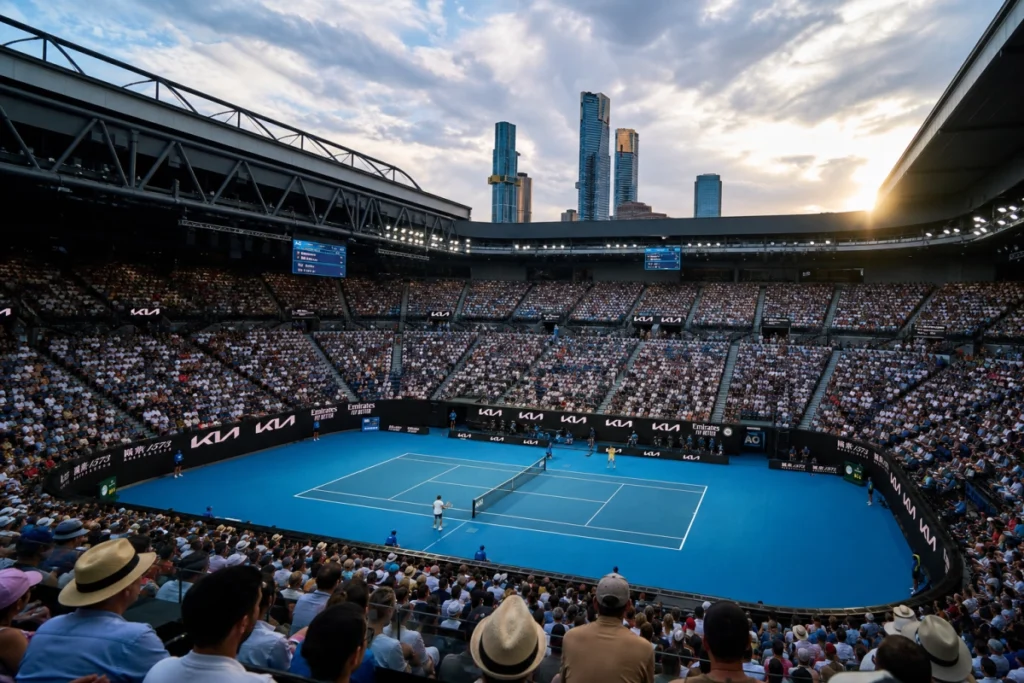
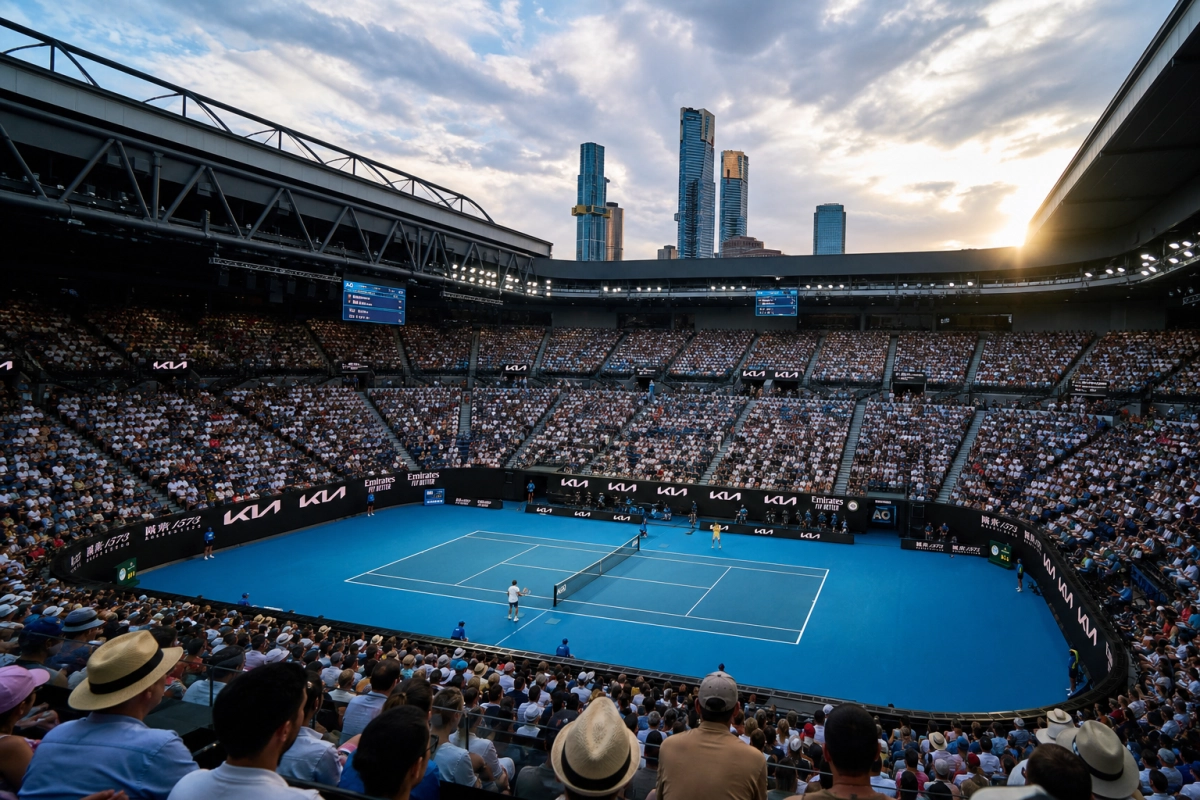
Melbourne Park was purpose-built for tennis, giving the Australian Open something the other Grand Slams had to work around: a modern, unified complex designed from the ground up for the sport. The retractable roofs installed over the main showcourts — Rod Laver Arena, Margaret Court Arena, and John Cain Arena — addressed the tournament’s most persistent problem: extreme summer heat and unpredictable weather. When Melbourne temperatures spike above 40 degrees Celsius, those roofs allow play to continue uninterrupted, protecting both players and spectators.
The surface itself also deserves attention. Melbourne Park uses a hard acrylic surface called Plexicushion, which produces a medium-to-fast pace of play. Balls bounce consistently at a comfortable height, rewarding aggressive baseliners and all-court players. This contrasts meaningfully with the slower clay at Roland Garros and the fast grass at Wimbledon, giving each Grand Slam a distinct tactical character that shapes match outcomes and player strategies.
How the Tournament Format Works
The main draw fields consist of 128 players in both the men’s and women’s singles competitions, with matches played across a fortnight that progressively narrows the field to the final. Men’s singles matches are played as best-of-five sets throughout every round, while women’s singles matches are best-of-three. That distinction significantly shapes the physical demands players face. By the second week, accumulated fatigue from long five-set battles can be as decisive as technique or tactics.
The tournament also hosts a full slate of additional events alongside the singles draws, including:
- Men’s and women’s doubles
- Mixed doubles
- Junior singles and doubles in both categories
- Wheelchair singles and doubles across multiple divisions
- Legend events featuring former professionals in an exhibition format
The seeding system plays a meaningful role in shaping the draw. The top sixteen seeds in each singles draw receive protected placement, meaning they cannot face one another until the third round at the earliest. How the draw falls can have an enormous bearing on outcomes — a reality that generates its own layer of pre-tournament analysis every January.
The Surface and Its Strategic Implications
Melbourne’s Plexicushion hardcourt rewards specific styles of play in ways not always obvious to casual viewers. Sitting between the slow clay of Roland Garros and the rapid grass of Wimbledon, the surface favours players who can sustain high-intensity baseline exchanges while still possessing the firepower to dictate points. Pure grinders find the conditions slightly less forgiving than Paris, because the surface does not slow the ball enough to nullify powerful groundstrokes. Serve-and-volley specialists, meanwhile, find less reward than they would at Wimbledon.
The heat adds a variable no other Grand Slam consistently confronts. When Melbourne temperatures rise sharply, the court becomes noticeably faster, and physical attrition accelerates. Tournament officials operate an Extreme Heat Policy that can suspend play on outer courts when conditions become dangerous, but even within manageable ranges, the Melbourne summer tests endurance in ways that Paris, London, or New York seldom replicate. Players who prioritise fitness and heat acclimatisation during the pre-season often carry a meaningful edge into the second week.
Records and Rivalries That Define the Tournament’s Legacy
No examination of the Australian Open is complete without acknowledging the weight of history certain players have accumulated at Melbourne Park. Novak Djokovic holds the men’s singles record for titles at the Australian Open, reflecting both his technical suitability for hard courts and his extraordinary ability to sustain elite performance through Melbourne’s specific physical grind. On the women’s side, Serena Williams long stood as the benchmark, while Margaret Smith Court — whose name graces one of the main stadiums — remains deeply embedded in the tournament’s identity.
What gives these records particular weight is context. The Australian Open’s combination of surface, heat, and early-season scheduling means sustained success requires a remarkably consistent set of physical and mental qualities. That consistency, when it appears, produces the kind of enduring rivalries that become the defining narrative threads of a tennis era.
What Sets the Australian Open Apart in the Grand Slam Calendar
The Australian Open arrives when the tennis calendar is at its most open — rivalries from the previous year unresolved, new contenders unproven, and the season’s narrative yet to be written. That position gives every result at Melbourne Park an outsized significance. A title won in January does not just count in the rankings; it sets the psychological tone for everything that follows.
Melbourne is a city that embraces major sporting events with easy confidence, and the Australian Open benefits from that civic enthusiasm. The grounds at Melbourne Park have developed into something closer to a festival than a conventional tennis venue — a place where fans move between courts, linger in public spaces, and treat the fortnight as an event in its own right. That combination of serious competitive stakes and genuine accessibility is not easy to engineer, and the Australian Open has managed it more deliberately than most.
What remains constant, beneath all the structural and commercial evolution, is the sport itself. The Australian Open produces matches of the highest order precisely because its conditions demand so much. Hard courts under summer heat, best-of-five sets across a fortnight, and a draw full of players motivated by the knowledge that the year begins here and nowhere else — those ingredients combine to produce performances that reveal character as much as technique. That, more than any single record or famous final, is what makes the Australian Open an enduring fixture in the fabric of professional tennis.