

Why Tactics Separate Good Players from Great Ones
Watching professional tennis, it’s easy to focus on the obvious — the velocity of a Jannik Sinner forehand, the precision of Carlos Alcaraz’s drop shot, or the mechanical perfection of Novak Djokovic’s return. What’s harder to see, but far more decisive, is the tactical framework operating beneath every rally. The best tennis strategies aren’t improvised. They’re constructed deliberately, shaped by scouting, surface awareness, and a clear-eyed understanding of an opponent’s vulnerabilities.
Tactics in tennis function like a chess game played at high speed. Each point is a sequence of decisions — where to serve, how to open the court, when to attack, when to reset. Players who master this process don’t just win more points; they win the right points at the right moments. Understanding these layers doesn’t require a coaching background. It requires knowing what to look for — and once you do, the sport reveals an entirely different dimension of intelligence.
The Serve as a Tactical Weapon
Many casual fans view the serve as a means of starting a rally. At the professional level, it’s the most powerful tactical instrument in the game. Elite servers use placement, spin variation, and pace to construct the entire point before it begins.
There are three primary serve targets: the T, the body, and the wide angle. Each creates different geometry for the following shot. A wide serve in the deuce court pulls the returner off the court, opening the opposite side for a winner. A body serve jams the returner, limiting their swing and forcing a weak reply. The best servers cycle through these targets unpredictably — variety isn’t just aesthetically interesting, it’s tactically essential.
Spin plays a critical role too. A heavy kick serve to the backhand forces a high, awkward bounce — particularly effective on clay against opponents with flat backhands. Slice serves that stay low are dangerous on grass, where the surface amplifies the skidding effect.
Reading the Returner to Exploit Weaknesses
Effective servers study their opponents’ return tendencies throughout a match. Does the returner stand far behind the baseline? A kick serve to the backhand becomes even more effective. Does the opponent crowd the baseline aggressively? Serving wide creates sharper angles they struggle to cover. This real-time adjustment — reading what the returner is doing and responding — separates merely powerful servers from truly intelligent ones.
Groundstroke Patterns and the Architecture of a Rally
Once the serve has done its work, the rally becomes a structured problem-solving exercise. Professional players don’t simply hit to open space — they manufacture it through deliberate shot sequencing. The difference between a player who hits good groundstrokes and one who uses them tactically is the difference between reacting to a rally and directing it.
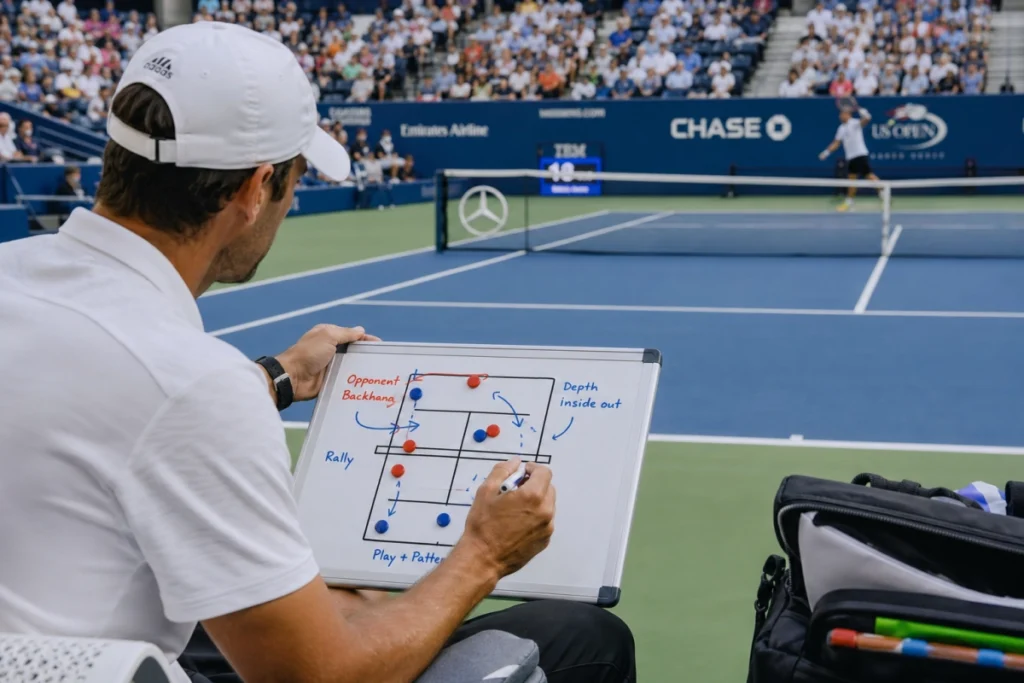
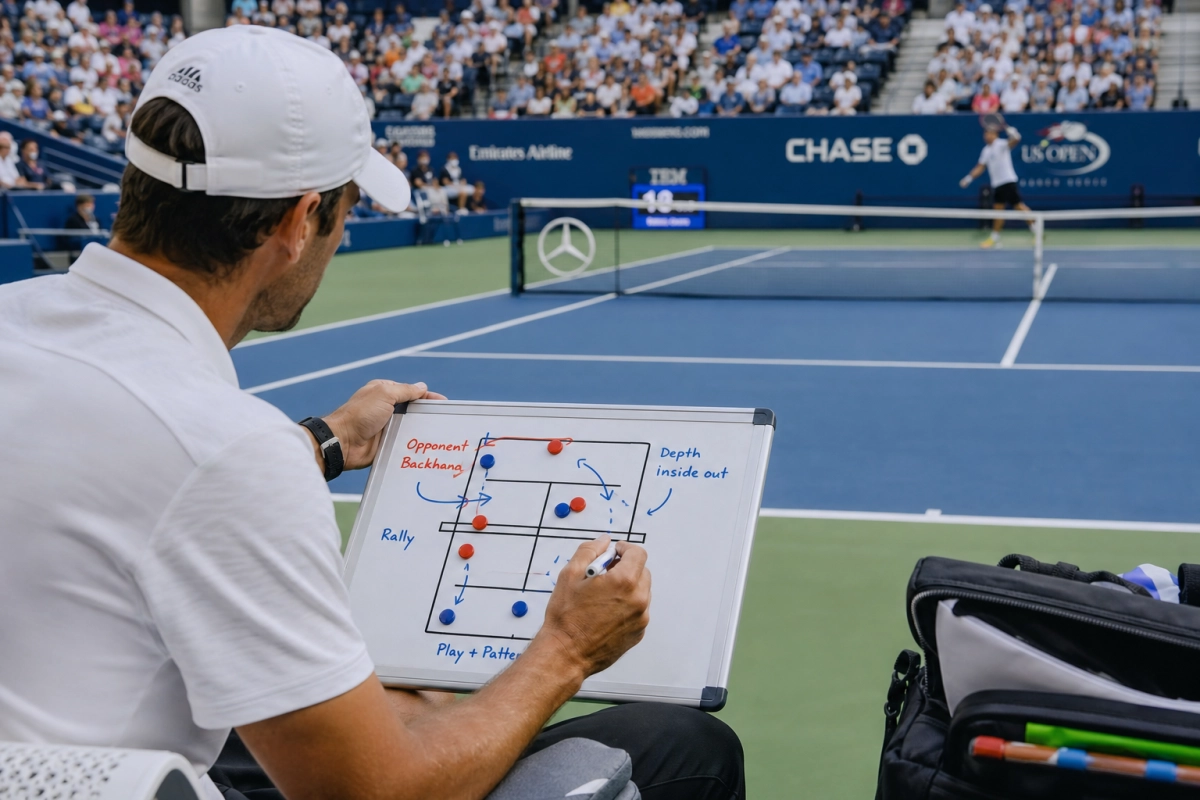
The most foundational pattern in modern tennis is the cross-court to inside-out forehand sequence. A player drives deep and crosscourt to the opponent’s backhand, forcing a defensive reply, then moves around the ball to unleash an inside-out forehand to the open court. Rafael Nadal built perhaps the most dominant single-wing attack in tennis history around exactly this combination, particularly on clay where he had time to position and generate extreme topspin.
Depth and direction work together in ways that aren’t immediately obvious. A ball hit with pace but without depth can be absorbed and redirected easily. A ball hit deep to the backhand corner pins an opponent, limiting their recovery angle and reducing the quality of their next shot. This is why elite players talk about “earning” short balls — the short ball is the reward for sustained, purposeful pressure.
The Role of Shot Shape in Controlling Rally Tempo
Beyond direction and depth, the shape of a groundstroke functions as a tactical variable in its own right. Heavy topspin produces a high bounce that pushes opponents back and disrupts their preferred contact point. Flat drives stay lower and compress preparation time. Slice groundstrokes skid through the court, forcing opponents who prefer to strike above the hip to adjust uncomfortably.
Players use these shapes to manipulate rally tempo — slowing a point to reset after being pressured, or accelerating to prevent an opponent from settling. Djokovic’s backhand slice, for instance, is rarely defensive. It’s a precision instrument used to neutralize power, redirect the rally’s geometry, and recover court position before shifting back into attack mode.
Court Positioning and the Battle for Territory
Where a player stands is as revealing as how they hit. Positioning communicates tactical philosophy, defines available time, and determines who is dictating and who is defending.
Standing two meters behind the baseline signals a willingness to absorb pace — viable against heavy hitters, but it cedes court real estate and invites drop shots. Creeping inside the baseline compresses the court dramatically, shortens recovery time for the opponent, and makes an inherently aggressive positional statement.
The net remains the most tactically efficient position on the court — a player controlling the net wins points faster and with less physical expenditure. At the professional level, the decision to approach requires careful risk calibration. Players look for specific trigger conditions:
- A short ball that allows an approach with pace and good positioning
- A forced reply that limits the opponent’s passing angle
- A moment when the opponent is off-balance or out of position
- Surface conditions — particularly grass — where passing shots are harder to execute under pressure
Transitional Positioning Between Defense and Attack
Elite players don’t simply toggle between defensive and offensive positioning — they transition through a middle zone where the most important decisions are made. When pushed wide or deep, a player’s first priority is neutralizing: hitting a high, heavy ball crosscourt to buy recovery time. The mistake less experienced players make is attempting to attack from a defensive position. The transition from defense to offense is a sequence — absorbing pressure, repositioning inside the baseline, then striking when the geometry finally favors it.
Adapting Game Plans Mid-Match
Every professional enters a match with a game plan. The best enter with three. The ability to recognize when an initial strategy isn’t working — and diagnose why, quickly and calmly — is one of the least visible but most consequential skills in the sport.
Adaptation happens at multiple timescales. Within a game, a player might notice their opponent is reading the wide serve and switch to a body serve. Within a set, they might introduce more slice and short angles to disrupt a rhythm that’s favoring the opponent. Across a match, adjustments become more structural — shifting from a baseline-heavy approach to a more aggressive net game when baseline exchanges are being lost.
Surface awareness shapes these adjustments profoundly. On clay, the premium is on consistency, spin, and patience. On grass, the calculus shifts almost entirely — the low bounce rewards flat aggressive striking, serve dominance is magnified, and the net becomes viable far more often. Hard courts occupy the middle ground, rewarding players who blend power with consistency.
Reading an opponent’s physical and emotional state matters equally. A player who begins bouncing the ball twelve times before a second serve instead of their usual six is likely tight under pressure. These behavioral signals, registered and acted upon, are where elite tactical awareness shades into psychological mastery.
The Role of Momentum and Tactical Patience
Momentum in tennis is real, but frequently misunderstood. It isn’t a mystical force — it’s the cumulative product of tactical decisions that either reinforce confidence or erode it. The tactical implication is significant: when a strategy is working, the disciplined choice is to resist the temptation to deviate, even when individual errors occur. Patience here is not passivity. It is the deliberate maintenance of a tactical identity under pressure — the refusal to abandon a well-constructed game plan at the first sign of adversity.
The Intelligence Behind Every Point
Professional tennis rewards physical gifts generously — speed, power, and endurance all matter enormously. But the players who define eras and accumulate titles across multiple surfaces are almost always the ones whose tactical intelligence operates above the competition. They don’t just hit better shots. They construct better points.
The serve patterns, the groundstroke sequences, the positioning choices, the mid-match adjustments — none of these exist in isolation. They form a coherent tactical language, spoken at high speed under extreme pressure. Learning to read that language transforms the experience of watching tennis from an appreciation of athleticism into something richer: the recognition of a strategic contest being waged with extraordinary precision inside every single point.
That recognition is what separates a spectator from a genuine student of the game. And once developed, it’s impossible to watch professional tennis any other way.